


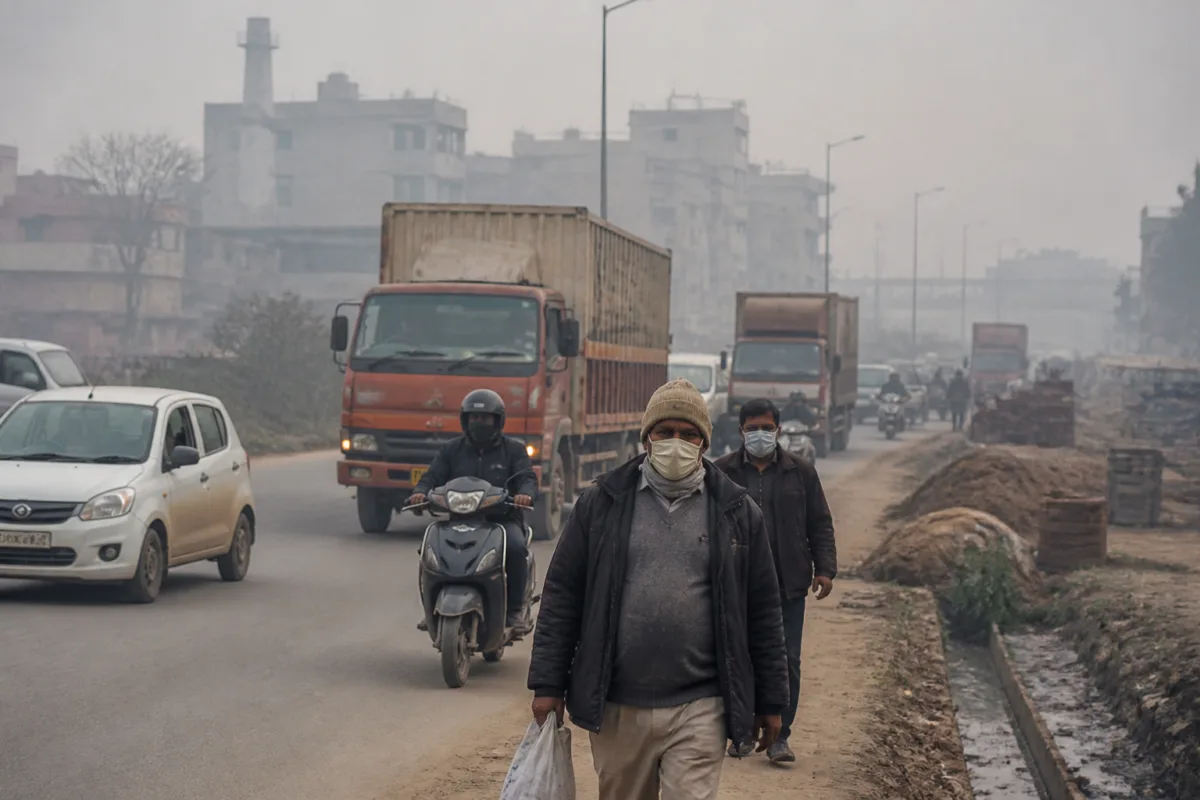
Delhi’s air quality improved to the poor category two days after Diwali, but the sharp contrast with neighbouring Loni shows why the National Capital Region’s pollution crisis cannot be understood through the capital’s average AQI alone. Delhi’s 24-hour average fell from 344 on Monday to 299 on Tuesday, while real-time air quality in Loni touched 470, in the severe category, earlier the same day.
The improvement in Delhi was linked to stronger northwesterly winds, which helped disperse pollutants. Yet the wider pattern remained highly uneven. Of Delhi’s 58 monitoring stations that recorded data, 28 reported very poor air quality, 28 were in the poor category and only two recorded moderate levels. No station reported severe air quality. Delhi Cantonment recorded an AQI of 135 and Sri Aurobindo Marg 155, making them the only locations in the moderate category.
This distribution matters because a citywide average can conceal intense exposure in particular neighbourhoods. Delhi’s average AQI of 299 was just below the threshold for the very poor category, but nearly half of the reporting stations still recorded very poor conditions. PM10 was the predominant pollutant in the capital, indicating that the problem was not limited to a single short-lived post-Diwali spike or one isolated source.
Loni presents an even clearer example of how local conditions can diverge from regional averages. The New Tehsil-Loni station recorded a real-time AQI of 470 on Tuesday, while its 24-hour average was 245 at 5.05pm. Loni Market had recorded 450 on the night of November 9, and New Tehsil-Loni had reached 463 at 9pm that day. The town’s AQI remained in the very poor category from November 1 to 9, with daily readings ranging from 277 to 373.
The different readings also demonstrate why pollution data needs to be read carefully. The Loni values cited by the Uttar Pradesh Pollution Control Board, Delhi’s monitoring network and IQAir used different systems and averaging periods and are not directly comparable. IQAir reported a US AQI+ of 162 in Loni on Tuesday evening, alongside a PM2.5 concentration 14.1 times the World Health Organization’s annual guideline value. The variation does not erase the pollution burden; it shows that public communication depends on explaining what each number measures.
The sources identified by residents and officials in Loni point to a structural problem rather than a festival-only episode. More than 1,000 small and medium industrial units, vehicle emissions, construction dust, poorly maintained roads, open garbage burning and brick kilns were cited as contributors. An official also pointed to sulphur dioxide and nitrogen oxides released by chemical-processing units. These sources operate through different administrative channels, which makes enforcement more difficult than issuing a single seasonal restriction.
Loni is one of several pollution hotspots identified by the Ghaziabad administration. The list also includes Sahibabad, Raj Nagar Extension, Bhopura, Indirapuram, Vasundhara-Vaishali, Vijay Nagar, Lal Kuan and Siddharth Vihar. The geography is significant: pollution control in the NCR depends on coordination across Delhi, Uttar Pradesh, local bodies, transport agencies, pollution-control authorities and the police. A reduction in Delhi’s average does not necessarily mean that neighbouring settlements are experiencing the same improvement.
The response framework already recognises the need for coordinated action. Stage III restrictions under the Graded Response Action Plan are in force across Delhi-NCR. In Loni, these include a halt to non-essential construction and demolition activity and restrictions on vehicles below BS-VI emission standards. The Uttar Pradesh Pollution Control Board said more than 2,800 public construction sites across Ghaziabad district had been directed to suspend work, with penalties planned for violations.
That figure also reveals the enforcement challenge. Construction restrictions are meaningful only when sites are identified, inspected and monitored consistently. The Ghaziabad district administration has directed the development authority, municipal corporation, UPPCB, transport department and police to prepare coordinated pollution-control plans. This arrangement places implementation across institutions that control different parts of the urban system, from road dust and construction permits to industrial emissions and vehicle compliance.
Municipal measures have focused on mechanised road sweeping and water sprinkling. A proposed drone-based sprinkling initiative, however, faced a setback after an inadequate number of companies responded to the tender. Residents have called for regular, rather than emergency, road cleaning and water sprinkling, along with action against illegal industrial emissions and open garbage burning. Their demands suggest that the visible response during severe episodes is being judged against everyday conditions on local roads and around industrial areas.
Delhi’s own source profile adds another layer to the problem. The transport sector was estimated to account for 18% of pollution in the capital on Tuesday, according to the Decision Support System. Stubble burning contributed an estimated 2% that day, although its share was forecast to rise to 7.9% on Wednesday. Satellite data detected 559 farm-fire incidents across six states on Monday, including 239 in Madhya Pradesh, 198 in Punjab, 50 in Rajasthan, 47 in Uttar Pradesh, 17 in Haryana and eight in Uttarakhand.
Between September 15 and November 9, 8,665 farm-fire incidents were detected across those six states, according to data from the Consortium for Research on Agroecosystem Monitoring and Modelling from Space laboratory of the Indian Agricultural Research Institute. These figures show that regional and seasonal factors remain part of the NCR pollution story, but they do not displace the local sources recorded in Loni. Transport, dust, waste burning, industrial activity and agricultural fires operate simultaneously and at different scales.
Weather can temporarily improve the readings without resolving those sources. Mahesh Palawat, vice-president at Skymet and a weather expert, said northwesterly winds were affecting the Delhi region at an average speed of 12-14 kmph and were expected to remain strong over the next couple of days. The Air Quality Early Warning System for Delhi also forecast a decline in PM2.5 and PM10 concentrations over the following two days. The forecast describes dispersion conditions, not the removal of the activities generating pollution.
This distinction is central to interpreting a short-term improvement. When winds strengthen, the AQI may fall because pollutants disperse. When the weather changes, the same emissions can again accumulate. The evidence supplied in the report therefore supports a limited conclusion: Delhi’s conditions were expected to improve over the next few days, while Loni and other hotspots continued to require local controls. It does not establish that the underlying sources had been reduced.
The health experience reported by residents reinforces the gap between an average reading and street-level exposure. People in Loni described breathing difficulties, eye irritation and coughing, with children, senior citizens, outdoor workers and people with asthma particularly affected. Some residents said they had stopped exercising outdoors in the morning and evening and were using N95 masks when outside. These accounts connect monitoring data to the daily functioning of neighbourhoods, including work, mobility and outdoor activity.
The larger urban question is whether NCR pollution management can move from episodic emergency restrictions to continuous, source-specific administration. The current response includes GRAP restrictions, construction suspensions, vehicle controls, road sweeping, water sprinkling and inter-agency planning. But the same evidence shows that industrial units, roads, construction sites, waste-burning locations and regional farm fires fall under different responsibilities. A citywide AQI improvement can therefore coexist with severe exposure in a nearby settlement.
The available data confirms that Delhi’s air improved after the post-Diwali spike, helped by stronger winds, but it also confirms that the NCR’s pollution burden remained geographically uneven. Loni’s severe real-time reading, the concentration of pollution hotspots across Ghaziabad and the range of local and regional sources make the next phase of monitoring important. Authorities’ coordinated plans, compliance at construction sites, action against industrial and waste emissions, and the evolution of wind and farm-fire contributions will determine whether the improvement becomes more widespread or remains temporary.

