


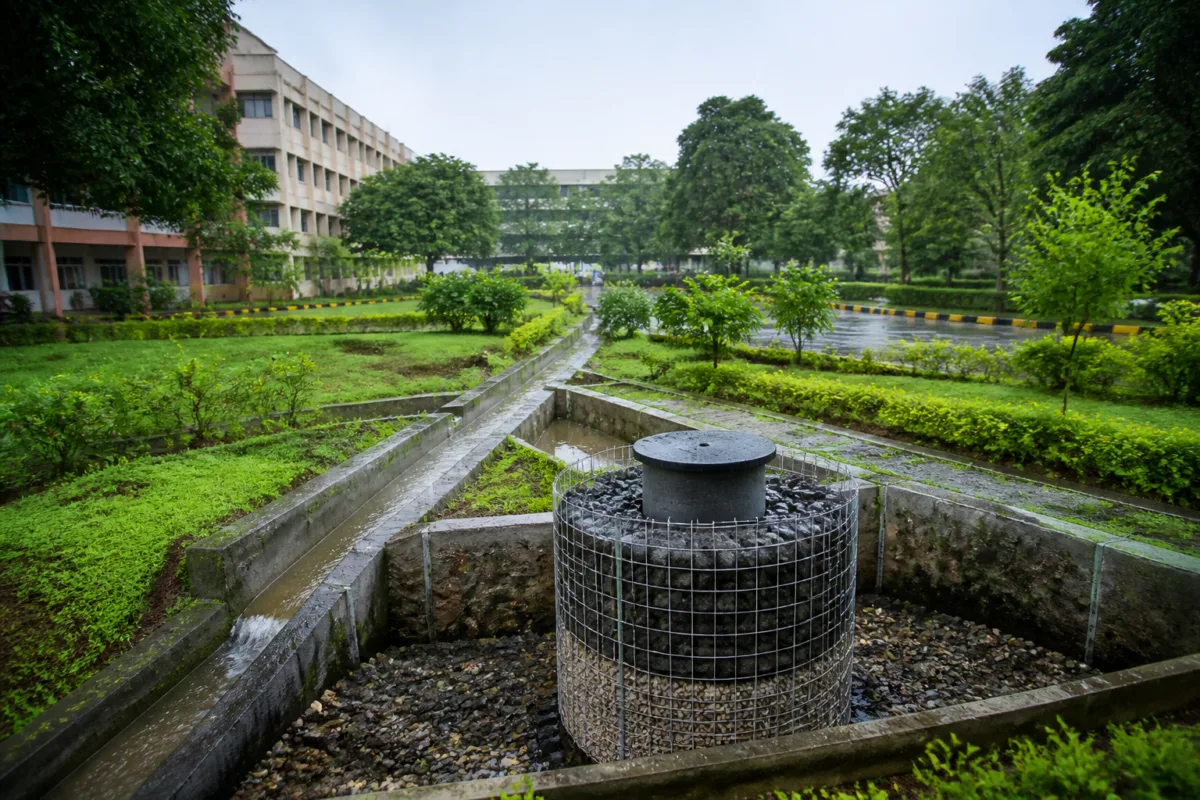
JNTU-Hyderabad’s rainwater harvesting system is doing more than collecting runoff. By linking surface collection structures to recharge borewells, the 100-acre campus has reportedly become self-sufficient in water, avoided tanker purchases for 15 years and helped improve groundwater conditions in nearby colonies. The example is significant because it addresses a problem that conventional rainwater pits often struggle with in Hyderabad: water must move through hard Deccan Plateau rock before it can replenish underground reserves.
Telangana Today reported that the university harvests around 10 crore litres of rainwater annually through 11 harvesting structures and 24 recharge borewells. The system was conceived and implemented by Prof MVSS Giridhar of JNTU-Hyderabad’s Centre for Water Resources. According to his account, groundwater levels on the campus are generally kept within 10 metres of the surface, although the depth can reach nearly 50 metres during summer.
These figures describe a system designed around local geology rather than a generic harvesting template. The source report says conventional recharge pits do not produce better results across Telangana because the Deccan Plateau’s rocky terrain limits water penetration. In response, the JNTU system uses borewells to carry filtered rainwater beyond the surface layers and towards underground aquifers. That distinction is central to understanding why the project has continued to function where simpler pits may be less effective.
The intervention also changes the role of a campus in the urban water system. Instead of allowing rainwater to leave the site as runoff, the university retains and redirects it. The collected water would otherwise flow into drains or contribute to flooding near Rythu Bazaar, according to the report. The campus therefore acts simultaneously as a water consumer, a recharge zone and a buffer against concentrated stormwater flows.
The system’s design begins with recharge pits containing four layers. The bottom layer uses 40-60 mm gravel, followed by 20-40 mm gravel and coarse sand. Each layer occupies one-fourth of the pit’s depth. A geotextile sheet with 125-micron perforations is placed over the sand to filter dust and floating particles before water enters the borewell. Perforations in the casing pipes then allow the filtered water to move into deeper layers.
This arrangement reflects an institutional understanding of two linked risks: groundwater depletion and contamination. Merely directing water underground can damage a recharge system if sediment and surface pollutants are not controlled. The JNTU model therefore combines collection, filtration and subsurface conveyance. The source material does not provide detailed water-quality results or long-term measurements for each borewell, but it does describe a physical design intended to reduce the entry of suspended material.
The reported operational outcome is substantial. Before the recharge structures were built, several borewells on the campus had either dried up or suffered reduced yields. During summer, the university purchased water through tankers at a rate of 30 per day to meet its needs. Prof Giridhar said the university has not purchased a single water tanker in the last 15 years. The report links that change to improved water levels and greater sustainability of existing borewells for pumping.
The tanker figure is important because it connects groundwater recharge to an everyday administrative cost. Water resilience is often discussed through storage capacity or rainfall volumes, but institutions experience scarcity through procurement decisions, emergency deliveries and disruptions to regular operations. Avoiding tanker dependence does not eliminate the need for responsible groundwater management, but it indicates that recharge infrastructure can alter how a large urban institution meets its basic water requirement.
The project was conceived more than a decade ago and was funded by the Central Ground Water Board, the All India Council for Technical Education and the Technical Education Quality Improvement Programme, according to the report. It has also received an Indian patent. Prof Giridhar said each structure costs around Rs 70,000 to Rs 75,000, depending on the site and the number of borewells required.
That cost is not a universal price for urban water security. Site conditions, borewell requirements, filtration design, maintenance and local hydrogeology can all affect the final expenditure. However, the reported cost provides a useful institutional benchmark for considering decentralised recharge at campuses, residential associations and other large premises. It also shows why a technically appropriate system may require more than the installation of a standard pit.
JNTU-Hyderabad’s experience suggests that the most important planning question is not simply whether a property has a rainwater harvesting structure. It is whether the structure is suited to the site’s geology, connected to a functioning recharge pathway and maintained as part of the property’s water system. The university’s design uses 24 recharge borewells and 11 collection structures, indicating that the intervention is distributed across the campus rather than concentrated in a single facility.
The wider relevance lies in the system’s reported spillover. Prof Giridhar said the project helped restore groundwater levels not only within the campus but also in adjacent colonies. He also said Ordnance Factory, spread across 3,500 acres, and more than 100 welfare residential associations have implemented the system. The concept has reportedly been shared with Tirumala Tirupati Devasthanams and the Environment Protection Training and Research Institute.
These examples point to a possible institutional pathway for urban recharge: large campuses and managed communities can become distributed water infrastructure. Their land parcels offer space for collection and filtration, while their internal management structures can support installation and maintenance. The source does not establish whether all these adopters have achieved results comparable to JNTU-Hyderabad, so the reported expansion should be understood as evidence of replication, not proof of uniform performance.
The contrast with the surrounding water shortage is also revealing. Telangana Today reported that several residential areas in Hyderabad were experiencing water shortages even during winter, attributing the situation in the report to the impact of El Niño. A university with a functioning recharge system can therefore appear insulated from the same urban stress affecting nearby neighbourhoods. That difference is not only about rainfall; it is also about whether an institution has invested in capturing water, protecting recharge points and managing its borewell assets over time.
At the same time, the JNTU case does not establish that rainwater harvesting alone can make an entire city water-secure. The reported results apply to a defined 100-acre campus with a particular design, institutional management and local geological setting. Hyderabad’s broader water system includes residential areas, public networks, groundwater users, lakes, drains and large developments, each with different responsibilities and constraints. Scaling the model would require site-specific assessment rather than uniform installation targets.
The evidence does establish a narrower but important proposition: urban rainwater harvesting can be more effective when it is engineered as groundwater recharge infrastructure instead of treated as a standalone compliance feature. JNTU-Hyderabad’s reported shift from buying up to 30 tanker loads a day during summer to buying none for 15 years gives that proposition a measurable operational dimension. Its 10-crore-litre annual harvesting capacity adds a second measure of scale.
What remains unclear from the supplied material is how rainfall variability affects the annual figure, how much water is consumed on the campus, what maintenance schedule the structures follow and whether groundwater quality is monitored over time. Those details would be necessary to compare the system with other recharge methods or assess its full cost-effectiveness. For now, the campus offers a documented example of how geology-aware design, public funding and institutional management can turn a large urban property into part of the city’s water resilience network.

