


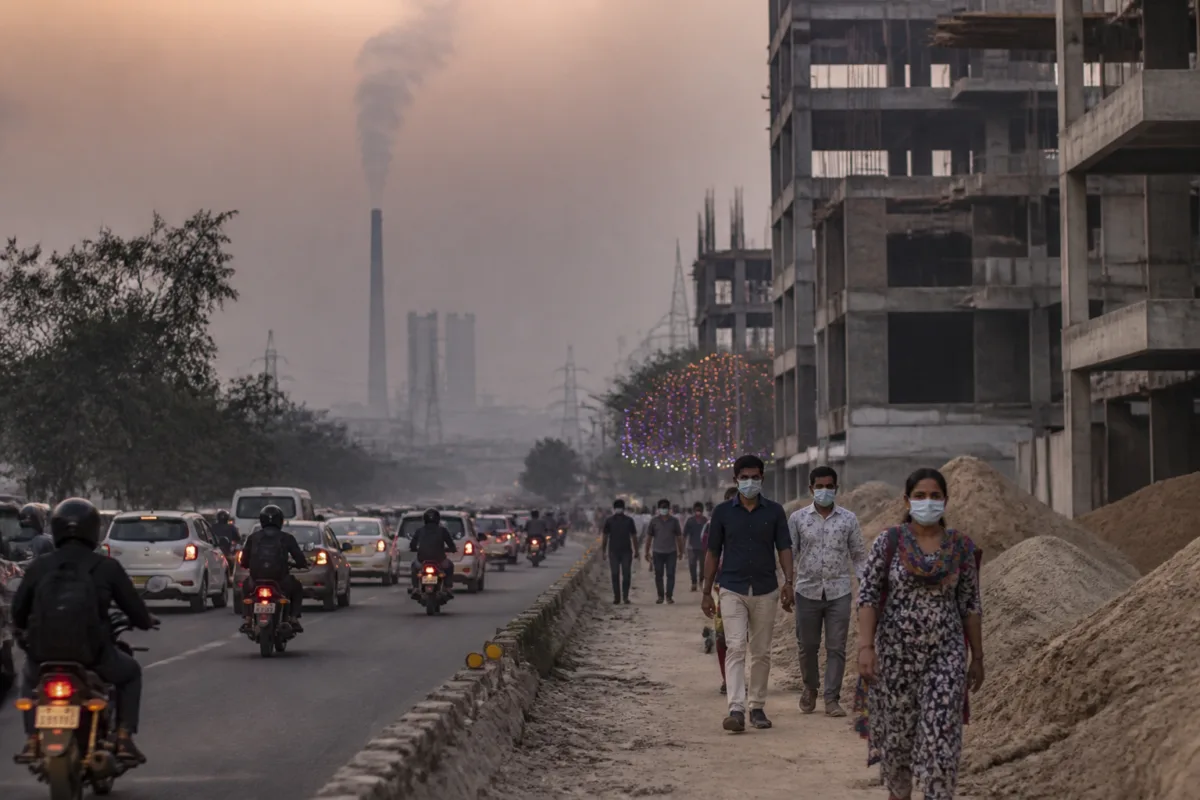
Ahmedabad air quality had already deteriorated before the main Diwali celebrations, with the city recording two days in the “unhealthy” category and three days of “poor” air quality during the first five days of November, according to a report by Nav Gujarat Samay. The report said the Air Quality Index reached 123 by Friday evening and warned that it could cross 200 around midnight as fine particulate pollution increased.
The immediate concern is the likely addition of fireworks to an atmosphere already carrying pollution from construction activity, vehicle movement and factories located within the city. But the evidence in the report also points to a wider urban problem: Diwali may intensify Ahmedabad’s pollution, yet the city’s baseline air quality is being shaped by ordinary activity across its built environment throughout the year.
The report identifies PM2.5 and PM10 as the principal pollutants whose levels were rising. These particles are associated with dust and combustion, and in Ahmedabad they can come from several overlapping sources. Construction and housing work can expose soil and building materials, while traffic can add exhaust emissions and resuspend road dust. Industrial activity within and around the urban area adds another source of emissions. The report does not provide a source-wise emissions breakdown, however, so it cannot establish the precise contribution of each sector to the recorded AQI.
That limitation matters because urban air pollution is rarely produced by one event alone. A festival-related spike is more likely to occur on top of existing pollution generated by transport, construction and industrial activity. When several sources operate at the same time, a short period of intense emissions can become more harmful for residents than any single source considered in isolation.
The report’s description of November’s first five days is significant for that reason. It suggests that poorer air was being recorded before the peak of the festival. The city had two days classified as unhealthy and three days classified as poor, according to the report. It gives an evening AQI reading of 123 on Friday and projects that the number could exceed 200 by midnight, but it does not name the monitoring station, publish hourly readings or provide the underlying data series. Those details would be necessary to compare neighbourhood-level exposure and verify how widely the reported conditions applied across Ahmedabad.
The health implications are especially important for people who spend time outdoors or have respiratory sensitivity. The report warns that residents were breathing air capable of posing a health risk and identifies the rise in particulate matter as a concern. It does not provide hospital or emergency data, nor does it quantify the health impact of the reported pollution. The available evidence therefore supports concern about exposure, but not a measured estimate of illness attributable to this particular episode.
Fireworks are the most visible seasonal source in the report. It says that standards for manufactured fireworks have been tightened over time, while locally produced, household-scale fireworks may not follow the same standards. The report links their use to an increase in toxic substances in the air. Because it does not cite a regulatory inspection record or an emissions measurement comparing different types of fireworks, that claim should be read as a reported concern rather than as a quantified finding.
The larger policy question is whether seasonal campaigns can work without stronger control of the pollution that exists before the festival begins. The Gujarat Pollution Control Board has appealed to residents to celebrate a “green Diwali”, avoid fireworks, reduce waste, use local products, limit single-use plastic and choose walking, cycling or public transport where possible. It has also urged citizens to use earthen lamps and environmentally friendly candles, make rangoli with natural materials, donate usable goods and segregate waste.
The appeal is part of the “Green Diwali Abhiyan-2026”, described in the report as a nationwide campaign being conducted by the WWF EIACP Programme Centre–Resource Partner with the support of the Union Ministry of Environment, Forest and Climate Change. Its message is “Say no to fireworks, say yes to clean air”. Residents can reportedly submit details and geo-tagged photographs of environmentally friendly activities for possible publication on the EIACP platform. The campaign also allows citizens to assess their carbon footprint by scanning a QR code shown on its poster.
These measures place a considerable part of the response on household behaviour. That has a legitimate role in reducing fireworks smoke, noise and festival waste, but the report itself shows why a citizen-only response is incomplete. Residents are being asked to avoid fireworks while the city continues to experience pollution from construction, traffic and factories. Those sources require enforcement, monitoring and coordination by public agencies, builders, transport authorities and industrial operators rather than only voluntary action by households.
For a city experiencing extensive construction and housing activity, dust management is a particularly important administrative issue. The report identifies construction-related dust as one of the factors behind worsening air quality, but it does not state whether specific sites were inspected, whether violations were recorded or which agency is responsible for enforcement. That missing information makes it difficult to determine whether the problem lies in inadequate rules, weak compliance, limited monitoring or gaps in implementation.
The same institutional question applies to traffic and industrial emissions. A city-wide AQI number can indicate that air quality has worsened, but it does not show which roads, work sites or industrial areas are contributing most to the problem. Station-level data, continuous monitoring and source-specific enforcement would be needed to move from a general warning to targeted action. The report does not contain that information, leaving the operational response unclear.
The timing of the warning also exposes a recurring tension in urban governance. Public agencies often intensify advisories around high-pollution events because the risk is easier to communicate and more visible to residents. Yet the most important evidence may be the air quality recorded before the event. If Ahmedabad was already experiencing several days of poor or unhealthy air before the main Diwali celebrations, the festival is not the beginning of the problem. It is a stress test of the city’s existing pollution controls.
The available report confirms four points: Ahmedabad’s air quality had worsened in the days before the main Diwali celebrations; particulate matter was a stated concern; fireworks were expected to add further pressure; and GPCB was urging residents to adopt environmentally safer practices. It does not establish the exact contribution of fireworks, construction, vehicles or factories, and it does not provide a complete monitoring record or health-impact assessment.
Those gaps should guide what is monitored next. Hourly AQI and PM2.5 readings, station locations, post-Diwali comparisons, construction-site compliance records and enforcement actions would show whether the deterioration was temporary or part of a wider pattern. Until that evidence is available, Ahmedabad’s pre-Diwali pollution episode is best understood not only as a festival warning but also as a measure of how much everyday urban activity the city’s air can absorb.

