


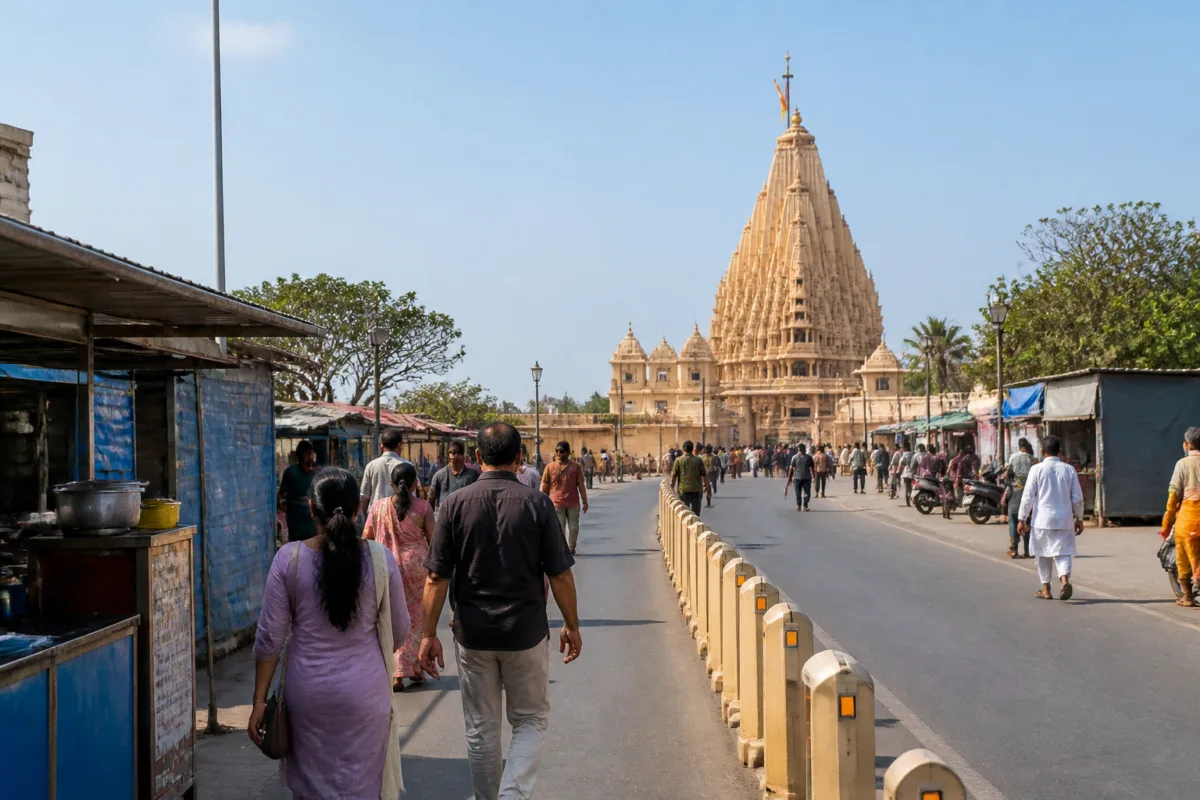
The Somnath non-veg food ban will remain in force after the Supreme Court declined to interfere with a Gujarat High Court order enforcing restrictions on the preparation, storage and sale of non-vegetarian food near the Somnath temple and along designated connecting roads.
The Supreme Court also requested the Gujarat High Court to decide the pending appeals, if possible, within two months. The interim position therefore remains unchanged, and restaurants selling non-vegetarian food in the notified areas will continue to face the restrictions while the broader legal challenge is heard.
The case concerns an order passed by a Gujarat High Court division bench comprising Chief Justice Manas Ranjan Pathak and Justice Nirzhar S. Desai. Restaurant owners had challenged the bench’s October 30 order, which kept the restrictions operational after an earlier order by Justice Nisha M. Thakore had cancelled the district administration’s notification.
The legal position changed twice on October 30. Earlier that day, Justice Thakore granted relief to restaurant owners and set aside the notification issued by the Gir Somnath district administration. Later the same evening, the division bench stayed that decision and directed that the notification should continue to be implemented. The restaurant owners subsequently approached the Supreme Court seeking interim relief against the High Court’s order.
The original restrictions were introduced through a notification issued by the Gir Somnath Collector and District Magistrate on August 10, 2026. It covers a 500-metre radius around the Somnath Mahadev temple and six specified roads linking the temple with other important religious and visitor locations. The notified routes include connections involving Bhalka Tirth, Bhidiya Circle, Shankh Circle, Safari Circle, Gita Mandir and Hamirji Circle, among other locations.
The notification applies not only to the sale of non-vegetarian food but also to its preparation and storage within the specified areas. That makes the dispute an issue of local land-use and commercial regulation as well as a question concerning food businesses. The district administration’s enforcement will continue under the existing court direction unless a subsequent order changes the position.
For restaurants and hotels operating within the notified zone, the Supreme Court’s refusal to grant interim relief means that the immediate legal route to suspend the restrictions has not succeeded. For visitors and residents, the current rules remain those set out in the district notification. The next significant step is the Gujarat High Court’s consideration of the pending appeals, which the Supreme Court has asked it to complete, if possible, within two months.

