


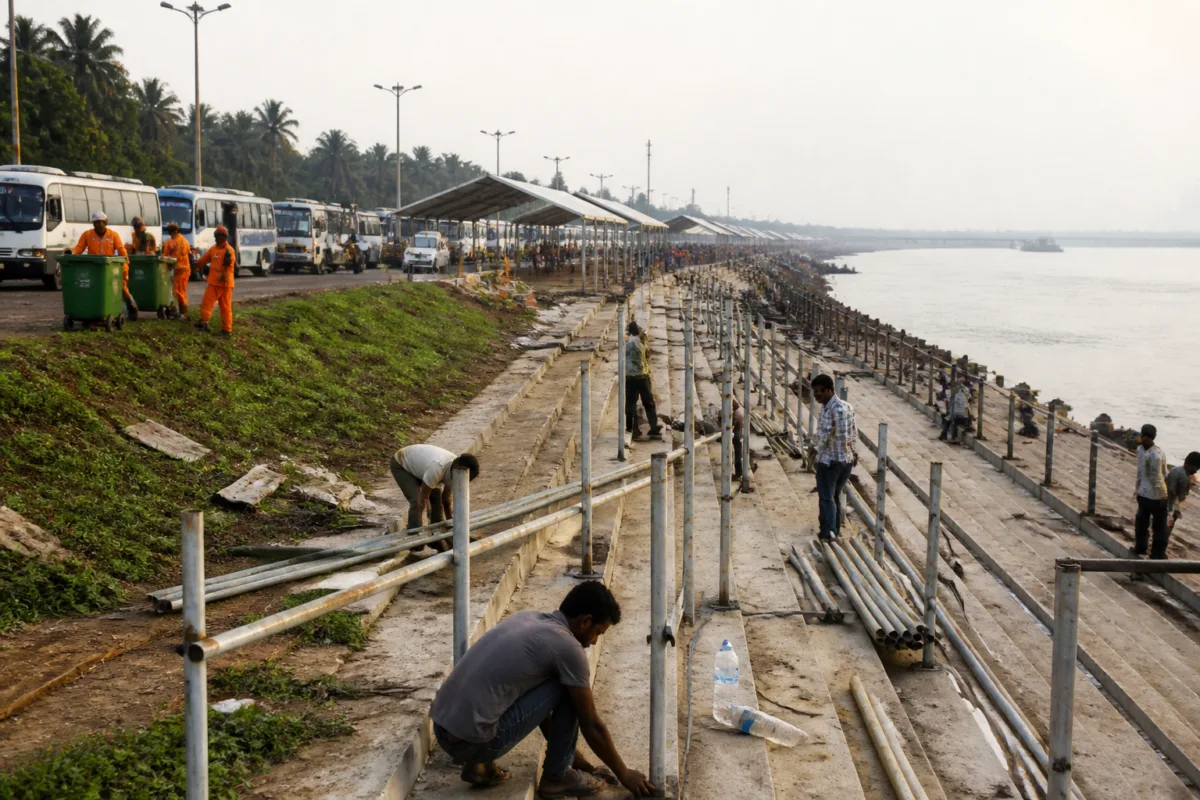
The Godavari Pushkaralu 2027 is being planned as a temporary urban operation on a scale that could test Andhra Pradesh’s ability to move, accommodate, clean and digitally coordinate millions of people in a limited period. East Godavari district collector Keerthi Chekuri has said that as many as 80 lakh pilgrims could arrive daily during the 12-day event, with the administration preparing a multi-department plan covering transport, bathing ghats, sanitation, waste, accommodation and connectivity.
The scale of the projected footfall changes the nature of the exercise. This is not only a religious gathering requiring crowd management at riverfront locations. It is also a short-duration expansion of urban infrastructure, in which temporary townships, roads, shuttle routes, toilets, waste systems and public facilities must work together. The district administration is coordinating with 22 key departments, indicating that the event will depend on several public agencies operating against a common schedule and geography.
The numbers outlined by the administration show where the principal pressures will fall. Of the estimated 80 lakh pilgrims expected daily, around 60 lakh are projected to visit urban areas and 20 lakh rural areas. That split matters because the two settings require different operating arrangements. Urban locations will need higher-capacity transport links, denser sanitation services and tighter pedestrian management, while rural bathing points will require access roads, temporary facilities and waste collection systems spread across a wider area.
The administration plans to construct 5,100 metres of temporary bathing ghats in East Godavari district. These ghats are intended to facilitate the movement of pilgrims towards rural areas and provide additional bathing capacity. Their effectiveness will depend not only on the length of the structures but also on how they connect with entry and exit routes, parking or transfer points, sanitation facilities and emergency access. The report says dedicated entry and exit routes are being planned to regulate movement, making circulation a central part of the temporary design.
Transport planning is being developed around NH-16, NH-51E and the Greenfield Highway. The plan includes toll gates, Pushkara Nagars, or temporary pilgrim townships, and shuttle bus routes. This suggests that the administration is treating the event as a network rather than as a single riverfront destination. Pilgrims will have to be distributed between arrival corridors, temporary accommodation, bathing areas and departure routes. Any weak link could increase pressure on the rest of the system, although the supplied report does not provide projected capacities for each road, shuttle route or toll gate.
The accommodation plan also reflects the temporary-city character of the event. Proposed facilities include German-style hangars, tents for VIPs and VVIPs, tent cities and other lodging arrangements. These facilities will need supporting services such as water, toilets, electricity, access roads, waste collection and digital connectivity. The report does not specify the number of beds or the locations of the proposed accommodation facilities, so the size of this component cannot yet be assessed beyond the broad categories announced by the administration.
Sanitation is one of the clearest indicators of the operational challenge. The district administration plans to install 20,000 toilet and urinal units and deploy about 8,000 sanitation workers daily in three shifts. This amounts to a staffing model designed for continuous operations rather than a one-time cleaning drive. It also means that sanitation will have to be coordinated across bathing ghats, temporary townships, transport corridors, public gathering spaces and rural sites.
The expected solid waste generation is estimated at up to 2,800 tonnes a day. That figure places collection, transportation and disposal at the centre of the event’s infrastructure plan. The administration says special arrangements are being made for collection, transportation and scientific disposal. However, the report does not identify the disposal facilities, processing capacity, transfer points or monitoring arrangements that would support this commitment. Those details will determine whether the waste system can match the projected daily load.
The sanitation numbers also illustrate the difference between providing an asset and operating a service. Toilets and urinals can be installed ahead of the event, but they require water, cleaning, lighting, access for maintenance teams and regular removal of waste. Similarly, deploying 8,000 workers across three shifts requires rostering, supervision, equipment and movement plans. The district’s announcement establishes the scale of the intended response, while the operational details remain part of the action plan being prepared.
Digital systems are another part of the proposed framework. The administration plans to use Digital Twin Technology and provide digital connectivity through Andhra Pradesh State FiberNet Limited, or APSFL. The report does not explain the specific functions planned for the digital twin. It does, however, place the technology alongside barricades, sanitation facilities and transport arrangements, suggesting that digital coordination is being considered as part of the physical management system rather than as a separate technology project.
For a temporary urban environment, digital connectivity could support the administration of multiple locations, but the supplied material does not establish whether the proposed system will be used for live crowd monitoring, route management, asset mapping, emergency response or public information. The distinction will be important. A digital model can represent infrastructure and movement corridors, but its usefulness during a high-footfall event depends on reliable data, communications coverage, trained operators and clear responsibility among departments.
The institutional structure is equally significant. Chekuri and Rajamahendravaram municipal commissioner Rahul Meena briefed the Pushkaralu special officer and the principal secretary of the municipal administration and urban development during a video conference. The meeting brought district administration, municipal leadership and senior state-level officials into the same planning process. The involvement of 22 departments indicates that implementation will require coordination across administrative boundaries and service functions.
That coordination is especially important because the projected visitors will not remain within one type of jurisdiction. The event will involve municipal areas, rural locations, highways, temporary settlements and riverfront facilities. Roads may be managed differently from town facilities; sanitation responsibilities may be divided between local bodies and special event teams; and transport routes may cross several administrative areas. The report does not set out the division of responsibilities, but the multi-department action plan appears intended to address that complexity.
The proposed Guinness World Records events add another layer to the planning exercise. The administration is considering an Akhanda Nadi Harathi, a Kuchipudi performance involving 20,000 to 30,000 participants and world-class sanitation initiatives. These events may increase the requirements for crowd segregation, timed movement, temporary staging and public safety. The supplied report does not state whether the record attempts have been formally registered or how they will be integrated with the core pilgrimage operations. Their inclusion in the preparations nevertheless shows that the event is being designed to combine religious participation, cultural programming and public-service performance.
The distinction between ceremonial activities and essential infrastructure will matter during implementation. A large performance requires concentrated movement at a specific time and place, while sanitation and transport systems must function continuously across the 12-day period. The administration’s planning challenge will therefore involve sequencing different demands without allowing special events to disrupt access to bathing areas, accommodation or emergency routes. The available information does not yet provide the event calendar or traffic-control plan needed to evaluate that sequencing.
The Pushkaralu preparations offer a useful lens on how cities manage short-duration population surges. The administration is not expanding permanent urban infrastructure for a long-term population increase. Instead, it is assembling a temporary system with fixed deadlines and a concentrated operating window. The system must be built, tested, staffed and dismantled or repurposed within a defined period. That makes procurement, interdepartmental command, maintenance and daily monitoring as important as construction itself.
The data released so far establishes the scale of the proposed response: 80 lakh expected pilgrims daily, a projected urban share of 60 lakh, 20 lakh visitors to rural areas, 20,000 toilet and urinal units, 8,000 sanitation workers, up to 2,800 tonnes of solid waste each day and 5,100 metres of temporary bathing ghats. These figures are planning estimates, not reported outcomes. The administration has not yet provided a detailed budget, implementation calendar, facility-wise capacity plan or performance indicators in the supplied material.
Those missing details will be important as the plan develops. The next stage will need to show how the estimated footfall has been translated into road, shuttle, bathing, accommodation, toilet and waste capacities. It will also need to clarify how agencies will share information, who will control movement during peak periods and how rural and urban sites will be serviced. Until those elements are published, the announcements describe the intended architecture of the event but not yet its complete operating model.
The preparations make clear that the Godavari Pushkaralu 2027 will be judged not only by the number of pilgrims it can receive, but by whether temporary infrastructure can function as an integrated urban system. The district administration says a comprehensive action plan is being prepared in coordination with 22 departments. Its subsequent milestones will be the release of detailed capacities, routes, responsibilities and timelines for the proposed facilities and services.

