


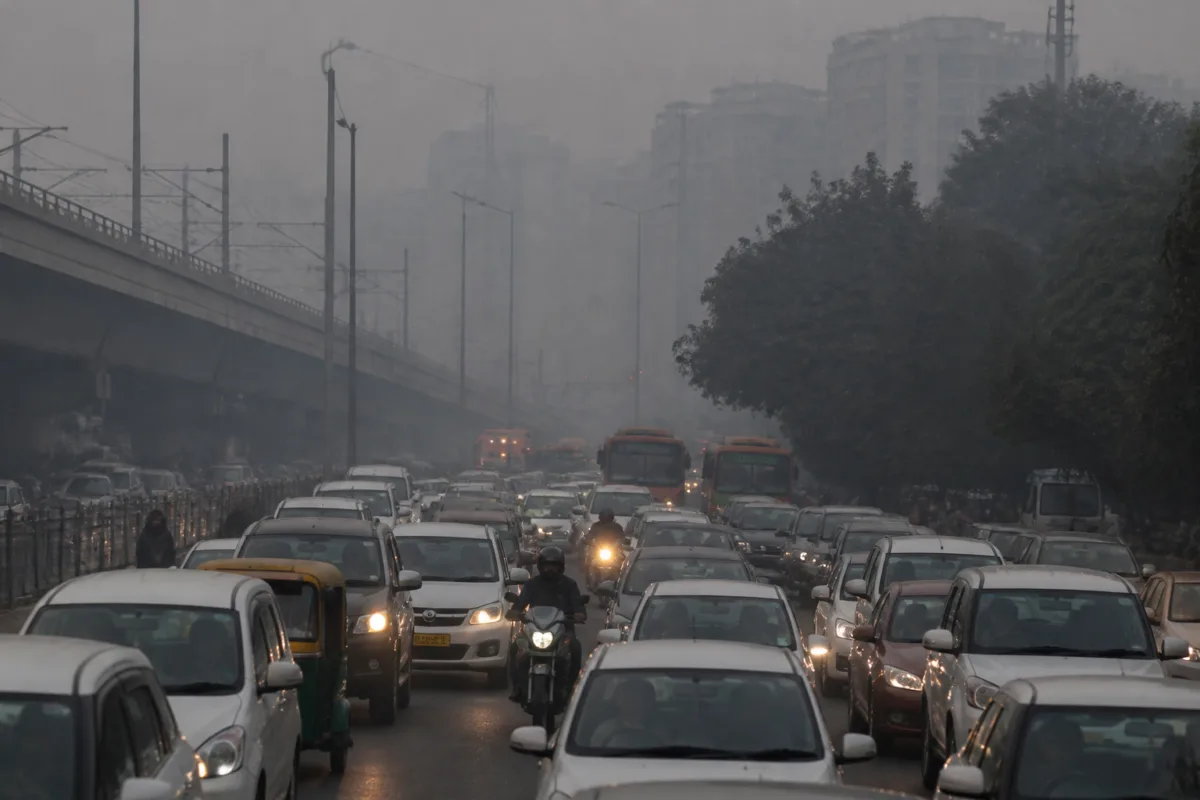
The Supreme Court on Friday questioned whether crop-residue burning alone could explain Delhi-NCR’s severe air pollution, pointing to vehicle emissions and bumper-to-bumper traffic as major contributors to the crisis. The court also asked authorities to improve the system for purchasing and managing agricultural residue.
A three-judge bench led by Chief Justice Suryakant, along with Justices Joymalya Bagchi and V. Mohana, was hearing a petition related to air pollution in the National Capital Region. During the hearing, the Chief Justice referred to the strict anti-pollution measures in force in Delhi and remarked, “I hope you are all enjoying the weather in Delhi.”
Senior advocate Aparajita Singh, appearing as amicus curiae, told the court that air pollution levels remained close to the “severe” category. She said the air quality was so poor that breathing it was comparable to smoking 30 cigarettes a day, according to the report cited in the supplied coverage. Singh also told the bench that stubble burning contributed 14% of Delhi’s pollution.
She said Delhi was already heavily polluted and that farm fires worsened the situation. Immediate action was needed to prevent both crop-residue burning and local sources of pollution such as waste burning, she said.
The court questioned whether stubble burning could be treated as the sole cause of the pollution crisis and asked about the role of vehicles. The bench specifically referred to private cars and expensive vehicles, observing that they continued to operate even as authorities focused repeatedly on farm fires.
“ We keep talking about stubble burning and you have even made equipment available to stop it. Maybe some people are still hesitant to use it. But what about the affluent sections? Their vehicles and expensive cars continue to run,” the Supreme Court said, as reported in the supplied article.
Singh responded that transport was actually the main source of air pollution in Delhi-NCR. The Chief Justice said vehicle emissions were a significant cause of pollution and added that traffic moving bumper-to-bumper on roads connecting Delhi with the wider NCR made the problem worse.
The court’s discussion placed the pollution emergency within the region’s broader transport system, where daily movement between Delhi and surrounding urban centres creates sustained traffic volumes. It also indicated that measures aimed at agricultural emissions cannot address the entire problem if urban transport emissions and congestion remain significant contributors.
Additional Solicitor General Aishwarya Bhati, appearing for the Centre, told the court that Delhi had been directed to allow entry only to vehicles complying with Bharat Stage VI emission standards. She also outlined measures to phase out diesel-powered autorickshaws and impose stricter rules on buses entering Delhi from other cities.
The submissions cover both vehicle standards and the movement of public transport across the NCR. The supplied report did not provide details on the implementation status of these directions, the number of vehicles affected or the penalties for non-compliance.
At the close of the hearing, Justice Suryakant observed that the more orders the Supreme Court issued, the more cases of non-compliance could follow, describing this as a feature of human behaviour. The hearing continued within the court’s ongoing consideration of measures to address Delhi-NCR’s air pollution crisis.

