


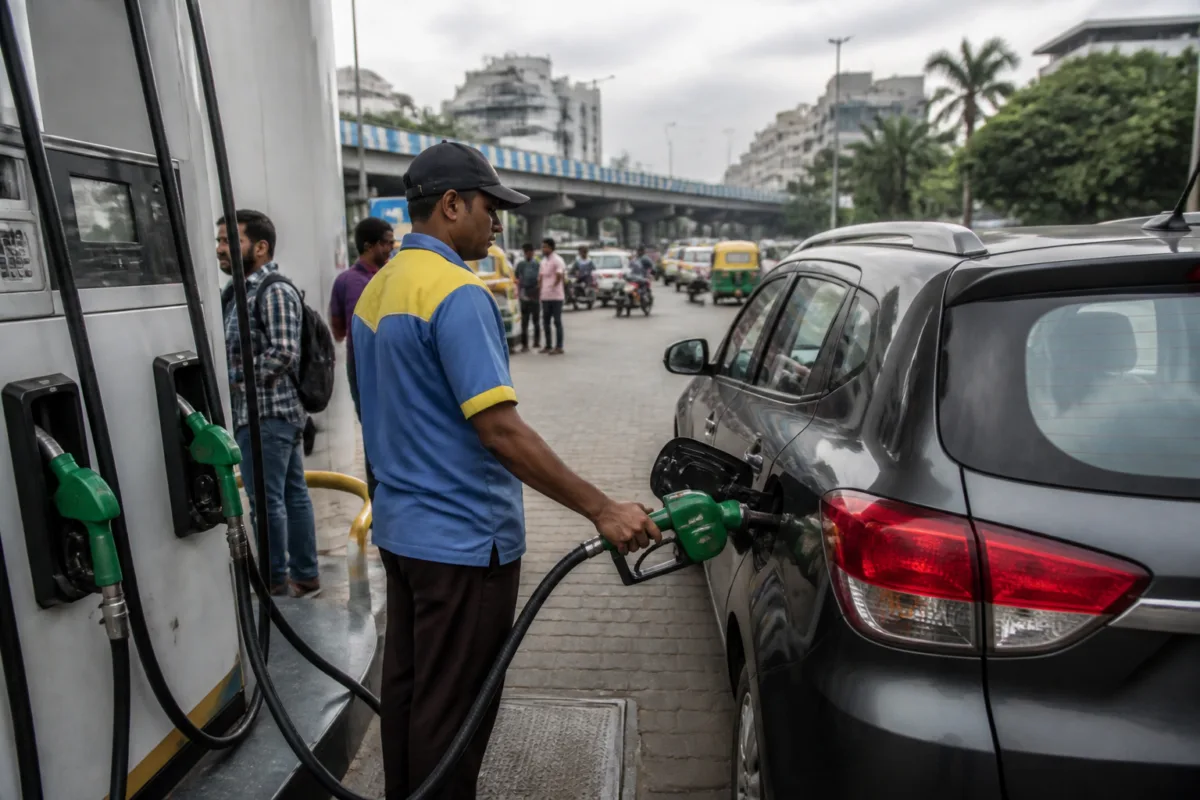
The Karnataka government has alleged that petrol sold by major oil marketing companies in the state contained ethanol well above the prescribed 20 per cent limit, with laboratory tests recording concentrations as high as 31.2 per cent in samples collected across seven locations.
Food, Civil Supplies, Consumer Affairs and Legal Metrology Minister Rizwan Arshad said the findings were based on tests of petrol samples collected from Bengaluru, Kolar, Chikkaballapura, Bengaluru Rural, Ramanagara, Mangaluru and Tumakuru. The samples were tested by the Shriram Research Institute in Bengaluru, which is accredited by the National Accreditation Board for Testing and Calibration Laboratories and is ISO-certified, according to a state government press release.
The highest ethanol concentration, 31.2 per cent, was recorded in a sample from Indian Oil Corporation Limited, while an HPCL sample recorded 30.5 per cent, the government said. Other results included 27 per cent in HPCL Motor Spirit petrol, 26.5 per cent in Bharat Petroleum Corporation Limited’s Speed petrol, 26.1 per cent in Nayara petrol and 25.5 per cent in Shell petrol.
Two other BPCL samples recorded ethanol concentrations of 24.2 per cent and 22.6 per cent. The tests also found 22.4 per cent in another HPCL sample and 20.8 per cent in another IOCL sample. Among the remaining Motor Spirit samples, ethanol levels ranged from 13.5 per cent in a Shell sample to 20.6 per cent in a Nayara sample. A BPCL sample recorded 19.9 per cent, while an MRPL sample recorded 19.2 per cent.
The Karnataka government alleged that samples had initially been submitted to the in-house laboratories of IOCL and BPCL, but that the companies’ reports did not disclose ethanol content despite it being a prescribed testing parameter. The state release said the omission raised questions about transparency, but the supplied material does not include a response from the oil marketing companies.
The dispute has direct implications for consumers because petrol blending affects the fuel system in vehicles and the equipment used to store and dispense fuel. The Karnataka government claimed that excessive blending could reduce mileage and potentially damage vehicle components such as filters, fuel pumps, injectors, hoses and seals. It also said that 99 per cent of India’s 35 crore vehicles were not designed to run on blends above E20, while vehicles sold after April 2023 were certified for blends of up to 20 per cent.
The state further raised concerns about dispensing infrastructure at petrol stations, stating that most units currently in use were designed to handle fuel containing up to 15 per cent ethanol. The claim places the issue beyond fuel composition alone, raising questions about whether storage, pumping and vehicle systems are aligned with the country’s ethanol-blending programme.
Karnataka has sought action against oil marketing companies found supplying petrol containing more than 20 per cent ethanol, compensation for consumers whose vehicles may have suffered damage, and mandatory display of ethanol blend percentages at fuel stations. It has also demanded that different fuel blends be made available so consumers can choose according to their vehicle’s compatibility.
The government proposed an E20 spoilage fund to compensate affected consumers through a time-bound claims process, with vehicle damage to be certified by authorised service centres. It also called on the Union government to publicly clarify the actual ethanol blend being supplied to consumers.
The state said officials had already been empowered under the Motor Spirit and High Speed Diesel (Regulation of Supply and Distribution and Prevention of Malpractices) Order, 2005, to act against malpractice in fuel supply and distribution. It cited a notification dated April 15, 2009, conferring these powers on designated officials and said further testing would continue across Karnataka under Mission Nikhara, launched by Arshad. The government said it would publish its findings as the testing programme progresses.

