


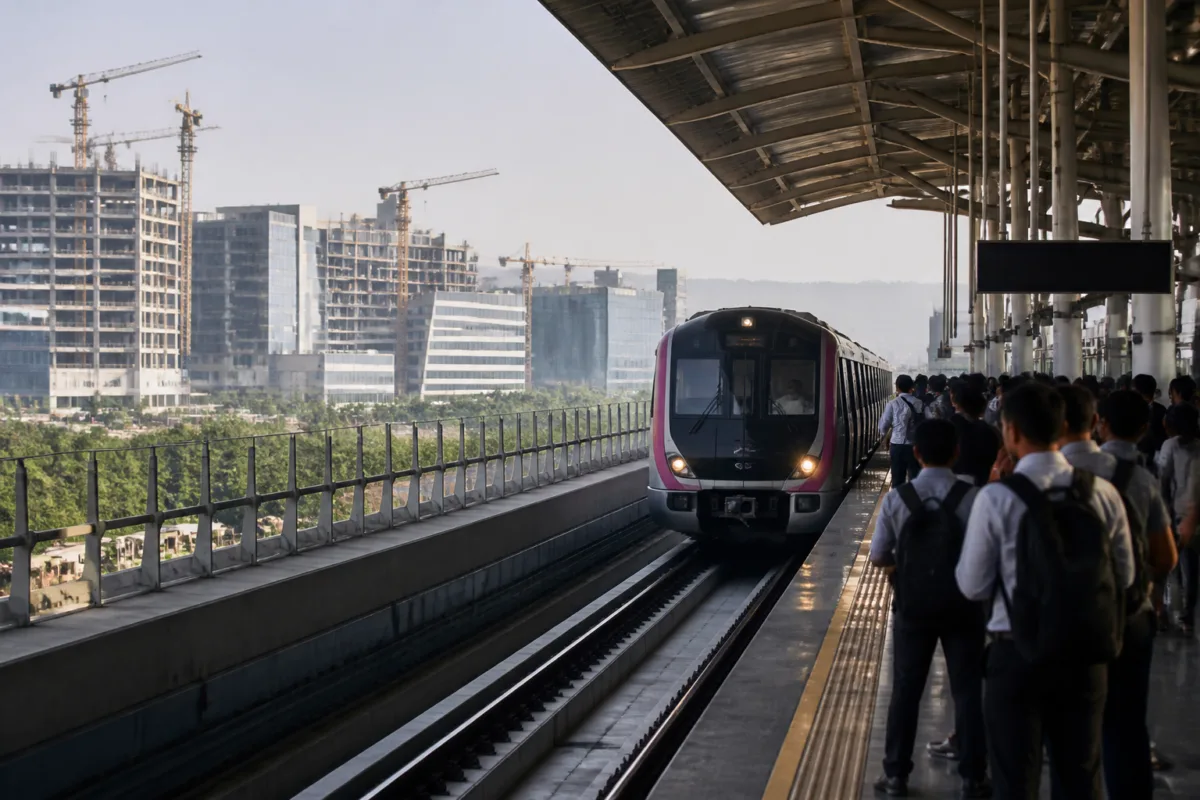
Pune Metro Line 3, also known as the Pink Line, has begun passenger operations between Hinjawadi and Shivajinagar, giving commuters a new public transport connection across one of the city’s busiest employment and residential corridors. The service was formally inaugurated on November 4 and is scheduled to operate for about 17 hours and 30 minutes each day.
The line connects the Hinjawadi IT Park area with Shivajinagar through a 23-station corridor. According to the report, 17 stations are currently open to passengers, while the remaining stations are expected to be brought into service in phases by January 2027. The route is designed to serve technology workers, students, office commuters and residents travelling between western Pune and the city centre.
The first train from Maan towards District Court departs at 6 am. The last train in that direction leaves at 10.30 pm, while the final service from District Court towards Maan departs at 11.40 pm. The journey between Maan and District Court is expected to take approximately 45 minutes.
Important stations on the corridor include Megapolis, Hinjawadi, Wakad, Balewadi, Baner, Savitribai Phule Pune University, Shivajinagar and Civil Court. The route passes through major employment, education and residential areas, including the Hinjawadi IT Park and the university precinct. The operational station list also includes stops such as Quadron, Infosys Phase II, Dolar, Wipro Technologies, Persistent Systems, Shivaji Chowk, NICMAR, Ramnagar, Laxmi Nagar, Balewadi Phata, Baner Gaon, Indian Agricultural Research Institute, Sakal Nagar, the Reserve Bank of India, Agriculture College and Shivajinagar.
Civil Court is the key interchange point for Line 3. At the station, passengers can connect with Maha-Metro’s Vanaz-Ramwadi corridor and the Pimpri-Chinchwad-Swargate corridor. This interchange is intended to make it easier to travel between Hinjawadi, central Pune, eastern Pune and Pimpri-Chinchwad without relying entirely on road transport.
The new service is also being supported by feeder and last-mile options. PMPML buses, auto-rickshaws, taxis and e-bikes are available at metro stations, according to the report. These connections will be important because the line’s usefulness will depend not only on train frequency and travel time, but also on how easily passengers can reach stations from offices, neighbourhoods and bus routes.
The corridor includes a 7.60-megawatt solar power system. The report states that the installation is expected to meet around 30 per cent of the metro’s electricity requirement. The project is also linked to plans for 19.1 kilometres of connecting roads, footpaths and cycle tracks around the Hinjawadi metro area.
With the first phase now carrying passengers, the immediate focus will be on stabilising operations and opening the remaining stations. The full 23-station corridor is expected to become available in stages, with all stations targeted for passenger operations by January 2027.

