


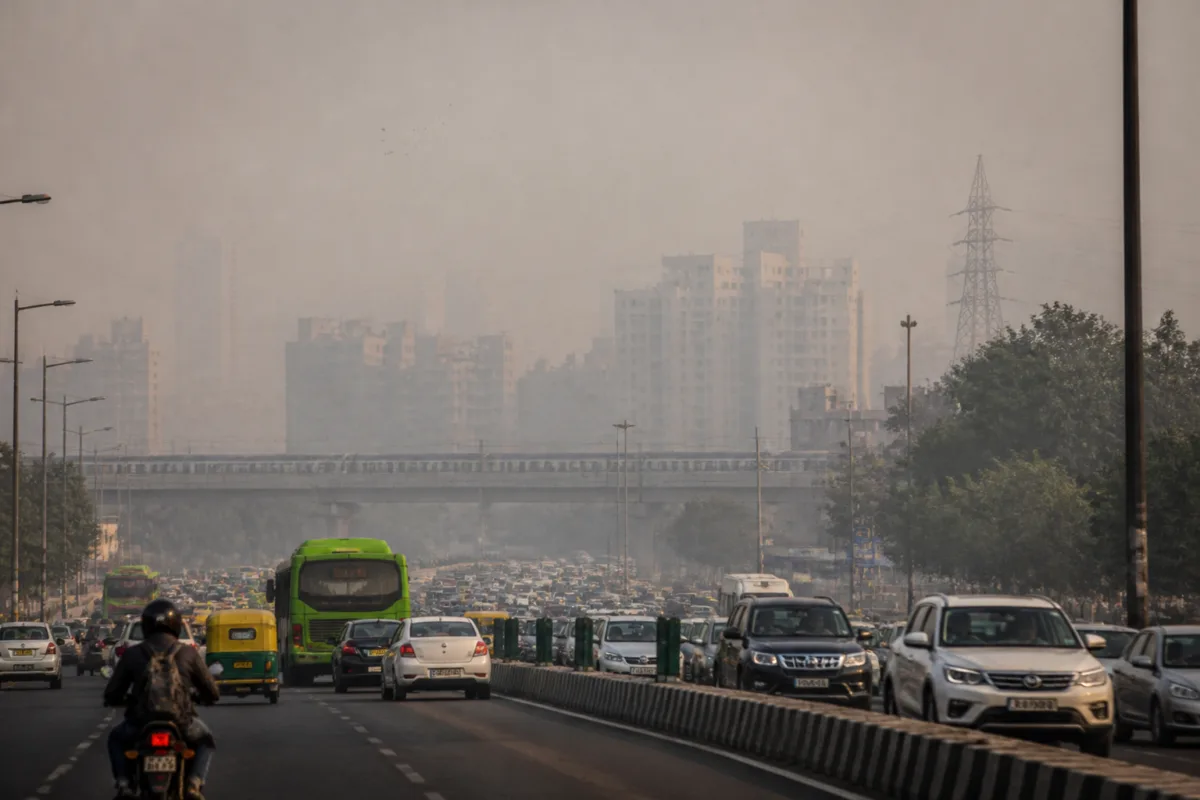
A new study’s modelling suggests that Delhi-NCR air pollution could be reduced sharply if human-generated emissions are controlled across the wider region rather than within the capital alone. The finding shifts attention from the familiar question of how Delhi should clean its air to a more difficult governance problem: how several states, sectors and administrative systems can act as one pollution-control zone.
The study by the National Institute of Advanced Studies proposes dividing India into 16 air-quality management regions, described as “airshedems”. These regions are designed around the movement and concentration of pollution, while also accounting for geography, climate, land use, population density, economic activity, public health and administrative boundaries.
That combination is significant because air pollution does not follow municipal or state borders. Delhi’s air is affected by transport, industry, agriculture, residential fuels and crop burning across a much larger geography. A plan restricted to the territory of the National Capital Territory may therefore address only part of the emissions system that produces the pollution residents experience.
The study, titled “Airshedem-Based Mitigation as a Pathway to Cleaner Air in India”, was authored by Ummed Singh Saharan and Gufran Beig. Researchers identified the 16 airshedems by analysing more than two decades of climate data from 2000 to 2023, satellite-derived pollution estimates, emission inventories and machine-learning methods.
Their analysis found substantial inequality in the distribution of pollution sources. Two of the 16 airshedems cover 23% of India’s landmass but account for 50% of the country’s particulate matter with a diameter of 2.5 micrometres, or PM2.5, and nitrogen oxide source loads, according to the study. Residential activity, transport and industry were identified as the primary contributors in these regions.
The concentration of emissions in a relatively small number of regions gives the airshed approach its central policy argument. Instead of distributing pollution-control efforts evenly across the country, authorities could prioritise regions where emissions are most concentrated and where action could affect both local and downwind populations.
Delhi’s region, classified as airshedem-2 or AS-2, is one of the two highest-emitting regions identified by the researchers. It includes Delhi, Haryana, Punjab and Chandigarh, along with parts of Uttarakhand, Himachal Pradesh, Jammu and Kashmir, Uttar Pradesh, Rajasthan and Madhya Pradesh.
The region’s emissions are linked in the study to its dense population, extensive agricultural activity, industrial and urban development, heavy transport, residential biofuel use and crop burning. These sources are spread across different jurisdictions and are managed by different departments and governments. That makes the air-quality problem institutional as much as technical.
### What the Delhi-NCR air pollution model shows
The researchers simulated a scenario in which anthropogenic, or human-generated, emissions were shut off only in AS-2. The model indicated that PM2.5 concentrations in the region could fall by approximately 60%. Pollution in neighbouring regions could decline by between 5% and 17%, while the national average could fall by 10%, from 33 to 30 micrograms per cubic metre.
A statement attributed to Gufran Beig gives a broader estimate, saying that controlling anthropogenic emissions within AS-2 could reduce PM2.5 concentrations by around 70% locally, 40% across the Indo-Gangetic Plain and 10% nationally. The difference between the study’s approximately 60% result and the around 70% figure appears within the supplied report as two reported estimates from the modelling and the researcher’s statement; the material does not explain the distinction between them.
The important point is not that Delhi can eliminate pollution through a single intervention. It is that emissions control in the region could produce benefits well beyond the jurisdiction where a measure is introduced. The model also shows that action in AS-2 would reduce pollution in neighbouring regions, establishing a measurable downwind effect.
However, the study’s results also set a limit on what emissions control alone can achieve. Even after all local human-caused emissions were switched off in the model, AS-2 retained a background PM2.5 concentration of 21 micrograms per cubic metre. Pollution transported from neighbouring countries contributed approximately 5 micrograms per cubic metre to this background concentration.
This residual pollution is an important part of the policy picture. It indicates that local intervention can deliver a major improvement without producing clean air by itself. Some pollution would remain because of background conditions and movement across wider geographic boundaries. The precise contribution of each remaining source would require further action and assessment, but the supplied study establishes that the local emissions problem is only one part of the exposure experienced in AS-2.
### Why an airshed is different from a city boundary
Conventional urban administration is organised around political and territorial boundaries. Municipal bodies manage local roads, waste, construction activity and some aspects of public health. State departments oversee agriculture, industry, transport and energy. Pollution, by contrast, moves through a connected atmospheric system.
The airshedem proposal attempts to bring those two realities together. It does not discard administrative boundaries; the study says it integrates them with climate, geography, economic and social factors. The objective is to create a planning unit that reflects how pollution is generated and transported while remaining practical for government implementation.
For Delhi, this would mean that an air-quality strategy could not rely only on measures within the capital. Transport emissions, industrial activity, agricultural burning and residential fuel use across the surrounding states would need to be considered within a shared regional framework. The study’s identification of AS-2 provides a geographical basis for that coordination, although the supplied material does not specify which authority would lead it or how responsibilities would be divided.
The institutional question is therefore central. A regional pollution plan would require coordination between multiple state governments, central agencies and local administrations. It would also need sector-specific measures because the emissions profile of AS-2 is not produced by one activity. Transport, residential energy, industry and agriculture each operate under different regulatory and enforcement systems.
### India’s second high-emission region
The study identifies airshedem-7, or AS-7, as the other major high-emitting region. Unlike AS-2, AS-7 is described as one of the central and southern Indian airsheds, with extensive forest cover and significant mining activity. Its pollution profile is primarily associated with intensive coal and mineral mining, thermal power generation and automobiles.
The contrast between AS-2 and AS-7 matters because it shows why a single national pollution-control template may not be sufficient. AS-2 combines dense settlement, agriculture, urban development and residential fuel use, while AS-7 has a stronger connection to mining and thermal power. The same air-quality target would therefore involve different sectors, authorities and implementation challenges in each region.
The study’s framework also suggests that pollution control must be based on more than atmospheric conditions. Its researchers included socio-economic and cultural factors alongside climatology and environmental geography. That approach recognises that emissions are connected to how people travel, cook, work, farm and build cities, rather than being generated only by isolated industrial facilities.
The source material does not provide a full implementation plan, cost estimate or timeline for establishing the 16 airshedems. It also does not indicate whether the framework has been adopted by a government agency. At this stage, the proposal is best understood as a research-based planning framework supported by modelling, not as an operational programme.
### The larger urban governance question
The Delhi-NCR air pollution debate has often been framed through seasonal emergencies and individual sources. The airshedem concept places those episodes within a larger system of persistent regional emissions. It also changes the scale at which accountability must be considered. If pollution generated in one state affects residents in another, local action remains necessary but cannot be the sole measure of policy performance.
The study does not suggest that cities are powerless. Its simulation indicates that controlling emissions within AS-2 could generate a large local reduction and measurable improvements in neighbouring areas. But it also demonstrates that the remaining background concentration would be substantial, even in an extreme scenario in which local human emissions were completely shut off.
That combination of benefit and limitation is the central evidence from the research. Regional action can produce larger gains than isolated city measures, but the air-quality problem remains connected to cross-border transport, background pollution and multiple sectors. The framework therefore raises a practical question for India’s urban governance system: whether pollution management can move from fragmented jurisdictional responses towards coordinated plans built around the geography of emissions.
The study confirms the potential scale of targeted regional intervention, particularly in AS-2. What remains uncertain is how the proposed airshedems would be institutionalised, funded, monitored and enforced. Those questions will determine whether the framework becomes an administrative tool or remains a conceptual advance in air-quality research.

