


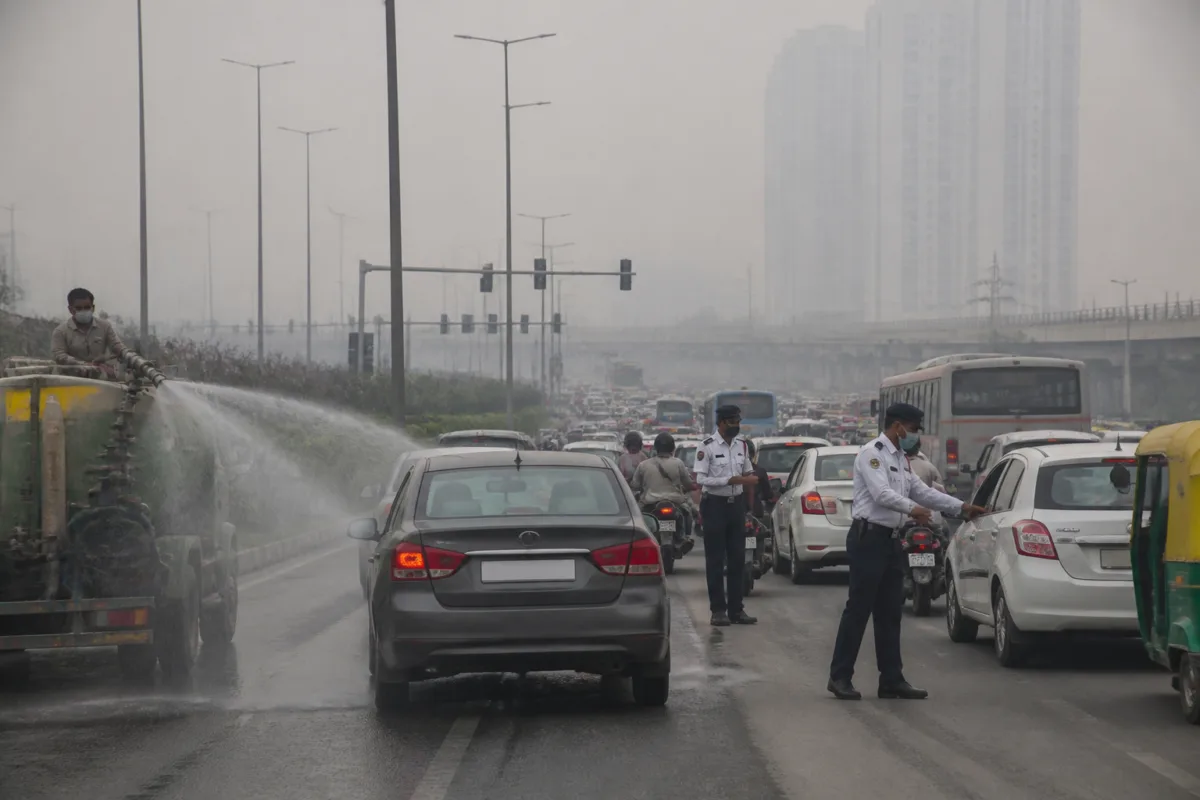
Delhi’s overall Air Quality Index reached 451 at 8 am on Tuesday, placing the capital’s air in the hazardous range cited in the report and prompting intensified enforcement of Stage-II measures under the Graded Response Action Plan across the National Capital Region ahead of Diwali.
Data from the Central Pollution Control Board showed that several monitoring stations in Delhi recorded air quality in the severe category, while other parts of the city reported very poor conditions. Rohini recorded the highest listed reading at 429, followed by Punjabi Bagh at 424 and Bawana at 408.
Other locations also reported elevated pollution levels. Patparganj recorded an AQI of 379, followed by R K Puram at 374 and ITO at 373. The readings at Jawaharlal Nehru Stadium, Okhla Phase-2 and Chandni Chowk were 355, 352 and 352 respectively, while Jawaharlal Nehru University recorded 328.
The least polluted locations listed in the report remained in the poor category rather than reaching safe levels. The AQI at Indira Gandhi International Airport’s Terminal 3 was 287, followed by Anand Vihar at 279, Uttam Nagar at 274 and IMD Lodhi Road at 226.
The Commission for Air Quality Management invoked Stage-II of GRAP across the NCR on Monday as pollution levels rose. The enhanced restrictions came into immediate effect in addition to the measures already operating under Stage-I.
Delhi Police carried out a checking drive at the Ghazipur border after restrictions on vehicle entry under Stage-II came into force. The action reflects the multi-agency nature of the response, with municipal corporations, traffic police and pollution-control boards in Delhi, Haryana, Uttar Pradesh and Rajasthan directed to strengthen enforcement.
Under the measures, authorities have been asked to undertake daily mechanical or vacuum sweeping and water sprinkling mixed with dust suppressants on heavy-traffic corridors and at congestion points. These activities are to be prioritised before peak traffic hours, when road dust and vehicle movement can add to local pollution concentrations.
Inspections and remedial action will also be intensified at identified pollution hotspots and at construction and demolition sites across the NCR. These sites are among the areas covered by the enhanced enforcement instructions, although the report does not specify the number of locations or penalties issued.
The escalation comes before Diwali, a period when authorities typically face additional pressure from traffic, road dust and local emissions. For residents, the immediate impact of the measures will be seen through border checks, tighter monitoring of construction and demolition activity, and more frequent cleaning and dust-suppression operations on major roads. The enforcement measures remain under the GRAP framework across the NCR.

