


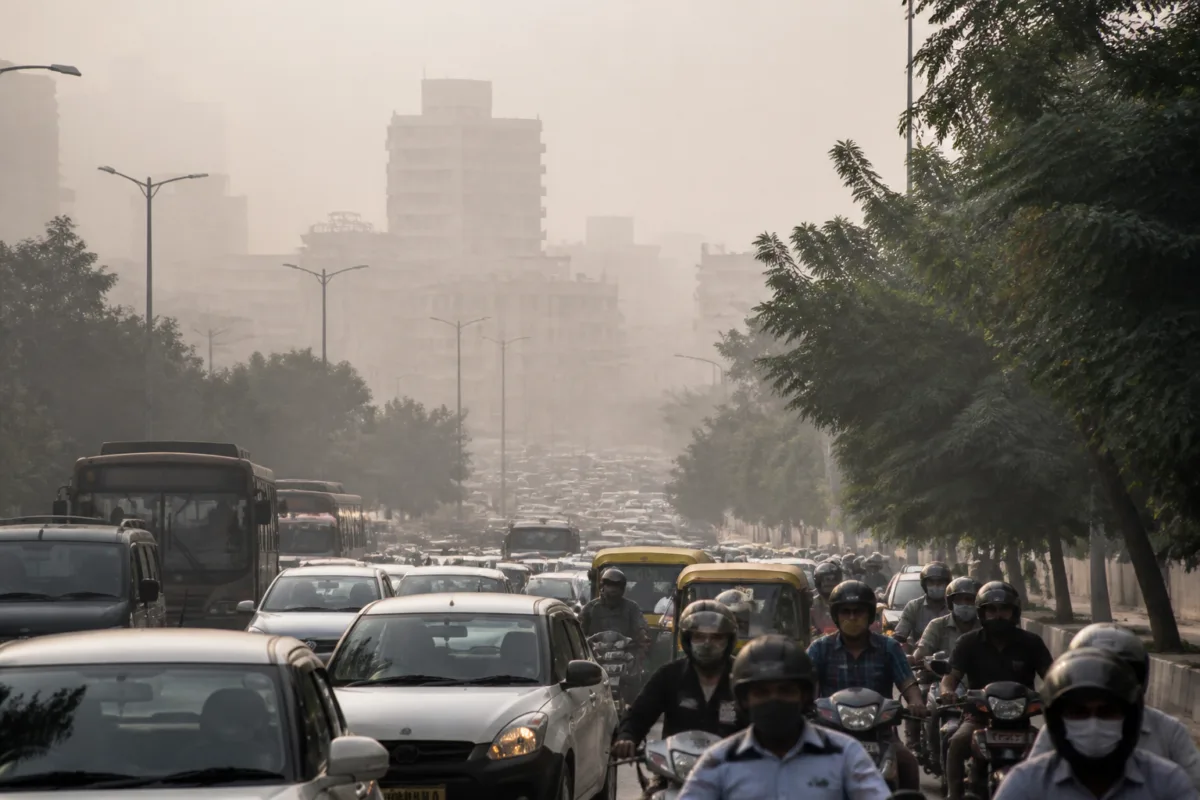
Delhi AQI readings rose from an average of 124 on 30 October to 464 at 11:31 am on 3 November, turning a short spell of post-rain relief into another severe pollution episode. The change over 96 hours is not only a story about deteriorating air; it shows how quickly the National Capital Region’s exposure can worsen when weather conditions stop dispersing emissions and pollution sources continue operating.
The supplied report attributes the rise to a combination of weaker winds, falling temperatures, stubble-burning smoke and local emissions. Its central lesson is that clean air after rain is often a temporary atmospheric condition, not evidence that the underlying sources of pollution have been resolved. Once the weather becomes dry and the air’s ability to disperse pollutants weakens, emissions from traffic, industries, construction, road dust and waste burning can accumulate again.
The numbers show the speed of the reversal. According to AQI.in data cited in the report, Delhi’s average AQI was 124 on 30 October, with a minimum of 45 and a maximum of 280. The average rose to 256 on 31 October, then to 369 on 1 November and 393 on 2 November. On 2 November, the maximum AQI reached 499. By 11:31 am on 3 November, the city’s AQI had reached 464.
These figures describe more than a gradual seasonal deterioration. They show a steep escalation within a narrow window, with the average reading increasing by 269 points between 30 October and 2 November. The maximum reading of 499 on 2 November also indicates that conditions were not uniform across the city. A citywide average can conceal sharper pollution peaks in particular locations, while a high maximum signals that some areas may have experienced substantially worse conditions than the average suggests.
The immediate explanation lies in the loss of the conditions that had briefly improved Delhi’s air. Rain and strong winds in the final days of October, influenced by a western disturbance and a weather system associated with Cyclone Arnab, helped reduce the concentration of some pollutants. Rain can bring particulate matter down from the atmosphere, while stronger winds can spread pollutants and reduce their local concentration.
That mechanism explains why rainfall can produce visible and measurable relief without changing the emissions system beneath it. The weather removes or disperses some pollution for a period, but vehicles continue to move, construction activity continues, industrial emissions continue and dust remains available to be lifted again. When the atmosphere dries, the same urban sources can begin rebuilding pollution concentrations.
This distinction is important for Delhi and the wider NCR because the airshed does not follow municipal boundaries. The report notes that the deterioration is visible not only in Delhi but also in other NCR cities. Pollution generated in one area can therefore become part of a regional exposure pattern, while weather conditions affecting the region can determine how much of that pollution remains near the ground.
The role of atmospheric ventilation is central to understanding the episode. Ventilation refers to the atmosphere’s ability to move and disperse pollutants. Under more favourable conditions, wind carries emissions away from their source and vertical movement allows pollutants to mix into a larger volume of air. When wind speeds fall and the height to which air can rise declines, pollutants remain trapped closer to the ground.
The report specifically points to weak winds during the night and morning as a factor that can worsen the situation. Emissions from vehicles, industries and other sources can accumulate when the air is relatively stagnant. This means that the same level of daily activity can produce a much worse measured outcome under unfavourable weather conditions. The pollution problem is therefore shaped not only by how much is emitted, but also by whether the atmosphere can carry those emissions away.
Falling temperatures can add to this difficulty by contributing to conditions in which pollutants remain concentrated near the surface. The supplied report links the recent rise to weaker winds and falling temperatures, but it does not provide a separate numerical assessment of the contribution made by each factor. What the evidence does establish is that the deterioration followed the end of the rain-related relief and coincided with less favourable dispersal conditions.
The regional contribution from crop-residue burning is another part of the explanation. Smoke from stubble burning in Punjab and Pakistan can move towards the NCR with the wind, according to the report. If such incidents continue in the coming days, the report says, they may affect air quality in Delhi and nearby cities. This is a regional transport issue: emissions generated outside the capital can become part of the air breathed inside it, depending on wind direction and atmospheric conditions.
At the same time, the report does not present regional smoke as the sole cause of the AQI rise. It places stubble-burning smoke alongside local sources, including vehicles, industries, construction activity, road dust and waste burning. That combination matters for governance because it means that a short-term spike can have multiple contributors operating across different jurisdictions and administrative departments.
The institutional response to such conditions depends partly on forecasting. The report says that the India Meteorological Department and the Indian Institute of Tropical Meteorology, under the Ministry of Earth Sciences, incorporate weather conditions such as atmospheric dispersion into their air-quality forecasts. This indicates that air-quality monitoring is not limited to measuring pollution after it has accumulated. Forecasting also attempts to assess whether the atmosphere is likely to disperse or retain emissions.
That forecasting function is particularly relevant when the AQI changes as rapidly as it did in this episode. A reading of 124 on 30 October did not guarantee sustained improvement. The rise to 256 the next day and 369 on 1 November showed how quickly conditions could reverse. For residents, the practical meaning is that a recent improvement in the AQI cannot be treated as a durable shift without considering the weather and emissions conditions that produced it.
The data also exposes the limits of treating Delhi’s pollution as a single-source problem. If rain and wind temporarily reduce pollution, but dry weather is followed by renewed accumulation from traffic, industry, construction, dust and waste burning, then the city’s air quality is being governed by the interaction of emissions and atmospheric capacity. Regional smoke can intensify the episode, but the local emissions listed in the report remain part of the same system.
This makes the 96-hour change a governance question as much as a weather story. Different sources are connected to different agencies, locations and enforcement responsibilities. Vehicles operate across municipal borders, construction sites are dispersed through the urban region, industrial emissions may originate outside Delhi, and crop-residue burning takes place in states and countries beyond the capital. The NCR’s air therefore reflects an administrative geography that is more fragmented than the atmosphere itself.
The supplied evidence does not establish the precise percentage contribution of local emissions, regional smoke or each individual pollution source during this episode. It also does not provide a forecast value beyond stating that haze may increase in the coming days. Those limits matter. The available figures establish the scale and speed of the AQI deterioration and identify the mechanisms involved, but they do not support a definitive ranking of causes for the 96-hour rise.
What is clear is that the rain-related improvement was temporary and that weaker atmospheric ventilation allowed emissions to accumulate again. The episode also shows why short-term air-quality relief can be misleading when it is driven primarily by weather. The underlying urban sources remain active unless they are separately controlled, and their effects become more visible when the atmosphere loses its ability to disperse them.
For Delhi and the NCR, the immediate issue is not only whether the AQI will rise or fall on a particular day. It is whether public agencies can interpret rapidly changing readings through the combined lens of weather, regional transport and local emissions. The next relevant developments are the continuation of crop-residue burning, the return of dry conditions, wind strength and the extent to which pollution from traffic, industry, construction, road dust and waste burning continues to accumulate near the ground.

