


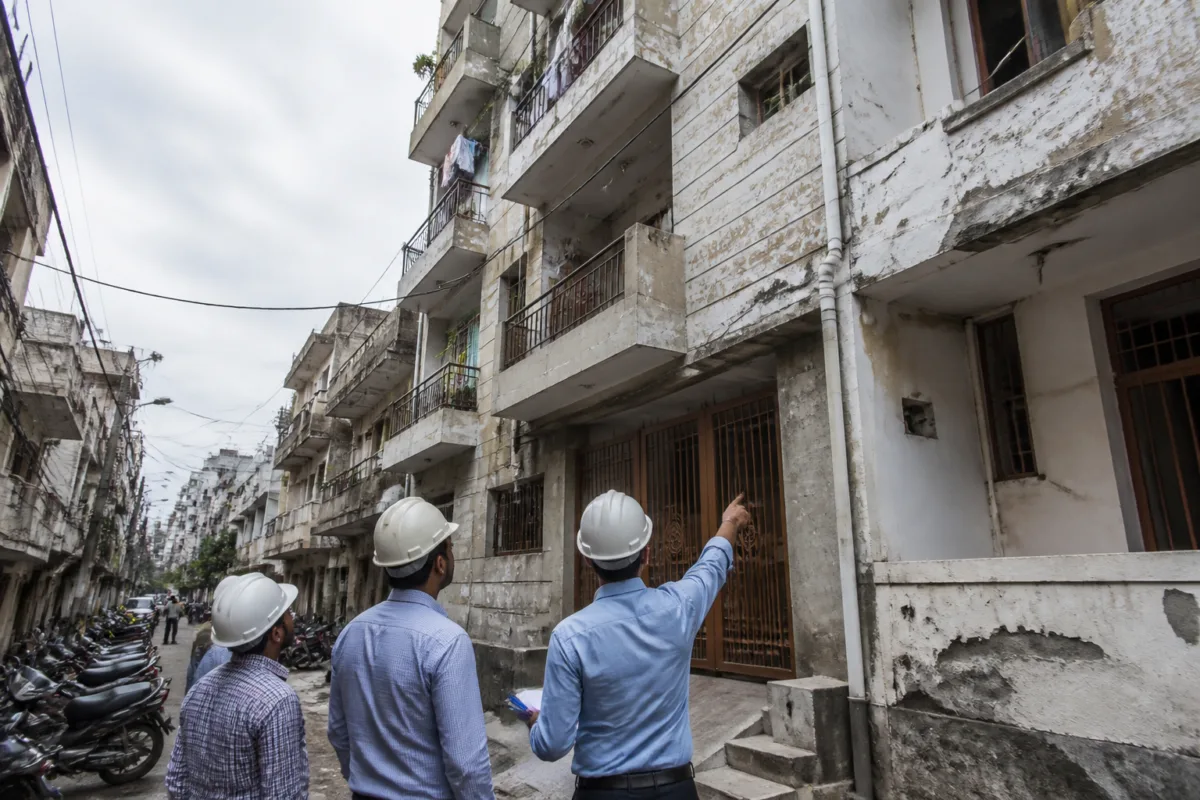
The Delhi PG safety drive has produced certificates from only around 250 of the 2,457 paying guest accommodations surveyed by the Municipal Corporation of Delhi, leaving the civic body with a large compliance gap as it prepares to escalate enforcement. The figures show that the challenge is not simply identifying buildings that may require inspection, but converting a court-directed safety exercise into verifiable action across a dispersed and lightly visible segment of urban housing.
The inspections began after the collapse of a paying guest accommodation in Satya Niketan in September, an incident that killed seven people and left six others critically injured. The Delhi High Court subsequently directed the MCD to inspect PG accommodations under its jurisdiction and examine their structural safety and compliance with building norms. The court’s intervention placed responsibility on the civic body to create a clearer safety record for a form of accommodation that operates across Delhi’s existing housing stock.
The MCD surveyed 2,457 PG establishments across its 12 zones and asked owners to obtain fresh structural safety audits. These audits are to be conducted by engineers empanelled with the civic body, with the resulting certificates submitted to the corporation. Officials have said that around 250 establishments have submitted certificates so far. That represents roughly one in ten surveyed properties, while more than 2,200 establishments have yet to complete the process or submit the required documentation.
The numbers matter because a survey is only the first layer of regulation. It can establish the scale of the sector and identify establishments operating within the corporation’s jurisdiction, but it does not by itself demonstrate that buildings are structurally safe. The certificate requirement is intended to produce technical evidence about stability, load-bearing capacity and defects that may not be visible during routine inspections. Until those assessments are completed, the MCD’s knowledge of the actual condition of the remaining properties remains limited.
This distinction is central to the Delhi PG safety exercise. A building may appear functional during a visual inspection while still requiring a technical assessment of its structural capacity. The MCD has said that the audits are meant to identify defects that may not be apparent through ordinary visual checks. The process therefore shifts the compliance question from whether a property is operating to whether its structure has been examined through an authorised technical procedure.
The institutional arrangement also reveals a limitation within the municipal system. According to officials, the MCD does not have an in-house mechanism to conduct these technical assessments. Instead, PG owners have been asked to engage structural engineers empanelled with the civic body. This creates a model in which the municipality defines the requirement and recognises the technical panel, while property owners arrange the audit and submit the certificate.
That model may allow the MCD to cover a large number of properties without building an internal structural-audit capacity. At the same time, it makes documentation and compliance dependent on owners taking the required step and submitting the evidence. The present response suggests that the first stage has not generated a complete record: 250 certificates have been received from 2,457 surveyed establishments, despite the safety exercise being linked to a fatal collapse and a High Court direction.
The proposed enforcement sequence is therefore important. Officials said the corporation would initially issue verbal reminders to PG owners who have not submitted certificates. Those who continue to fail to comply would receive formal notices, followed by further action, including sealing of premises, as permitted under the rules. The approach begins with an opportunity to comply before moving to punitive action.
This sequence also indicates that the MCD is treating non-submission as an administrative violation requiring escalation, rather than immediately treating every unverified property as structurally unsafe. The supplied report does not establish that all establishments without certificates are dangerous, nor does it establish that every property that submits a certificate is free from all risk. It does show that the corporation is using the certificate as the key instrument for establishing whether owners have completed the mandated technical review.
## Delhi PG safety and the limits of post-incident enforcement
The chronology points to a familiar pattern in urban safety administration: a serious incident triggers a wider inspection exercise, which then exposes gaps in the routine compliance system. The Satya Niketan collapse led to the High Court’s direction and the subsequent survey of 2,457 PG accommodations. The current status report indicates that the difficult part now lies in securing cooperation, collecting technical documents and deciding what action should follow when owners do not respond.
The case also raises a question about how paying guest accommodation is governed within the wider housing system. PG establishments are not a single new-build project or a defined infrastructure network. They are distributed across existing buildings and may be experienced by residents as ordinary rental housing, shared accommodation or a commercial use of residential premises. The MCD’s survey across 12 zones reflects the administrative challenge of locating and monitoring such establishments at city scale.
The report does not provide the number of occupants across the surveyed properties, the age or structural condition of the buildings, the number of establishments operating with other building-norm violations, or the reasons why most certificates remain outstanding. Those gaps are significant. The current figure establishes the scale of documentation received, but it does not yet explain whether the low response is caused by administrative delay, owner resistance, difficulty obtaining audits or other compliance barriers.
What is established is that the corporation has moved from identification to enforcement planning. Officials have described the compliance process as gaining pace, while also acknowledging that the initial response was slow. The shift from verbal reminders to formal notices and possible sealing will test whether the MCD can turn a court-directed exercise into a functioning enforcement mechanism.
The role of empanelled structural engineers will be another important part of that process. The MCD’s stated lack of an in-house mechanism means that technical scrutiny is being delivered through an external professional network recognised by the civic body. The quality, consistency and completeness of those audits are not assessed in the supplied report, but the certificates are intended to provide a technical basis for determining whether buildings meet the required safety expectations.
## What the numbers reveal about municipal capacity
The 250 certificates received so far are not merely a progress update. They are an indicator of the distance between regulatory intent and implementation. The MCD has surveyed 2,457 establishments, but only a small proportion have completed the documentation step identified by the corporation. The difference between the two figures represents the workload still facing municipal officials, engineers and property owners.
The 12-zone spread adds an administrative dimension to the problem. A citywide exercise must be coordinated across multiple municipal jurisdictions within the MCD, while each establishment may require separate owner engagement, audit scheduling, document submission and follow-up. The report does not identify variations between zones, so it is not possible to determine whether the shortfall is concentrated in particular areas or distributed across Delhi.
Nor does the certificate count by itself measure the success of the programme. A higher submission rate would demonstrate improved procedural compliance, but the public-safety objective also depends on what the audits find and what the MCD does with that information. The supplied facts establish the audit requirement and the intended enforcement pathway, not the results of the technical inspections.
That distinction matters for accountability. A complete list of surveyed premises is not the same as a complete list of structurally assessed premises. Similarly, a submitted certificate is evidence that an audit has been conducted, but the report does not state how many certificates record defects, require repairs or identify buildings needing further action. Those outcomes will determine whether the exercise functions as a safety intervention or primarily as a document-collection drive.
The immediate urban question is how Delhi manages safety in accommodation that exists within ordinary buildings but may carry a higher concentration of occupants. The Satya Niketan collapse made the consequences of structural failure clear, but the present exercise concerns the wider system that is supposed to identify risks before a collapse occurs. That system requires reliable surveys, technically credible assessments, responsive owners and municipal action when documents are not submitted or deficiencies are found.
For now, the evidence confirms a substantial gap between the number of PG establishments surveyed and the number that have submitted structural safety certificates. It also confirms that the MCD has a defined escalation plan and is operating under directions issued by the Delhi High Court. What remains unknown is the structural condition of the establishments still outside the certificate record, the reasons for the delayed compliance and the findings that will emerge from completed audits. The next milestones are the issue of reminders, formal notices and any sealing action against establishments that continue to fail to comply.

