


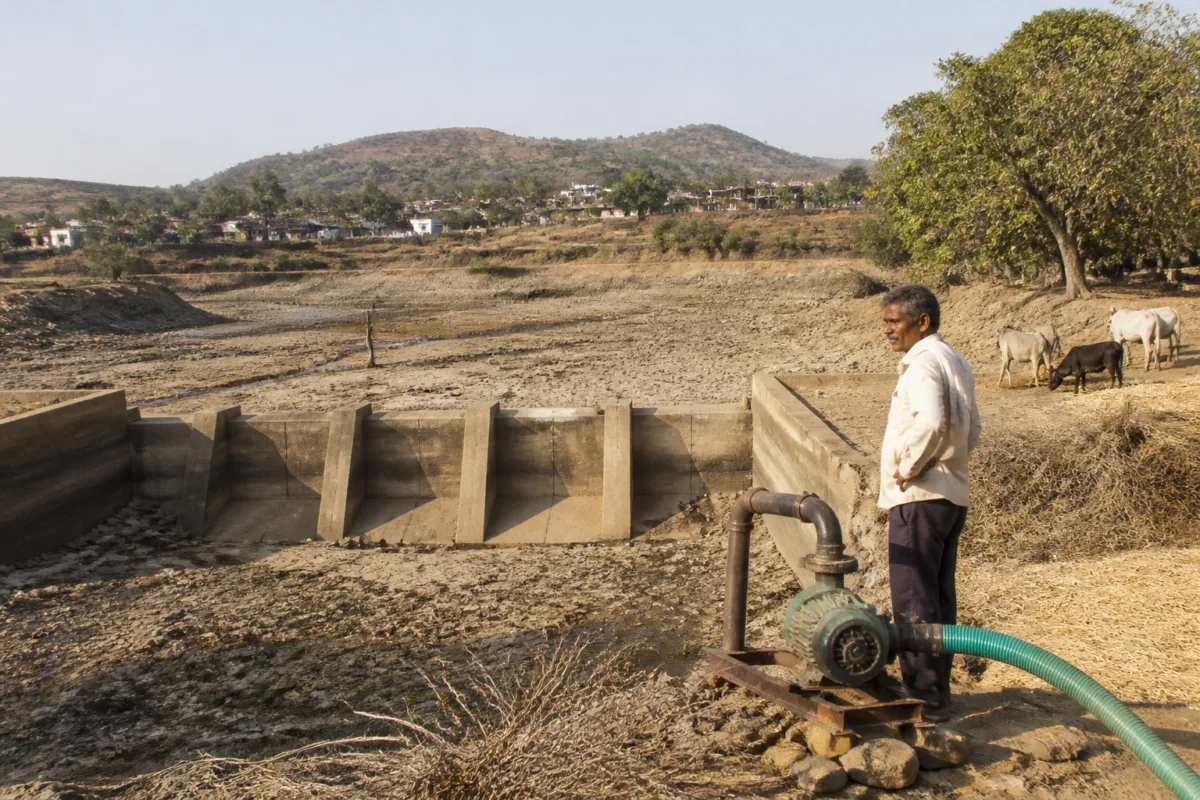
The Ambegaon water crisis is intensifying in the taluka’s eastern villages, where check dams on the Ghod river have reportedly dried up, halting farm pumps and threatening drinking water, livestock and fodder supplies. Local representatives are asking the administration to release water from Dimbhe dam into the river, but the report also exposes a wider administrative challenge: managing a shrinking chain of rural water sources before a farm and livestock emergency becomes a drinking-water crisis.
The immediate problem is concentrated around villages including Kathapur Budruk, Devgaon and Lakhangaon. According to a report by Sakal – Pune, the water stored in check dams along the Ghod river has been exhausted and parts of the riverbed are now dry. As a result, agricultural pumps have stopped working, crops are beginning to dry and fodder for cattle is becoming harder to secure.
The demands made by local representatives are not limited to the release of water. Satish Rode Patil, president of the Ambegaon Taluka Agricultural Produce Processing Association, has asked the administration to release water from Dimbhe dam so that the check dams can be refilled. Former panchayat samiti member Ravindra Karanjkhele has called for a survey of villages likely to face water scarcity and for advance planning of water supply arrangements.
These demands point to two linked but distinct stages of a water crisis. The first is the loss of water needed for cultivation and livestock. The second is the pressure that follows on household water sources when riverbeds and local storage structures no longer provide a dependable supply. The report says residents are already having to make alternative arrangements for drinking water, while the falling availability of water for animals is adding to the burden on farmers.
The Ghod river’s local check dams appear to be functioning as more than minor irrigation structures. In the villages named in the report, they are described as important points from which farm pumps draw water and around which local water availability is organised. Once these structures are empty, the impact moves through the rural economy: crops lose irrigation, fodder dries, livestock require separate water arrangements, and wells may come under additional pressure.
The report does not provide measurements of the check dams’ storage capacity, the present water levels in Dimbhe dam, the number of affected villages or the quantity of water required to refill the structures. It also does not establish whether the drying has resulted from reduced rainfall, upstream withdrawals, seasonal demand, reservoir operations or a combination of factors. Those gaps matter because releasing water from a reservoir is an administrative and resource-allocation decision, not simply a local response to an empty riverbed.
What is clear from the available account is that the crisis is being experienced at several levels. Farmers are losing access to water for standing crops. Livestock owners are facing difficulty securing drinking water for animals. Fodder availability is declining. Households may have to search for alternative drinking-water sources. The report also records concern that groundwater levels in wells could be affected as the riverbed remains dry and demand shifts to other available sources.
Ankita Walunj, a panchayat samiti member, said the shortage of fodder and animal drinking water had become a major challenge for farmers. Her statement places livestock at the centre of the crisis rather than treating the problem only as an irrigation shortfall. In rural areas, livestock can represent household income, food security and productive capacity. A shortage of water and fodder therefore creates pressure that extends beyond the immediate cost of obtaining water.
The administrative response requested by local representatives has three components. The first is an on-ground inspection of the affected eastern part of Ambegaon. The second is coordination by the water resources department on whether water can be released from Dimbhe dam into the Ghod river. The third is a survey of potentially water-scarce villages, followed by planning for drinking water. Together, these requests suggest that local actors are seeking both an emergency intervention and a system for identifying the next locations at risk.
The sequence is important. If authorities respond only after household drinking-water sources fail, the intervention is likely to become more expensive and more difficult. Water tankers or other emergency arrangements may then be needed, while farmers and livestock owners would already be competing for limited supplies. The source report does not state whether such arrangements have been sanctioned or deployed, so the status of any government response remains unclear.
The Dimbhe dam demand also raises the question of how water is prioritised across connected locations. A release into the Ghod river could help replenish local check dams, but the available report does not state the volume sought, the operational feasibility of such a release, the reservoir’s current storage or the interests of other users dependent on the same water system. These facts would be necessary to assess the proposal’s likely reach and duration. They are not supplied in the report and cannot be assumed.
The story’s deeper significance lies in the dependence of villages on linked layers of water infrastructure: a dam, a river channel, check dams, farm pumps, wells and household supply arrangements. Each layer has a different function, but failure at one point increases pressure on the others. When check dams empty, farms draw less water from the river, households seek alternatives and wells may become the next line of defence. This is why a local storage failure can quickly become a wider administrative problem.
The report also shows the limitations of treating water scarcity only as a question of supply. The requests from local representatives include physical water release, but they also call for inspection, village-level surveys and planned supply. Those demands reflect the need for timely information: which villages are affected, which sources remain usable, how much water is needed for people and animals, and whether the situation is worsening. Without that information, interventions risk being reactive and uneven.
At present, the evidence confirms a serious local shortage but does not establish the full geographic or numerical scale of the crisis. The named villages are Kathapur Budruk, Devgaon and Lakhangaon, while the report refers more broadly to Ambegaon’s eastern region. It records dry check dams, a dry riverbed, halted agricultural pumps, drying crops and fodder, and concern over drinking-water and well levels. It does not provide official measurements, a government assessment, a timeline for water release or a confirmed list of affected households.
That distinction is important for public accountability. A request to release water from Dimbhe dam is a clearly documented demand made by local representatives. It is not the same as a confirmed government decision. Similarly, the possibility of a worsening drought-like situation is reported as a concern expressed by farmers, not as an official classification of the area. Any response should therefore be tracked against specific milestones: an administrative inspection, the water resources department’s decision, a village survey and the creation of drinking-water arrangements.
The Ambegaon water crisis ultimately illustrates how rural water security depends on coordination across departments and scales of administration. The immediate issue is the empty Ghod river and its check dams. The institutional issue is whether reservoir operations, local water-supply planning and village-level assessments can be aligned before the shortage reaches households and livestock in a more severe form. The available report establishes the urgency of that question, while the actual scale of intervention and the administration’s next steps remain to be documented.

