


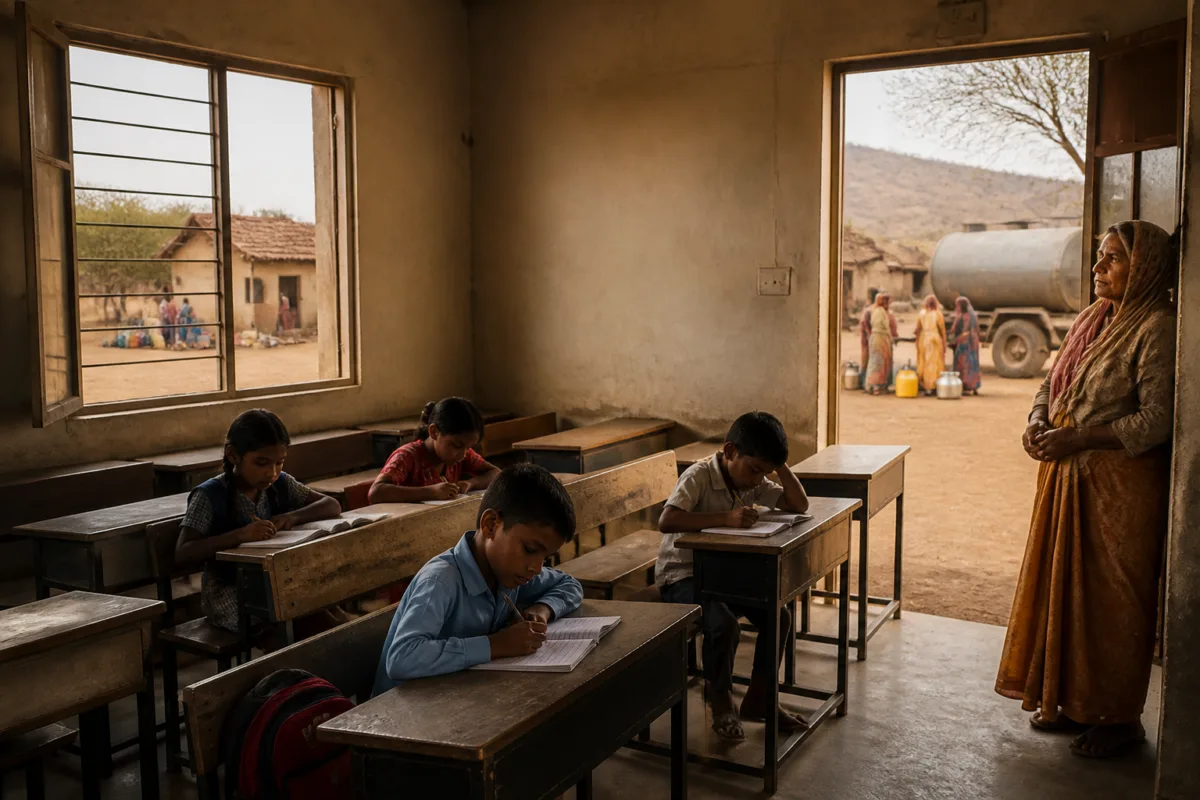
The drought in Maharashtra is not merely pushing sugarcane workers out of villages earlier than usual; it is altering the entire migration cycle that connects Beed’s rural households to farms, construction sites and cities. In Damu Naik Tanda, a primary-school classroom has become a visible measure of that disruption: 11 of 20 children have migrated with their parents or been left behind with elderly relatives, even before the Diwali vacation.
The change is significant because seasonal migration has traditionally followed a relatively predictable calendar. Farm labourers generally leave after Diwali, once local agricultural work has run out, and return after the cane-cutting season. This year, however, the report says that drought and poor crop yields forced many workers to leave in August. Some travelled as far as Tamil Nadu, where the sugarcane crop matured earlier, before they are expected to move again to Karnataka or western Maharashtra.
That double migration reveals how climate stress is reshaping labour mobility. Workers are not simply moving from one village to one destination for a fixed period. They are following the availability of work across several states, with the timing determined by crop conditions and contractor arrangements. For families already dependent on irregular agricultural employment, the result is a longer period away from home and greater uncertainty about schooling, care and income.
The scale described in the report is substantial. Maharashtra has around 15 lakh seasonal sugarcane cutters, of whom approximately 10 lakh are from Beed district, according to the figures cited. Beed is part of Marathwada, where all 76 talukas are reported to be drought-hit. The report also cites a sugarcane cutters’ union representative who said migration to Tamil Nadu had risen by around 30% this year, with workers who had not previously done cane-cutting also entering the trade.
These figures place the classroom at Damu Naik Tanda within a wider labour and infrastructure system. The empty seats are not only an education problem. They are evidence of how a rural economy with insufficient local work transfers the responsibility for survival to mobile labour markets. When crops fail, the village loses workers, children lose regular family support, schools lose attendance and elderly relatives take on additional caregiving responsibilities.
For children who travel with their parents, migration interrupts education directly. For those who remain behind, the disruption takes a different form. Eight-year-old Ashwini Chavan lives with her blind grandmother and is responsible for filling five pots of drinking water from the tanker that arrives in the village each day. She also helps with household work and completes her schoolwork without being asked.
Her experience shows that staying in the village does not mean remaining outside the effects of migration. Children left behind may continue attending school, but their daily lives can include water collection, domestic work and care responsibilities that would otherwise be shared by adults. In Ashwini’s case, the absence of her parents coincides with a basic services burden: ensuring that the household has enough drinking water.
The report does not provide a broader attendance dataset or establish how many children across Beed have left school. But the classroom described by teacher Mahesh Phulzalke offers a direct local indicator of the impact. He said children had lost weight, become quieter and, in some cases, lacked notebooks and pencils because families had little money. His role has expanded beyond teaching: migrant parents call his phone to speak to their children and to check whether they attended school.
That informal role is important because it exposes a gap between the administrative idea of seasonal migration and the practical needs of families. A child may remain enrolled in a village school while spending months away with parents, or remain in the village while the household is separated. In both situations, continuity depends on personal arrangements rather than on a clearly described support system in the supplied report.
The economic pressure behind the movement is equally clear. Navnath Chavan, a migrant worker from Damu Naik Tanda, said soybean and cotton had produced little yield and that there was no work for farm-hands. He had also taken a Rs 3 lakh advance from a labour contractor the previous year and had to work it off. The advance is therefore not simply an income payment; it shapes where the worker travels and which work he must accept.
Chavan said he had to go where the contractor directed him and found Tamil Nadu difficult because he did not know the language. This points to the uneven bargaining power within seasonal labour migration. A worker may technically move across state borders in search of work, but the destination, timing and duration can be constrained by debt-like advances and the contractor’s requirements.
The movement also reflects a mismatch between agricultural calendars. The cane-cutting season in Maharashtra usually lasts five to six months, from October to March or April. This year, the report says, poor yields are expected to bring the season to an end by December. Workers who leave early for Tamil Nadu may therefore have to migrate again within the same cycle, rather than completing one longer period of work closer to home.
A shorter local season combined with an earlier departure creates several pressures at once. Families spend more time in transit or away from their village. Children face either interrupted schooling or separation from parents. Workers must find employment across multiple locations. And the period between one agricultural season and the next becomes longer, increasing the possibility that migrants will move into construction work in Mumbai, Pune or Gujarat.
This is where the story connects rural distress to urban labour markets. The report says farm labourers may turn to construction work after the cane is cut because there will be no agricultural employment until the next kharif season. Cities may therefore receive workers not because of a planned transition into urban employment, but because drought and crop failure have exhausted rural options.
The consequences of that movement are not described in the report through city-level housing, wage or service data. It does, however, establish the chain that produces it: failed crops reduce village employment; labourers accept migration advances; contractors direct them to distant farms; cane work ends early; and workers may then seek construction jobs in larger cities. The urban economy becomes the next link in a cycle that begins with water and agricultural stress in Marathwada.
This also complicates the way seasonal migration is understood. The village is often treated as the place of origin and the city as the destination, but the workers’ experience is more fluid. Tamil Nadu, Karnataka, western Maharashtra, Mumbai, Pune and Gujarat form parts of an employment geography connected by crop cycles, contractor networks and the absence of stable local work. The same household may depend on several regions without securing long-term stability in any of them.
The report provides no detailed account of government relief, school transport, migrant registration, labour inspections or portable welfare arrangements. It therefore cannot establish whether existing public systems are reaching these households. What it does show is that the burden of managing the disruption has fallen heavily on families, relatives, teachers and workers themselves. The teacher’s phone becomes a communication channel; the grandmother becomes a caregiver; the child becomes responsible for water; and the labourer follows work across state borders.
The institutional question is consequently larger than whether children attend school on a particular day. It is whether public systems recognise a family that is divided between locations, seasons and forms of work. A village school may continue to function while many pupils are away. A migrant child may travel with parents without receiving uninterrupted education. A child left behind may attend classes but carry household responsibilities that affect health and learning. These are different forms of the same mobility problem.
The evidence also shows why the timing of drought matters. A drought that forces migration in August, rather than after Diwali, removes several months of family contact and local schooling before the normal seasonal cycle has even begun. The early departure therefore magnifies the social impact of the same economic strategy. Families are still migrating for work, but the migration begins sooner, lasts across more locations and may end without a clear return to agricultural employment.
For Beed, the immediate story is about sugarcane cutters leaving early. The deeper story is about the weakening of a predictable rural livelihood pattern. When farm work becomes insufficient, mobility acts as a safety valve, but it also transfers costs to children, schools, caregivers and cities. The system keeps households earning, yet it does so through separation, repeated movement and dependence on distant employers.
What remains to be established is how many children are affected across the district, whether schools have formal arrangements for migrant students, how labour advances are regulated and what support is available between the end of cane cutting and the next kharif season. Those questions will determine whether this year’s early migration is a temporary response to drought or a sign of a more permanent change in the way Marathwada’s workforce connects to India’s farms and cities.

