


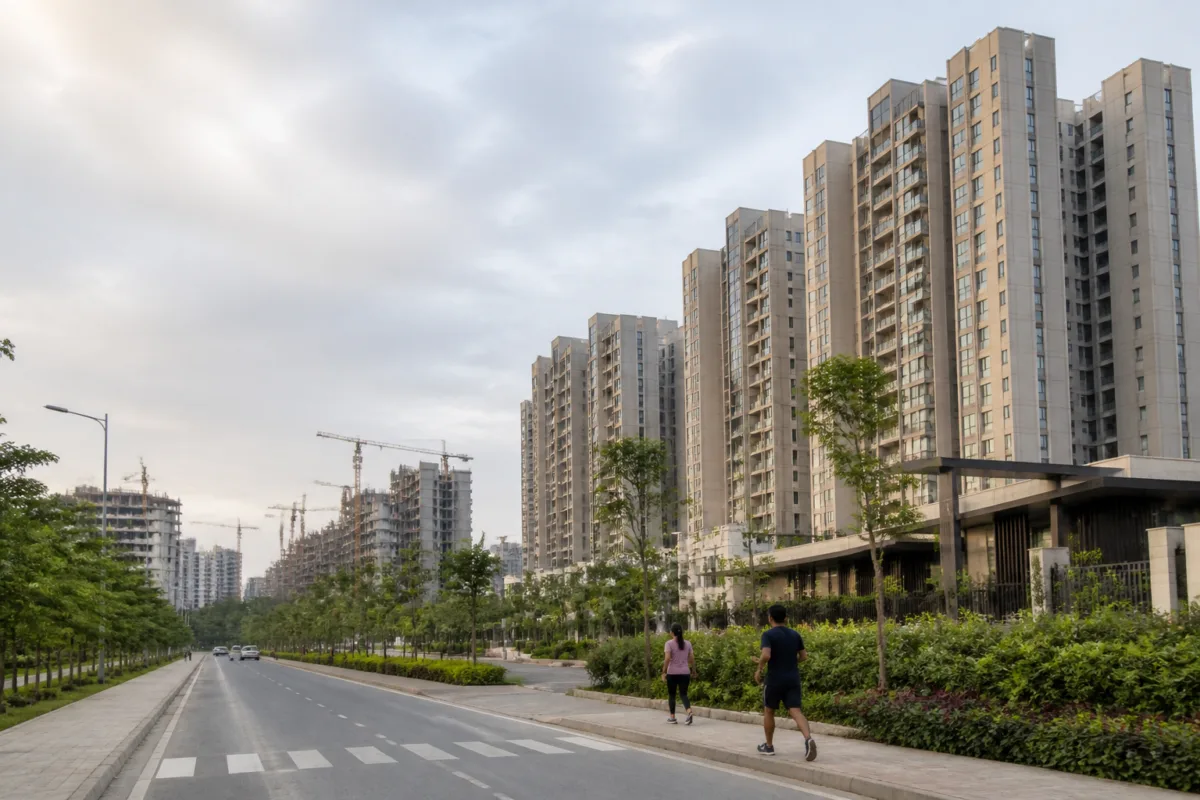
Lodha Developers’ latest results show a premium housing market that remains resilient even as developers confront higher interest rates, geopolitical uncertainty and questions about how artificial intelligence could alter demand. The Mumbai-based company reported a 10% year-on-year rise in sales bookings to Rs 5,037 crore in the September quarter, while its first-half pre-sales increased 7% to Rs 9,670 crore.
The numbers matter beyond one developer’s balance sheet. They indicate that demand for branded, quality housing remains strong in the segments served by Lodha, even as the company expands beyond its established markets and prepares a first pilot project in Delhi-NCR. At the same time, the company’s own commentary shows that the next phase of real estate growth will be shaped not only by household demand, but also by external economic conditions and changing expectations around technology and employment.
Lodha has set a sales bookings target of Rs 24,000 crore for the current financial year, compared with Rs 20,530 crore in FY26. Its September-quarter performance also included a 28% year-on-year increase in consolidated net profit to Rs 1,013.5 crore. Total income rose to Rs 4,584.9 crore from Rs 3,878.9 crore in the year-ago period, while the reported profit after tax margin stood at 22.1%.
The company’s managing director, Abhishek Lodha, said the business had sustained its operating and financial momentum since its initial public offering in 2021. Based on the first-half performance, he said Lodha expects to exceed its profit guidance for the year. The company’s first-half net profit was also described in the supplied report as having increased 63%.
These results point to a housing market where scale, brand and project execution continue to influence buyer decisions. Lodha attributed the response to its latest Bengaluru project to robust underlying demand for a quality brand. That assessment is particularly relevant as the developer enters new markets: the company is attempting to carry the brand and operating model developed in the Mumbai Metropolitan Region and Pune into Bengaluru and Delhi-NCR.
The geographical expansion is not simply a question of adding projects. It requires a developer to understand different land markets, local approval systems, transport connections, employment clusters and buyer preferences. The supplied report does not provide details of the land parcels, project sizes, pricing or approval status for the proposed Delhi-NCR pilot. What it does establish is that the launch is planned for the festive season and that it represents a step beyond Lodha’s traditional market concentration.
Bengaluru has become an important test for that expansion. The company recorded a positive response to another project launch in North Bengaluru during the September quarter. The report does not provide the project’s sales value or absorption rate, but Lodha linked the response to continuing demand for quality homes. This creates a useful distinction in reading the results: the company’s performance reflects reported bookings and profits, while the broader strength of the market still depends on how consistently such demand is sustained across locations and price segments.
The company’s comments also place premium housing within a wider debate about artificial intelligence. Lodha said the response to its Bengaluru launch helped address concerns about AI-led disruption affecting segments beyond affordable housing. The statement does not establish that AI has already reduced housing demand or changed employment patterns in the markets where Lodha operates. Instead, it shows that the company is monitoring the possibility that technological change could eventually affect household income, job security or purchasing decisions.
That concern introduces a structural question for urban real estate. Housing demand is often discussed through interest rates, income growth and population expansion, but the location and stability of employment are equally important. Large urban housing markets depend on the concentration of jobs and services that support a buyer’s ability to purchase or finance a home. If technology changes the distribution of employment across sectors, developers may need to reassess which urban corridors, buyer groups and housing formats can sustain demand. The supplied results do not quantify this risk, but the company’s own remarks confirm that it has entered its strategic assessment.
Interest rates represent a more immediate economic variable. Lodha said the recent rise in interest rates in India was unlikely to have a direct impact on housing demand in the segments it serves. The company remains watchful of second-order effects from changing economic conditions. This distinction is important. A rate increase may not immediately deter buyers of higher-value homes, but broader effects on business activity, employment, financing costs and household confidence can influence the market indirectly.
The company is also monitoring the continuing conflict in the Middle East and its geopolitical and macroeconomic implications. No direct impact on Lodha’s sales is established in the supplied material. The concern is instead about transmission through the wider economy. International conflict can affect economic conditions, but the report does not specify the channels, magnitude or timing of any impact on Indian housing demand. Lodha’s position is therefore one of watchfulness rather than a reported change in its sales strategy.
This caution sits alongside an ambitious growth plan. Lodha’s target of Rs 24,000 crore in annual sales bookings is around Rs 3,470 crore higher than the Rs 20,530 crore reported for FY26. The first-half figure of Rs 9,670 crore means the company has reported a substantial base for the year, but the supplied information does not provide a quarter-by-quarter booking schedule or the contribution expected from each geography. The target will therefore depend on launches, customer response and execution across the remaining period of the financial year.
The difference between pre-sales, revenue and profit is also relevant to understanding the company’s performance. Sales bookings represent customer commitments recorded by the developer, while total income and profit reflect the accounting performance reported for the quarter. Lodha’s September-quarter figures show improvement across all three indicators cited in the report: bookings rose 10%, total income increased from Rs 3,878.9 crore to Rs 4,584.9 crore, and net profit climbed 28% to Rs 1,013.5 crore. The figures should not be treated as interchangeable measures of housing demand, but together they show stronger reported operating performance.
For the city, the consequences of developer expansion are tied to where new housing is built and how it connects to existing infrastructure. The supplied report identifies North Bengaluru and a planned Delhi-NCR project, but it does not specify their transport access, civic infrastructure, density or relationship to employment centres. Those details will be important for assessing the urban impact of the expansion. A strong launch response can demonstrate market demand, but it does not by itself establish whether new housing is well integrated with mobility, utilities and public services.
Lodha’s results also illustrate how large developers are increasingly balancing residential growth with risk management. The company is pursuing new markets, maintaining a high sales target and expecting to exceed its profit guidance, while simultaneously tracking interest rates, geopolitical developments and AI-related disruption. That combination reflects the operating reality of urban real estate: demand can remain strong in the present while the business prepares for risks that may emerge through the wider economy.
The evidence currently confirms three developments. Lodha’s September-quarter sales bookings and profit increased, its first-half bookings grew, and the company is expanding its geographic footprint with Bengaluru activity and a planned Delhi-NCR pilot. What remains uncertain is the scale of demand in the new markets, the eventual impact of higher interest rates and global economic conditions, and whether AI will materially alter housing demand beyond the concerns identified by the company. The next significant markers will be the Delhi-NCR launch, the performance of the Bengaluru projects and Lodha’s ability to convert its first-half momentum into the full-year sales target.

