


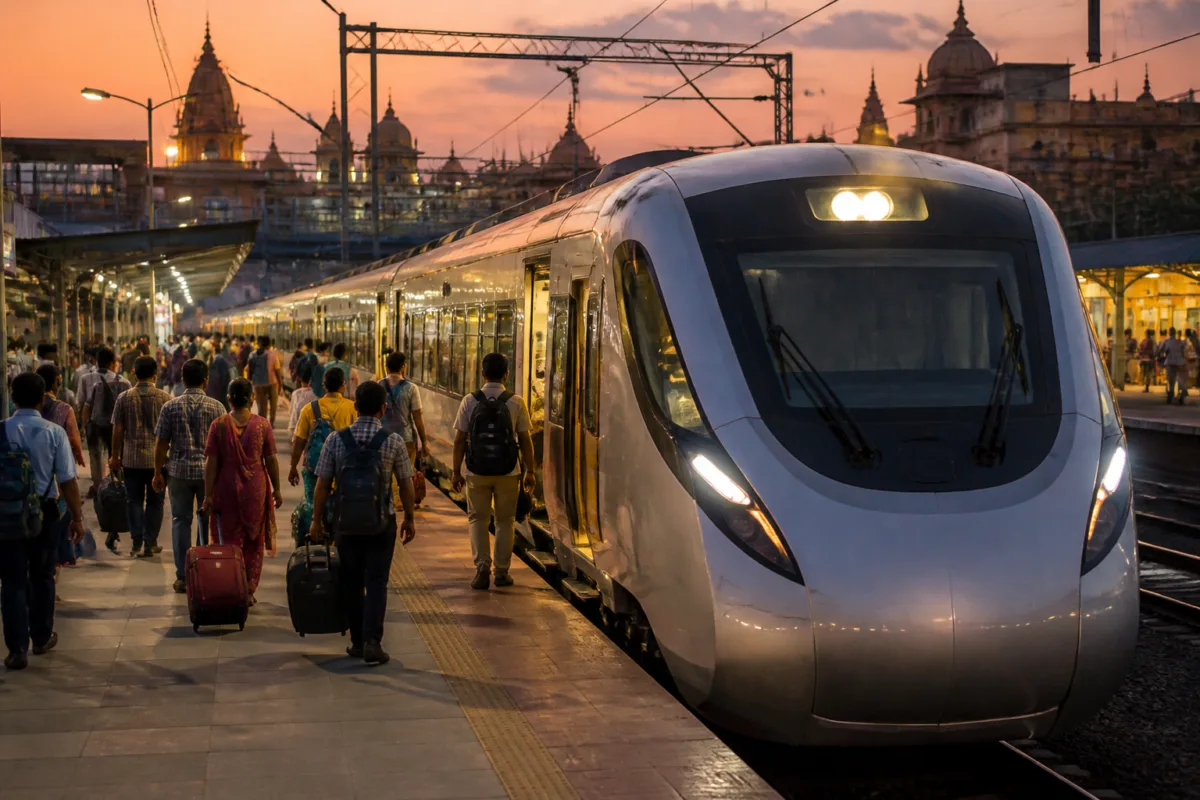
The new Vande Bharat Sleeper service between Varanasi and New Delhi began operations on Saturday, expanding Indian Railways’ overnight connectivity between the national capital and major urban and pilgrimage centres in Uttar Pradesh. The service runs through Prayagraj, Kanpur Central, Aligarh and Ghaziabad, and is intended to offer faster travel, modern onboard facilities and improved safety for passengers.
The train will operate six days a week. The Varanasi-originating service will not run on Fridays, while the New Delhi-originating service will remain unavailable on Saturdays. Its overnight schedule allows passengers to board in the evening and reach their destination the following morning, reducing the amount of daytime spent travelling between the two cities.
Prime Minister Narendra Modi welcomed the launch in a post on X, describing the service as a significant development for people travelling between Delhi and Kashi. He said the train would save time and improve the travel experience, adding that it had modern amenities and advanced safety systems. The Prime Minister also said the route would serve people travelling to Varanasi and Prayagraj for religious, tourism, educational and business purposes.
According to information shared for the service, the Varanasi-New Delhi journey is expected to be around 55 minutes shorter than the existing Shiv Ganga Express. In the reverse direction, the journey from New Delhi to Varanasi is expected to be approximately 35 minutes shorter. The route’s intermediate stops also connect the two termini with surrounding districts and the wider National Capital Region.
The sleeper train has an Austenitic stainless-steel car body and a crash-compliant design. Its engineering features include regenerative braking, an under-slung propulsion system, sealed flexible gangways, automatic sliding plug doors, noise insulation and LED lighting. Sensor-based intercommunication doors and integrated passenger information and communication systems are also provided.
Safety systems listed for the train include Kavach, the train collision avoidance system, along with fire detection systems, fire barrier doors and EN45545 HL3-grade fire safety compliance. CCTV cameras, disaster management lights and passenger emergency alarm systems are intended to support onboard monitoring and emergency response.
Passenger facilities include odour-free vacuum toilets, spacious luggage areas, three-pin charging sockets, Type-A and Type-C USB ports and passenger information systems. First AC passengers will have access to hot-water shower facilities. The train also includes Wi-Fi routers with access point networks, improved noise insulation and accessible facilities, including special berths and toilets for passengers with disabilities.
The Varanasi-New Delhi service follows the introduction of Vande Bharat Sleeper trains on the Howrah-Guwahati corridor and its return route in January 2026. The new service extends the sleeper network to another heavily travelled intercity corridor. Indian Railways’ next operational schedule for the service will continue to follow the six-day-a-week pattern, with separate non-operating days for the two directions.

