


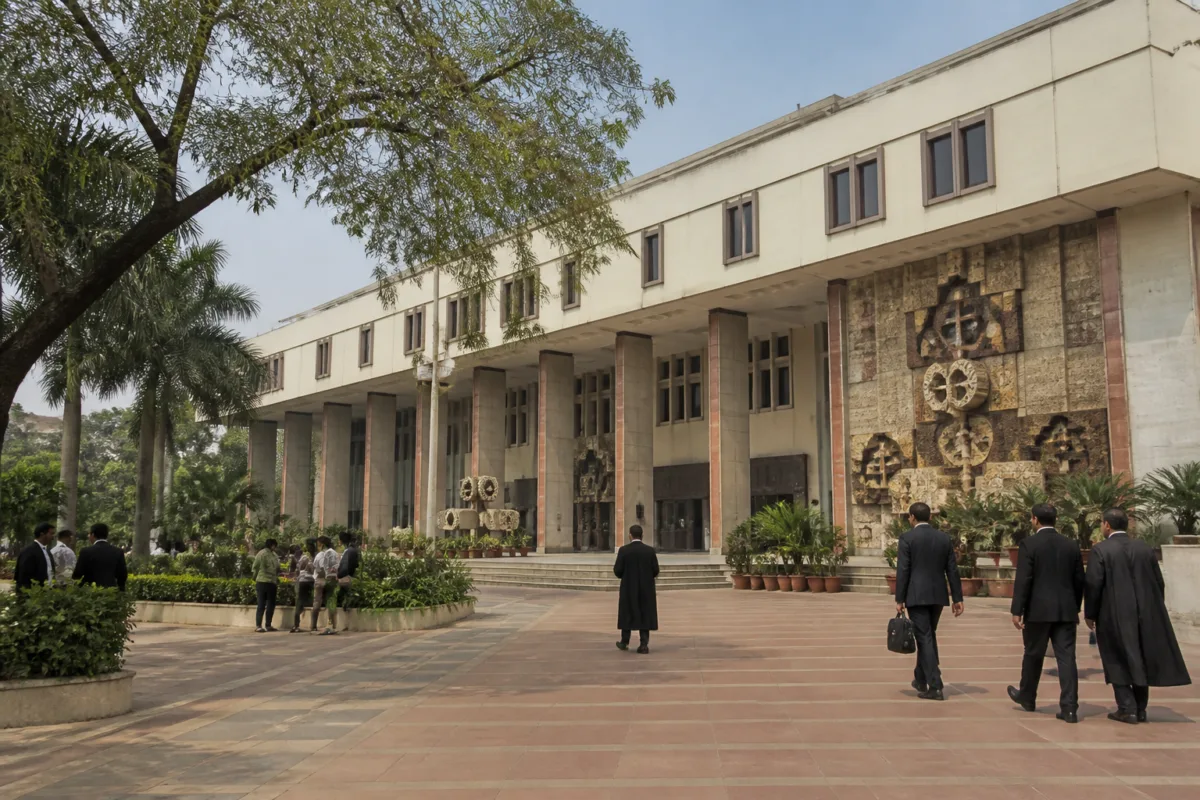
The Delhi High Court history is also a record of how a young national capital built the institutions needed to administer justice. Established on 31 October 1966 with four judges working from a government bungalow, the court moved through several temporary premises before acquiring its present home on Sher Shah Road. Its institutional expansion reflects changes in jurisdiction, administration and the physical infrastructure required by a growing public system.
The court’s formal creation was not the beginning of Delhi’s higher judicial history. Its roots go back to the High Court established in Lahore in 1919. Before Independence, Delhi fell within the jurisdiction of the Lahore High Court, a legal arrangement that continued until 1947. The geography of judicial administration therefore followed the political and administrative map of the period, rather than the boundaries of the national capital as they are understood today.
After 1947, the institutional arrangement changed again. In 1954, the Punjab government secretariat shifted to Chandigarh, and the High Court also moved there. Operating as the Punjab High Court, the institution continued to exercise jurisdiction over Delhi through a circuit bench at 15 Rajpur Road. This arrangement meant that Delhi had access to a higher court, but not yet a separate High Court created specifically for the capital.
That distinction matters because a court is not only a legal institution. It also requires a stable administrative base, courtrooms, chambers, records infrastructure and public access arrangements. The movement from a circuit bench to a separate High Court was therefore both a constitutional and a built-environment transition. Delhi’s judicial identity was being formalised through legislation and, subsequently, through a permanent institutional campus.
Parliament passed the Delhi High Court Act on 5 September 1966. The Delhi High Court came into existence less than two months later, on 31 October. It began with four judges, but without a building of its own. The first premises were a government bungalow on Maulana Azad Road, at the site where Vigyan Bhawan now stands. The choice of a government bungalow illustrates the practical way in which new public institutions often begin: administrative functions are established first, while permanent infrastructure follows later.
The court shifted after a few months to Travancore House on Kasturba Gandhi Marg. In 1967, it moved again to Patiala House, where it functioned for approximately nine years. The Patiala House premises later became the Patiala House Court complex. These successive moves show that the early challenge was not the absence of institutional authority. The High Court had been created through legislation. The challenge was providing a permanent physical setting suited to its expanding judicial and administrative responsibilities.
The shift towards a purpose-built home began with the foundation stone for the present building on Sher Shah Road. The foundation was laid on 4 November 1968 by then President Dr Zakir Hussain. The building was completed in 1976 and inaugurated on 25 September that year by then President Fakhruddin Ali Ahmed. The eight-year period between the laying of the foundation stone and the inauguration marks the long construction cycle associated with major public institutions, where planning, building and formal commissioning take place over several stages.
The building also carries a visible architectural and cultural identity. Murals created by the noted artist Satish Gujral are installed on the exterior of the main building. This detail places the court within a broader tradition of public architecture in which institutional buildings are expected to represent more than operational capacity. Their facades, public areas and artistic elements can also communicate permanence, authority and civic significance.
The Delhi High Court’s history therefore has two parallel timelines. The first is institutional: the movement from Lahore-based jurisdiction to a Punjab High Court circuit bench and then to a separate Delhi High Court. The second is spatial: the movement from a government bungalow to Travancore House, then Patiala House and finally a permanent building on Sher Shah Road. Neither timeline can be understood fully without the other.
## Delhi High Court history and changing jurisdiction
The court’s early jurisdiction extended beyond Delhi. When it was established in 1966, the Delhi High Court also exercised jurisdiction over Himachal Pradesh. A bench sat at the Ravenswood building in Shimla. This arrangement ended when Himachal Pradesh became a full state on 25 January 1971. The change demonstrates how the boundaries of a court’s work are shaped by wider changes in the constitutional and administrative organisation of territories.
For the Delhi High Court, the end of the Himachal Pradesh arrangement was an important institutional adjustment. It clarified the court’s territorial role while the permanent building on Sher Shah Road was still under construction. The court was therefore developing both its physical base and its jurisdictional identity during the same period.
The numbers also indicate the scale of institutional growth. From four judges at its beginning, the court now has 60 sanctioned posts: 45 permanent judges and 15 additional judges. The increase is not simply a staffing detail. It indicates that the court’s organisational requirements expanded substantially from the time when four judges worked out of a government bungalow.
The available account does not provide figures for the number of cases, courtrooms, staff or daily visitors across the decades. It therefore cannot establish how workload translated into space or how the building has been adapted over time. What it does establish is the broad relationship between institutional expansion and the creation of a permanent civic complex.
That relationship is relevant to the planning of public buildings. Temporary accommodation can allow a new institution to begin functioning quickly, but it does not automatically provide the spatial conditions required for long-term growth. A permanent building, by contrast, represents a decision to treat the institution as a continuing part of the city’s administrative structure. In Delhi’s case, the transition took place through multiple premises before the Sher Shah Road building was completed.
The story also shows why public infrastructure should not be understood only through roads, railways or utilities. Courts are part of the city’s institutional infrastructure. Their location and buildings affect how citizens, lawyers, judges, staff and government agencies interact with the justice system. The supplied account does not measure those user experiences, but the sequence of relocations makes clear that the court’s physical setting was central to its development.
## From temporary accommodation to civic permanence
The court’s early addresses map a particular history of Delhi’s public institutions. Maulana Azad Road, Kasturba Gandhi Marg, Patiala House and Sher Shah Road each represent a stage in the court’s spatial consolidation. The moves were not random changes of address. They formed a progression from borrowed or adapted premises to a building designed and commissioned as the court’s permanent home.
The present building’s history also connects judicial administration with national public symbolism. Its foundation stone was laid by the President, and its inauguration was also performed by the President. The involvement of the country’s head of state in both milestones indicates the significance attached to the creation of a permanent High Court building in the capital. The building was not treated as an ordinary office project, but as a public institution of national importance.
At the same time, the history cautions against viewing landmark buildings only through their appearance. The exterior murals by Satish Gujral are an important part of the building’s identity, but the larger story is the institutional capacity housed within it. The building became meaningful because it followed a legislative act, a new judicial jurisdiction and years of administrative movement.
The evidence supports a clear conclusion: Delhi High Court evolved through the interaction of law, territory and space. Its creation on 31 October 1966 gave Delhi a separate High Court. Its earlier links to Lahore and Punjab explain the institutional path that preceded that moment. Its temporary premises show how the court functioned before a dedicated building existed. Its later move to Sher Shah Road marked the physical consolidation of that legal and administrative identity.
What remains outside the supplied account is how the court’s building and facilities have changed since the 1976 inauguration, and whether current sanctioned strength has created new spatial pressures. Those questions would require additional records on courtroom capacity, staffing, case volumes, expansion works and facilities. The documented history, however, already establishes the central trajectory: Delhi’s High Court began in temporary accommodation, expanded its jurisdiction and staffing, and eventually acquired a permanent building that made its institutional presence visible in the capital.

