


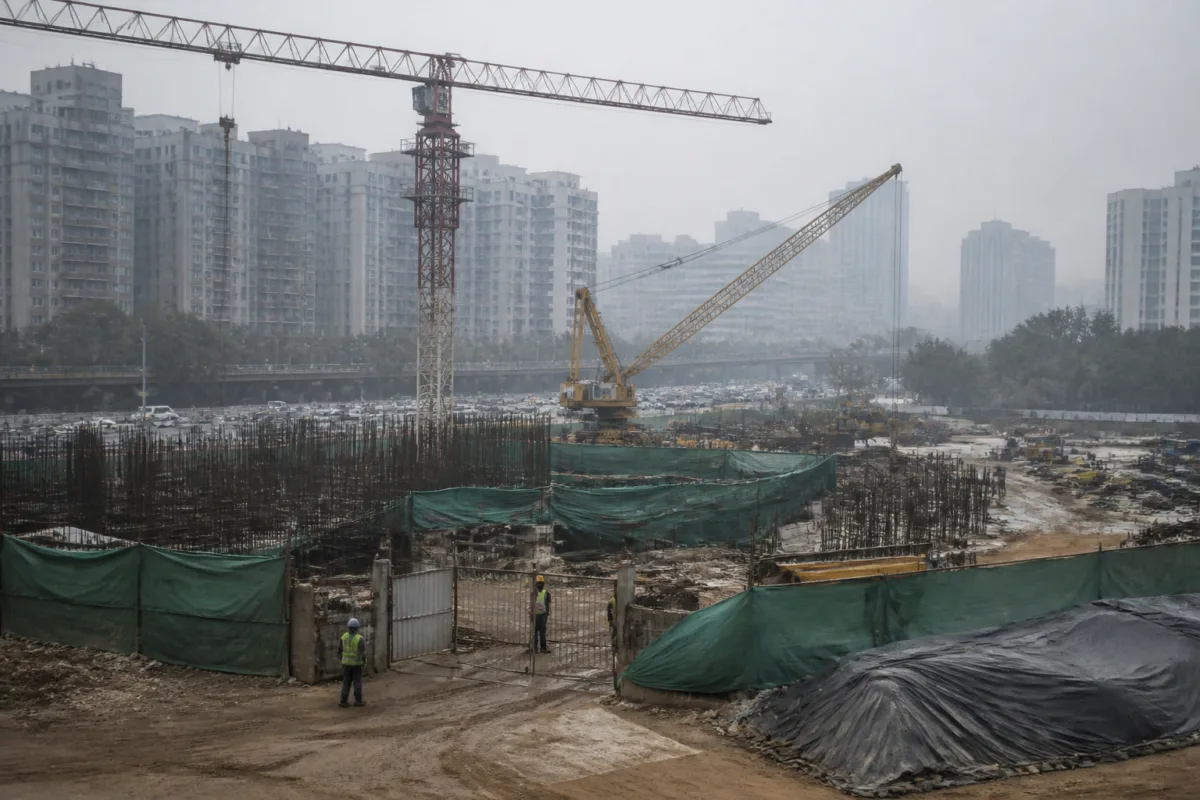
The Delhi-NCR construction ban will run from November 5 to 20, covering construction and demolition activity across the entire national capital region as the Centre intensifies measures to control winter pollution. Union environment minister Bhupender Yadav also ruled out any rollback of Delhi’s restrictions on non-Delhi BS-IV and older vehicles entering the city.
Yadav announced the measures during a visit to the Commission for Air Quality Management’s newly developed PAVAN Integrated Command and Control Centre in Delhi. He said non-conforming industries, polluting sources and traffic congestion hotspots would face swift action through the monitoring platform.
The announcement comes ahead of the implementation of Delhi’s permanent winter anti-pollution framework from November 1. The framework brings several seasonal measures under a single set of rules applicable every year between November 1 and February 28.
The measures include restrictions on the entry of non-Delhi vehicles below BS-VI standards, mandatory valid pollution-under-control certificates for fuel purchases, 50% work-from-home for office staff and curbs on dust-generating construction activity. Parking charges at authorised sites will also double during the winter period.
Under the framework, a ban on construction and demolition activities that generate dust is scheduled to apply from November 1 to January 31. Most construction work will be halted completely between December 10 and January 20, with exceptions for essential public infrastructure and emergency projects. Vehicles carrying construction material will also be prohibited from entering Delhi during this peak period.
The new NCR-wide shutdown adds another layer to restrictions imposed under the Graded Response Action Plan. Under the revised GRAP order, construction and demolition activity is banned during Stage III, when the air quality index is between 401 and 450, although linear public projects are exempted at that stage. Under Stage IV, triggered when the AQI exceeds 450, the ban extends to linear public projects including highways, roads, flyovers, overbridges, power transmission, pipelines and telecommunications works.
The Centre’s latest order follows repeated construction restrictions last winter under different GRAP stages. The most recent ban cited in the report was imposed between January 16 and 22, 2026. Violations under the GRAP order can attract environmental compensation in accordance with National Green Tribunal guidelines.
The enforcement system is expected to rely on PAVAN-I3C, which operates on a “Detect, Analyse, Act” model. The platform combines air-quality, emissions, weather, satellite imagery, traffic, public complaints and compliance data to help agencies identify violations and respond in real time.
According to the environment ministry, PAVAN-I3C draws information from 111 continuous ambient air-quality monitoring stations across Delhi-NCR, more than 2,300 industries and over 3,200 active construction sites. Yadav said the platform represented a shift from reacting to pollution to anticipating it, while the November 5-20 ban will require coordinated enforcement across the NCR states.

