


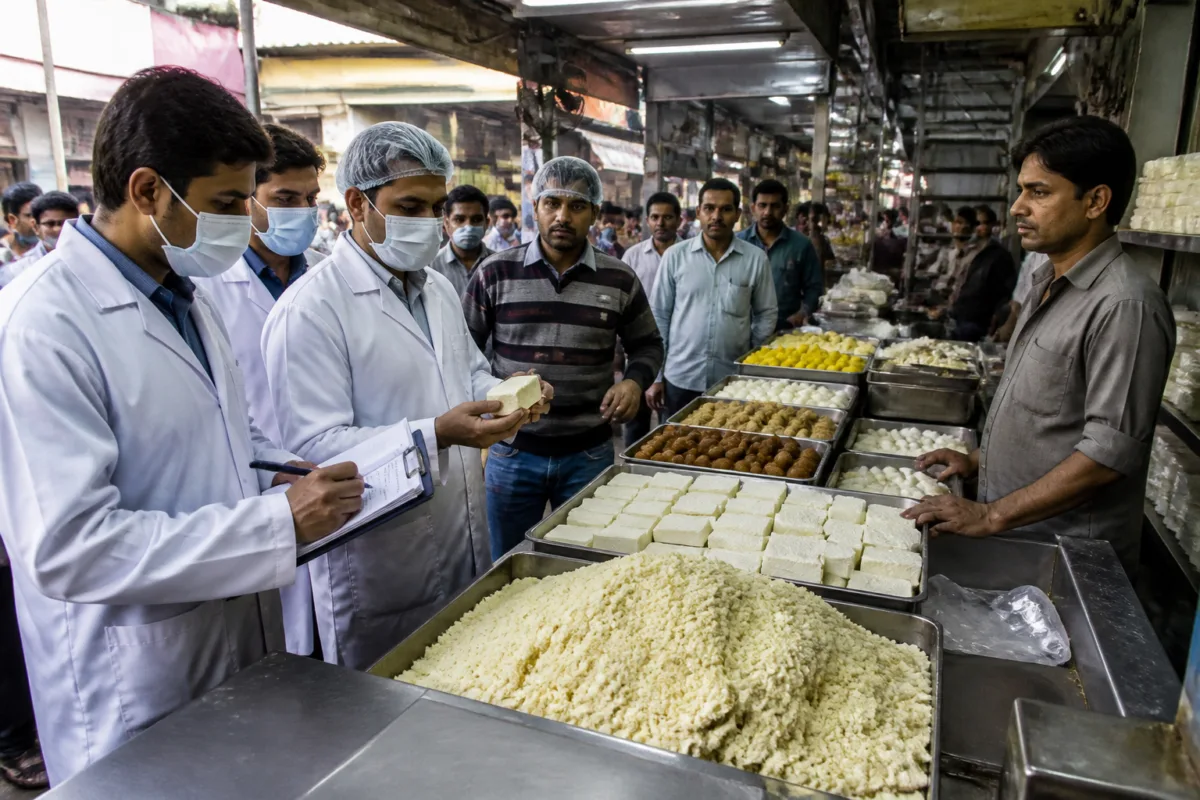
Delhi food safety drives that led to the destruction of more than 4,000 kg of khoya, paneer, sweets and other food products offer a limited but important view of how the capital’s food markets are monitored during periods of high demand. The enforcement campaign, conducted over two months by the Delhi Food Safety Department, involved 30 actions and 290 tested samples, of which 85 were found unsafe or below prescribed standards, according to a department statement reported by Millennium Post.
The figures do not establish the overall condition of Delhi’s dairy and sweets market. They do, however, show the scale of enforcement activity in selected locations and the proportion of tested samples that failed to meet the prescribed requirements. Nearly three in ten of the samples tested were classified as unsafe or below standards. That result is significant not because it can be treated as a citywide estimate, but because it shows how inspection outcomes can change when authorities concentrate on products and markets considered vulnerable.
The department intensified inspections and sampling during Navratri and the festive season, when demand for dairy products, sweets and related food items rises, the report said. The campaign focused on ghee, paneer, khoya and sweets. These products are widely associated with seasonal consumption, but the supplied report does not provide a breakdown of the 290 samples by product, location, manufacturer or type of violation. It also does not state how much of the destroyed material came from each category.
That absence of a detailed breakdown is central to understanding what the enforcement numbers mean. The destruction of more than 4,000 kg indicates that authorities removed a substantial quantity of food products from circulation. The 85 failed samples indicate that a measurable share of the tested material did not meet the prescribed standards. But the two figures cannot be directly combined into a failure rate for the entire quantity destroyed. The report does not say whether all destroyed products were linked to the 85 failed samples, whether some were seized for other reasons, or whether the destroyed material included products that had not yet undergone laboratory testing.
The distinction matters for public accountability. Enforcement data can describe the activity of an agency, but it does not automatically describe the full condition of a market. In this case, the Delhi Food Safety Department has disclosed the number of actions, samples and failed samples, along with the total quantity destroyed. It has not, in the material supplied, identified the precise violations, the businesses involved, the laboratory process, or the final legal or administrative action taken against sellers and manufacturers.
The locations named in the report provide another indication of the department’s enforcement strategy. Repeated inspections were carried out in vulnerable areas and wholesale markets, including Mori Gate Khoya Mandi, Okhla and Janakpuri. The inclusion of a specialised market such as Mori Gate Khoya Mandi alongside broader localities such as Okhla and Janakpuri suggests that the campaign covered both concentrated trade locations and neighbourhood-level markets. The supplied report does not explain how these areas were selected or whether they represent the department’s highest-risk locations across Delhi.
That question is important because food safety in a large city depends on more than isolated inspections. Dairy products and sweets move through a chain that can include production, wholesale distribution, retail sale and final consumption. The report identifies enforcement at selected markets and areas, but it does not map the movement of products between them. Without that information, readers cannot determine whether the campaign disrupted a particular supply chain, removed individual batches, or operated mainly through localised inspections.
The department’s decision to intensify sampling during the festive period also shows the role of timing in municipal and regulatory enforcement. Authorities responded to a period when demand for ghee, paneer, khoya, sweets and other food items was described as higher. This means the campaign was not presented as a routine account of all-year enforcement. It was a targeted intervention linked to a period of increased market activity. The report does not provide comparable figures for an earlier non-festive period, so it is not possible to determine whether the 30 enforcement actions represent an increase over the department’s normal workload.
The 85 unsafe or substandard samples are therefore best read as an indicator of what inspectors found within the campaign, not as a measure of consumer exposure across Delhi. The sample size is large enough to show that the department identified repeated non-compliance among the products it tested. At the same time, the report does not reveal the sampling method, the geographic distribution of samples or the criteria used to classify products as unsafe or below the prescribed standards. Those details would be needed to assess whether the findings were concentrated among particular products, markets or suppliers.
The distinction between unsafe products and products below prescribed standards is also relevant. The department’s statement, as reported, places both categories together in the figure of 85 samples. The supplied material does not explain how many were considered unsafe and how many were below standards for other reasons. It also does not identify whether the products failed because of adulteration, contamination, incorrect composition, labelling or another regulatory issue. As a result, the report establishes the outcome of testing but not the technical profile of the failures.
For consumers, the immediate result of the campaign was the removal and destruction of more than 4,000 kg of food products. That is the clearest operational consequence described in the report. For businesses, the campaign indicates that inspections were repeated in locations the department considered vulnerable. For the administration, the exercise produced a set of enforcement figures that can be used to demonstrate activity during a high-demand period. The source does not state whether consumers were informed about specific brands, sellers or batches, and it does not report any official advisory beyond the enforcement statement.
The institutional question is whether seasonal drives can provide sustained oversight of food markets or whether they mainly respond to predictable peaks in demand. The supplied evidence cannot answer that question, but it makes the issue visible. A campaign conducted over two months can remove products and identify failures at the point of inspection. It cannot, on its own, establish whether the same risks exist throughout the year or whether enforcement has changed supplier behaviour after the inspections ended.
The report also leaves open the question of what happened after the products were destroyed. No details are provided on prosecutions, penalties, licence action, follow-up inspections or corrective measures. These next steps are important because destruction records measure immediate enforcement, while repeat inspections and action against non-compliant operators would show whether the intervention produced a continuing regulatory effect. Without that information, the campaign’s long-term impact remains unestablished.
What the available evidence confirms is narrower but still consequential. Delhi’s Food Safety Department carried out 30 enforcement actions over two months, tested 290 samples, found 85 unsafe or below prescribed standards, and destroyed more than 4,000 kg of food products. The activity was concentrated during Navratri and the festive season and focused on dairy products, ghee and sweets in markets and localities including Mori Gate Khoya Mandi, Okhla and Janakpuri.
What remains unclear is equally important: the nature of the violations, the source and destination of the products, the businesses involved, the geographical coverage of sampling and the follow-up taken after destruction. Those details would determine whether the campaign represents a targeted seasonal intervention or evidence of a broader and recurring weakness in Delhi’s food-supply oversight. Further departmental disclosure on those points would allow the enforcement figures to be assessed beyond the immediate headline of destroyed products.

