


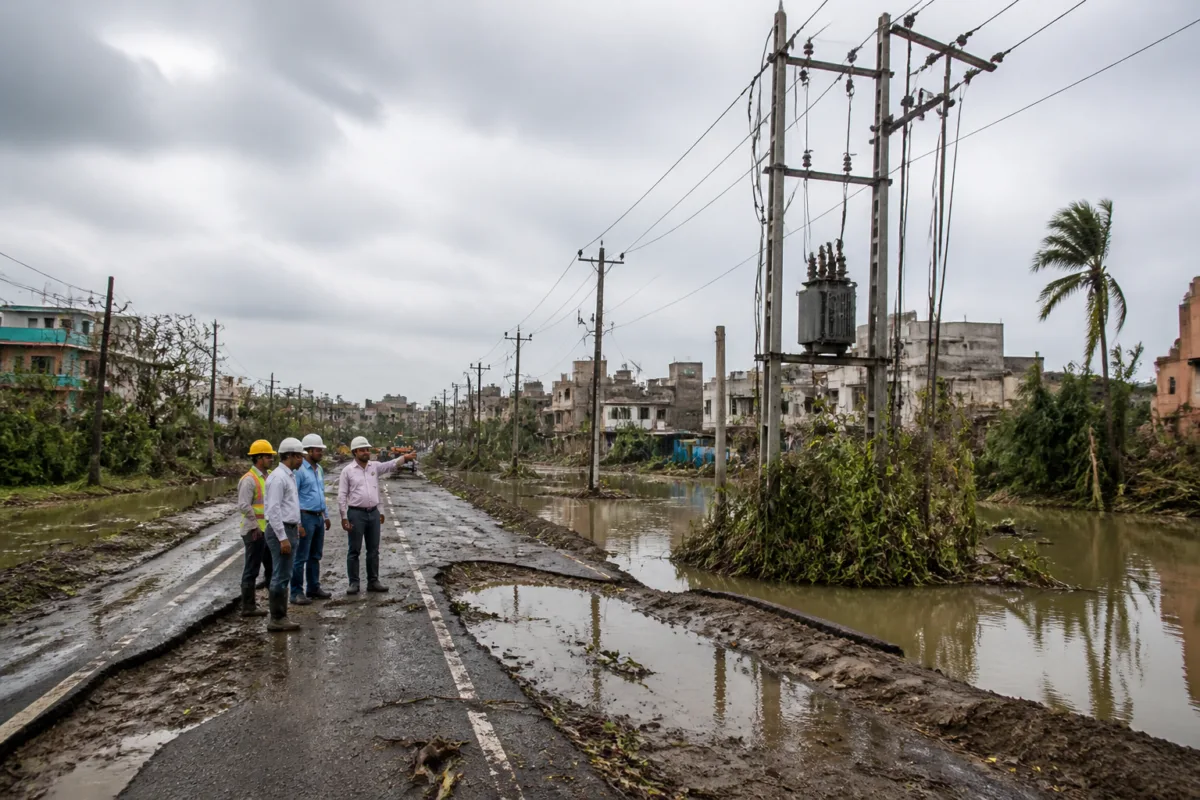
Odisha’s estimated loss of Rs 24,400 crore from natural disasters between 2014 and 2021 is not only a measure of storm and flood damage. It is also a measure of how vulnerable public infrastructure and state finances remain when repeated disasters force governments to rebuild essential systems faster than they can fund them. A study by the Coalition for Disaster Resilient Infrastructure (CDRI) found that the losses were equivalent to nearly 3.8% of Odisha’s gross domestic product, with the power and transport sectors bearing significant damage.
The finding is important because Odisha is widely associated with improvements in disaster preparedness and response. The CDRI assessment does not dispute that progress. Instead, it draws attention to a less visible part of disaster management: the cost of maintaining, repairing and replacing infrastructure after an extreme event. Evacuation and emergency response can reduce casualties, but they do not remove the financial burden of restoring roads, power networks and other public assets.
The study identified floods and tropical cyclones as the biggest risk factors for Odisha’s finances and critical infrastructure. The state’s location on India’s eastern coast exposes it to severe cyclonic storms, while flooding can affect transport links and electricity infrastructure across large areas. The report highlighted damage associated with cyclones including Phailin, Hudhud, Titli, Fani and Yaas.
These events show how disasters affect the urban and regional systems on which everyday life depends. Power infrastructure is required for homes, hospitals, water supply systems, communications and businesses. Road networks connect settlements to markets, medical facilities and administrative centres. When either system is damaged, the disruption extends beyond the physical site of destruction and can continue through the recovery period.
The financial impact is therefore wider than the immediate cost of replacing a damaged structure. Governments must fund relief, rehabilitation and reconstruction while continuing to meet routine obligations. The CDRI study said the financial burden of restoring damaged infrastructure often exceeds the resources immediately available through existing disaster relief mechanisms. Odisha consequently depends on additional assistance, budget reallocations and borrowing to bridge funding gaps.
This distinction between response finance and reconstruction finance is central to the study’s findings. Existing disaster relief funds may help address urgent needs, but large-scale infrastructure recovery can require longer-term spending. Roads, electricity networks and other assets may need to be rebuilt to higher resilience standards rather than simply restored to their previous condition. That can increase costs and extend the period during which public finances remain under pressure.
The report used fiscal modelling to assess the effect of severe disasters on state expenditure and borrowing requirements. It estimated that an event comparable to the 1999 Super Cyclone could lead to a sharp rise in government expenditure and borrowing. Even a disaster on the scale of Cyclone Fani, it observed, would significantly increase spending on relief, rehabilitation and reconstruction.
The modelling matters because it shifts the question from whether Odisha can respond to a disaster to whether it can absorb repeated financial shocks. A single major event can require emergency expenditure. Multiple events over time can create a cycle in which funds intended for development are redirected towards repairs and recovery. The supplied study does not quantify the effect of each such diversion on specific projects, but it identifies the broader pressure on state finances.
The energy and transport sectors are particularly important in this calculation. Damage to electricity infrastructure can interrupt public services and economic activity, while damage to roads can isolate communities and delay the movement of relief supplies and construction materials. The study projected that climate change could further increase annual losses in these sectors, although it did not provide a separate annual loss figure in the reported findings.
Climate change thus appears in the study not as a standalone environmental issue but as a risk to the continuity of infrastructure systems. The report’s conclusion is that development gains remain exposed when the financial systems supporting infrastructure recovery are weaker than the physical assets being built. Climate resilience, in this context, includes both engineering standards and the ability to mobilise money quickly after a disaster.
The policy recommendations reflect that wider definition of resilience. The CDRI study called for dedicated resilience funds, greater investment in disaster-resilient infrastructure, improved risk-financing mechanisms and wider use of insurance-based solutions. It also suggested exploring catastrophe bonds and contingent credit facilities, which could provide access to funds after defined disaster events.
These instruments would add to, rather than replace, existing government arrangements. A dedicated resilience fund could help separate long-term risk reduction and reconstruction needs from immediate relief spending. Insurance-based solutions could transfer part of the financial risk, while contingent credit could offer faster access to funds when a disaster meets specified conditions. The report does not establish which instruments Odisha will adopt or how they would be structured.
The institutional challenge is that disaster costs cross administrative and budgetary boundaries. A damaged road may involve transport authorities, local administrations and contractors. A damaged power network may require coordination between the state government, distribution agencies and other public institutions. Recovery also depends on the availability of technical capacity and construction resources. The supplied report focuses on fiscal impacts in the power and transport sectors, but its findings point to the need for coordination between infrastructure planning and disaster finance.
Odisha’s experience also illustrates why disaster preparedness cannot be evaluated only through the lens of emergency operations. The state has made significant progress in preparedness and response, according to the study, but the frequency of natural disasters continues to threaten infrastructure. Climate expert Sarat Sahu described the situation as a significant risk to the disaster-resilient infrastructure being built by the state. His observation captures the central tension: resilience investments can reduce vulnerability, but repeated hazards can continue to impose large repair and replacement costs.
The available figures make the scale of the challenge clear. Odisha’s estimated disaster-related economic loss of Rs 24,400 crore between 2014 and 2021 amounted to nearly 3.8% of its gross domestic product. The assessment covered a seven-year period and focused on the fiscal impact of disasters on the power and transport sectors. It did not establish that all losses were confined to those sectors, nor did the report as described provide a year-by-year breakdown.
That limitation is relevant for interpreting the number. The total is a measure of the estimated economic impact during the period assessed, not a forecast of a fixed annual cost. Nor does it mean that every rupee of loss became a direct government expenditure. However, the study’s fiscal modelling indicates that a substantial share of the burden reaches public finances through relief, reconstruction, additional assistance, reallocations and borrowing.
The bigger urban question is whether infrastructure planning and public finance are being designed for a future in which disruption is recurrent rather than exceptional. Odisha’s roads and power networks are part of a wider settlement system linking cities, towns and rural areas. Their failure affects households, institutions, logistics and local economies at the same time. Protecting those systems requires attention not only to where infrastructure is built, but also to how it will be financed after a major shock.
The CDRI study confirms that Odisha’s disaster-management achievements have not eliminated its exposure to fiscal and infrastructure risk. It identifies a funding gap between immediate relief mechanisms and the long-term costs of reconstruction, while warning that climate change could increase losses in energy and transport. The state’s revenue and disaster management department has said it will analyse the recommendations. The next policy question is how those recommendations are translated into dedicated funds, risk-financing mechanisms and infrastructure investment decisions.

