


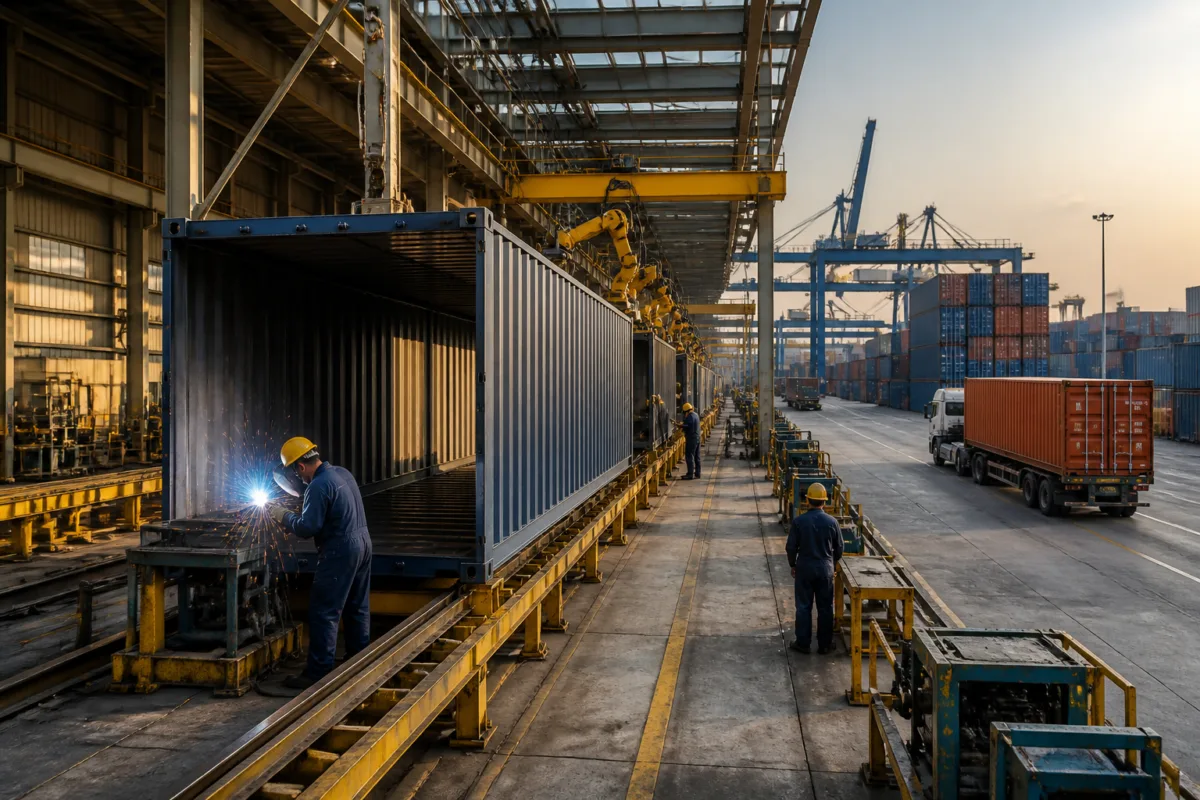
The Union Cabinet has approved the Container Manufacturing Promotion Scheme with a budgetary outlay of Rs 10,000 crore, seeking to reduce India’s dependence on imported containers and strengthen supply security for the country’s growing freight network.
The scheme, announced by Information and Broadcasting Minister Ashwini Vaishnaw, will run for 13 years. It was first announced in the 2026-27 Union Budget and is intended to expand domestic manufacturing capacity while improving the competitiveness of Indian-made containers.
China currently accounts for more than 95% of global container manufacturing, according to the report. India is seeking to build a domestic manufacturing base capable of securing a 15% share of the global market. The government has also set a target of increasing India’s annual container production capacity tenfold to 7.5 lakh TEUs.
The policy comes as containerised freight is expected to increase sharply. India’s container traffic is projected to rise from around 24 million twenty-foot equivalent units in 2024 to 175 million TEUs by 2047. The expansion will affect the movement of manufactured goods, exports, imports and essential supplies through the country’s ports and inland logistics network.
Prime Minister Narendra Modi said the scheme would provide financial support to new and existing manufacturers, promote globally competitive and quality-certified containers, reduce import dependence and strengthen supply chains. Shipping Minister Sarbananda Sonowal described the approval as a step towards building an Indian container manufacturing ecosystem that could compete globally.
The scheme has three components. The first is interest subvention assistance, which will provide a 3% annual interest subsidy on eligible capital loans. The assistance will apply to the establishment of greenfield container manufacturing facilities and the brownfield expansion of existing capacity.
The second component is operational expenditure assistance. This has a financial outlay of Rs 8,891 crore and will provide financial support for containers manufactured and sold according to global standards. The assistance is intended to bridge the cost gap faced by domestic manufacturers and improve their market competitiveness.
The third component covers testing and certification assistance. It will support the establishment of common facilities required to test and certify containers, an important requirement for manufacturers seeking to meet international standards.
For India’s urban and industrial systems, the decision links manufacturing policy with the capacity of ports, freight corridors, logistics parks and distribution networks. Containers are critical to moving goods between production centres, ports and domestic markets, and shortages or import disruptions can affect the reliability of these networks. The government’s stated objective is to create a domestic supply base before container demand rises to the projected 2047 level.
The approved support will be available to both new manufacturers and existing facilities. The scheme’s implementation will now depend on the operational framework for eligible loans, production assistance, testing facilities and certification requirements over its 13-year duration.

