


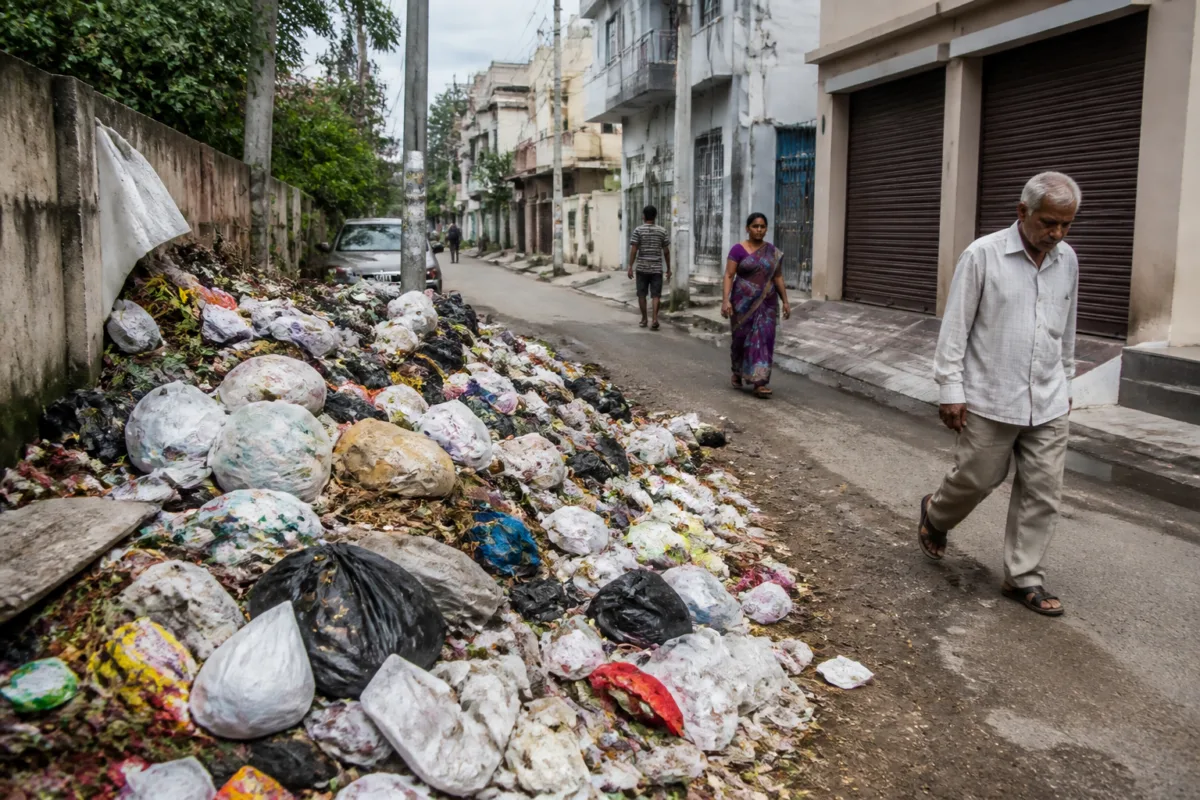
Bengaluru garbage collection has come to a standstill in parts of Lag gere Kemp egowda Layout, where residents have been leaving waste along roads after collection vehicles reportedly failed to arrive for several weeks, according to a report by Prajavani published on October 26. Garbage has accumulated on the main road and internal streets of the ward, disrupting movement and creating persistent foul odour for households.
Residents told Prajavani that the absence of a collection vehicle had left them with no practical way to dispose of household waste. With garbage continuing to decompose inside homes, some residents brought it outside and dumped it along the roadside in protest. The action has added to the waste already lying across the neighbourhood.
The accumulation has affected both the main road and smaller streets in the Lag gere Kemp egowda Layout ward. Residents said the piles were obstructing public movement, making it difficult for people to use the streets normally. The report did not specify the quantity of waste accumulated or identify the period during which collection services had stopped beyond stating that the vehicle had not visited for several weeks.
Residents also expressed concern about the possible spread of infectious diseases because of the uncollected waste. The report records their concerns about the odour and the deteriorating conditions, but does not cite any confirmed disease outbreak or health assessment from a medical or civic authority.
According to the residents, they had repeatedly approached the officials concerned about the failure of collection services. They alleged that their requests had not produced any result and accused the responsible authorities of neglecting waste disposal in the area. No response from the relevant municipal officials was included in the report.
The residents have demanded immediate intervention from the concerned minister and senior officials. Their requests include a visit to the locality, removal of the accumulated waste and restoration of daily garbage collection. The demands place the immediate responsibility for clearing the streets and restarting collection with the authorities overseeing the service.
The episode also shows how a breakdown in door-to-door collection can quickly shift the burden of waste handling to individual households and public streets. Once homes can no longer store waste, residents may dispose of it in open areas, further concentrating the problem in places used by pedestrians and other road users. In Lag gere, that cycle has produced visible waste piles across both the main road and neighbourhood streets.
The next steps identified by residents are the removal of the existing garbage and the resumption of daily collection. The report does not provide a confirmed clearance schedule, name the agency responsible for the missed collections or record an official explanation for the service disruption.

