


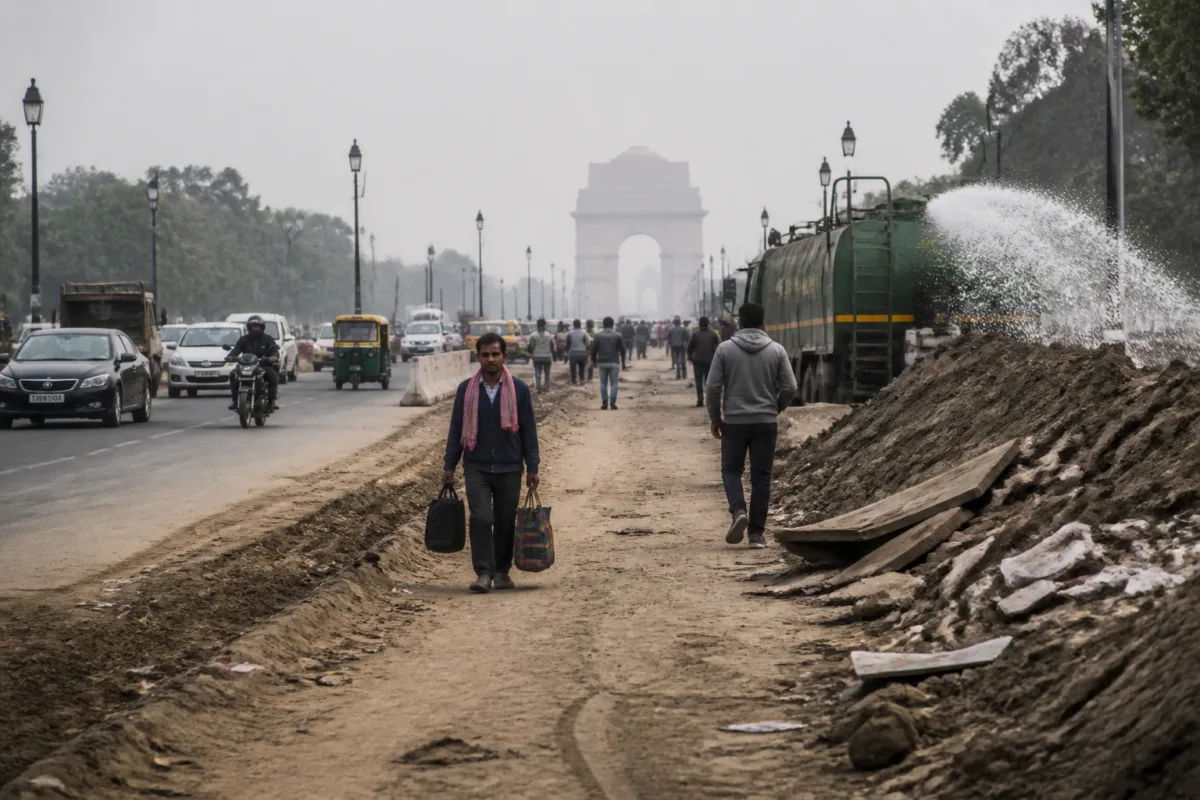
Delhi’s air quality improved to the moderate category near India Gate on Sunday, but road debris and visible dust in several areas indicated continuing gaps in the implementation of pollution-control measures under the Graded Response Action Plan, according to a report by Jagran – New Delhi.
The Central Pollution Control Board recorded an Air Quality Index of 155 near India Gate, placing the area in the moderate category. The report said Delhi’s overall AQI had also fallen below 200, following readings of 179 on Saturday and 230 on Friday.
The improvement comes as winter conditions begin to set in across the national capital, a period during which air quality is closely monitored because changes in weather can affect pollution levels. The report said GRAP had been implemented again in Delhi to control pollution and provide relief to residents.
However, the situation on the ground remained uneven. Jagran reported that debris was lying on roads in parts of the city and that dust had accumulated across several areas. These conditions point to difficulties in enforcing measures intended to limit dust emissions from roads, construction activity and poorly managed material, although the report did not specify the GRAP stage or identify individual agencies responsible for the locations mentioned.
The road-level conditions also affect people who live, work or travel through these areas. Dust from exposed surfaces and roadside debris can add to localised pollution and create inconvenience for pedestrians, commuters and nearby residents. The report said residents were facing difficulties because of the dust and alleged that no concrete action was visible from the concerned agencies.
The CPCB-linked assessment cited in the report also indicated that the improvement in Delhi’s air was not expected to continue through October 26. According to the report, three of Delhi’s 26 monitoring stations were expected to record air quality in the very poor category during that period.
The contrast between the moderate reading near a prominent monitoring location and the reported dust conditions on city roads highlights the importance of enforcement beyond headline AQI figures. Monitoring stations provide area-specific readings, while road dust and debris can vary substantially between neighbourhoods depending on construction activity, traffic, sweeping and the handling of waste or building material.
GRAP is intended to trigger pollution-control actions as air quality changes, but the report did not provide details of the measures activated in Delhi or any enforcement figures. It also did not report specific penalties, inspections or corrective actions by municipal or other concerned agencies.
The CPCB forecast cited by Jagran will remain relevant as authorities monitor the city’s 26 stations. The next reported assessment is expected to cover air quality through October 26, while the condition of roads, dust-control compliance and agency action will determine how far the improvement is reflected at street level.

