


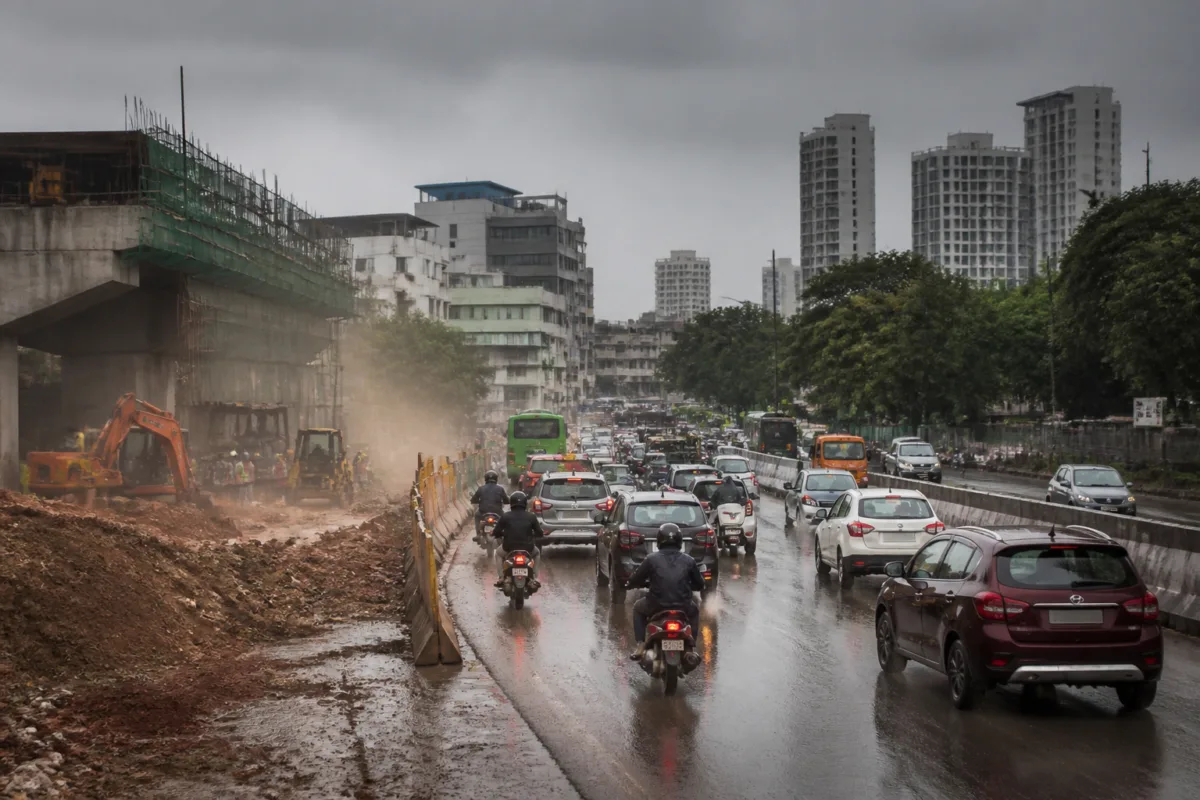
Bengaluru’s recent rain has cooled streets and temporarily settled dust, but it has not delivered the clean-air improvement many residents might expect. The city’s air quality has remained in the moderate category for most of the month, showing that rainfall alone cannot overcome the combined effects of traffic, construction activity and atmospheric conditions that determine how pollutants disperse.
Data from the Central Pollution Control Board’s CCR platform shows that Bengaluru’s air quality has generally remained moderate, defined in the report as an Air Quality Index above 50. The city recorded good air quality, or an AQI below 50, on September 25 and 26, but deteriorated soon afterwards. Several spells of rain since then have not been enough to return the city consistently to the good category.
That pattern matters because rain is often treated as a natural air-quality solution. Showers can remove or settle some particulate matter, particularly dust suspended close to the ground. But the effect is temporary and depends on the intensity and duration of rainfall, the condition of exposed soil and roads, traffic activity, construction practices, wind speed and the wider circulation of air over the city.
The Bengaluru case therefore points to a central distinction in urban pollution management: weather can change the concentration and movement of pollutants, but it does not remove the emissions sources that generate them. When rain stops and surfaces dry, dust can become airborne again. If wind speeds are low, pollutants can also disperse more slowly, leaving the city with moderate air quality even after wet weather.
Professor Gufran Beig, chair at the National Institute of Advanced Studies, said large-scale climate patterns could influence conditions over peninsular India. According to Beig, strong El Niño conditions may contribute to lower wind speeds and poorer air quality because weaker winds reduce the dispersion of pollutants. He said Bengaluru and Chennai may have avoided worse air quality because of recent rainfall, but conditions could deteriorate when the rain stops and the soil dries.
Bengaluru’s elevated location makes changes in wind speed an important part of this assessment, Beig said. The report also notes that lower wind speeds compared with previous years could contribute to higher pollution levels. This does not mean that a climate pattern alone determines the city’s AQI. Rather, it changes the atmospheric conditions in which locally generated pollution is diluted or retained.
A study by researchers at NIAS, Bengaluru, reported contrasts in winter air pollution across India during the transition from La Niña to El Niño between 2022 and 2024. The changes occurred despite relatively stable emission sources and no major shifts in mitigation efforts, according to the report. The finding underlines why pollution readings cannot be understood only through a count of local sources: the same emissions can produce different air-quality outcomes under different weather and circulation conditions.
For Bengaluru, the most visible local contributors identified in the report are road traffic and construction. Increased vehicular movement and congestion are adding to PM2.5 emissions, while ongoing construction is contributing to PM10. Both pollutants affect the AQI, but they arise through partly different urban pathways. Fine particles associated with combustion and traffic can remain a significant concern in busy road corridors, while larger dust particles can be generated by exposed construction material, unpaved surfaces and movement around building sites.
The distinction is important for governance. Rain can suppress dust temporarily, but it cannot substitute for controls at construction sites or reduce the number of vehicles using congested roads. Once surfaces dry, poorly managed construction dust can return to the air. The city-based air-quality expert quoted in the report said construction activity had contributed considerably to the increase in PM10 emissions and that the rise in PM10 was a key reason Bengaluru had not moved into the good AQI category despite rain.
This places responsibility across multiple urban systems rather than with a single environmental agency. Air-quality outcomes are shaped by transport demand, road congestion, construction regulation, dust management, weather monitoring and pollution measurement. Each system operates through a different institutional channel, but residents experience their combined result as a single AQI reading.
The CPCB’s CCR platform, as described in the report, collates air-quality and weather information from external providers based on availability, accuracy and consistency. That combination is useful for understanding the relationship between pollution and weather, but it also means that AQI interpretation requires attention to the conditions surrounding each reading. A moderate classification does not identify one source by itself, nor does a short period of good air establish a sustained improvement in emissions.
The available evidence instead shows a city caught between temporary atmospheric relief and persistent urban pollution sources. September 25 and 26 demonstrate that Bengaluru can enter the good category, while the subsequent return to moderate air quality shows how quickly that improvement can disappear. Rainfall helped, but its effect did not last because the conditions producing pollution remained in place and atmospheric dispersion may have weakened.
The winter months will be particularly important in this respect. The report says pollution levels are likely to remain elevated in the coming winter months, with local factors also playing a role. It links winter air pollution to wind speeds and air circulation, while identifying traffic and construction as continuing contributors. The evidence does not establish a single forecast for Bengaluru, but it does indicate that future readings will depend on the interaction between regional climate conditions and city-level emissions.
The larger urban question is whether Bengaluru treats air quality as a seasonal weather problem or as an everyday management challenge. If rain is relied upon as the main mechanism for improvement, the city may see brief reductions without addressing the sources that reappear when roads and soil dry. A more complete reading of the evidence places construction dust, traffic emissions and atmospheric dispersion within the same policy frame.
What the reported data confirms is limited but significant: Bengaluru has remained mostly in the moderate AQI category despite recent rain, recorded only brief good readings on September 25 and 26, and continues to face particulate pollution linked to traffic and construction. The developments to monitor are the city’s AQI as rainfall recedes, changes in wind speeds and air circulation, and whether PM10 and PM2.5 levels move in tandem with construction and traffic activity.

