


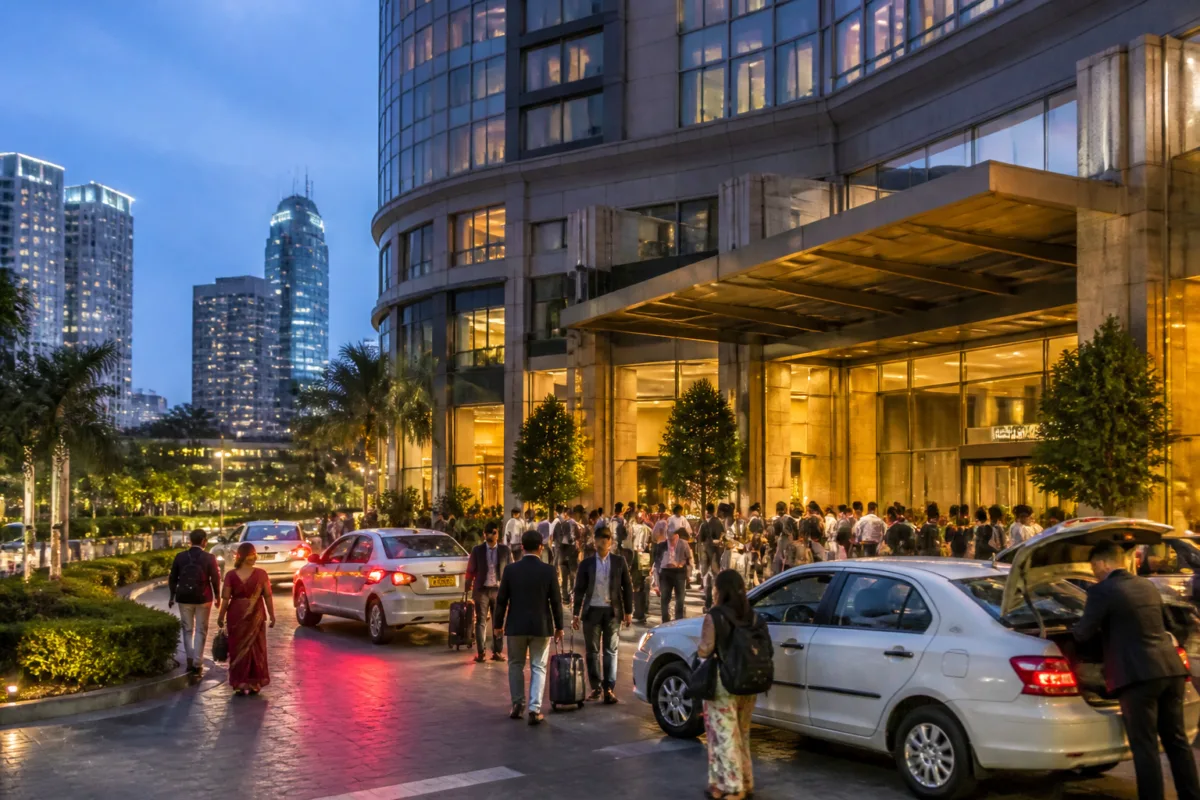
Indian Hotels’ strong second-quarter performance is more than a positive earnings update for the country’s largest listed hotel chain. It is also evidence of a wider urban capacity problem: demand for organised hospitality is rising faster than new rooms are being added in several important markets, allowing existing hotels to raise prices and occupancy.
The company reported a 22 per cent year-on-year increase in consolidated revenue for Q2FY27, ahead of analysts’ estimates, while revenue per available room, or RevPAR, rose 27 per cent. Occupancy increased from 75 per cent to 82 per cent, a 700-basis-point improvement, and average room rates grew 17 per cent. Together, these figures show how hotel performance depends not only on visitor numbers but also on the relationship between available inventory, location, events and the quality of existing properties.
For cities, that relationship matters because hotel rooms are part of urban infrastructure. They support business travel, conferences, exhibitions, tourism, weddings and large public events. When demand rises without a comparable increase in supply, the immediate effect is stronger pricing power for operators. The longer-term question is whether new supply can be added quickly enough, and in the right locations, to prevent capacity constraints from becoming a structural feature of the market.
The company attributed the quarter’s performance to resilient domestic demand, large meetings, incentives, conferences and exhibitions events, and the effect of renovations at marquee hotels across the country. The BRICS Summit was cited as one example of a major event supporting demand. Renovations also lifted revenue and occupancy at properties that were already part of the company’s network, showing that additional capacity does not always mean building a new hotel. Reconfiguring and upgrading existing assets can also increase the value generated from urban land and established locations.
That distinction is important in dense cities, where acquiring large development sites is difficult and new hotels can take years to plan and build. The report does not establish how much of Indian Hotels’ performance came from individual cities or quantify the number of rooms unavailable during renovations. It does, however, show that property upgrades, event-led demand and higher room rates worked together during the quarter.
The demand-supply imbalance identified by Elara Research is central to the company’s outlook. The brokerage expects the mismatch to support RevPAR growth over the next 18 months, citing accelerated demand growth. Its assessment reflects a market in which hotel operators can improve revenue not only by adding rooms, but by increasing occupancy and rates across existing properties while expanding their managed portfolio.
Indian Hotels has upgraded its FY27 revenue growth guidance following its performance in the first half of the financial year and the visibility provided by the seasonally stronger second half. The company continues to sign new hotels and is using what analysts describe as an asset-light expansion strategy. Under this model, growth can come through managed hotels and new signings without requiring the company to own every property directly. That can accelerate brand expansion, although the supplied report does not provide the precise capital commitments, locations or completion schedules for the new projects.
The company’s operating figures reinforce the importance of occupancy and management income. Consolidated operating profit grew 24 per cent, while the operating margin expanded by 50 basis points year-on-year to 28.4 per cent. The standalone operating margin increased to 38.9 per cent from 34.9 per cent in Q2FY26. According to the report, higher occupancy, operating leverage and stronger flow-through from management fees supported the improvement.
Management fees are significant in an urban property market because they allow a hotel company to participate in a wider network of buildings and locations without owning all the underlying real estate. Motilal Oswal Research expects Indian Hotels’ medium-term momentum to be supported by a room addition pipeline of 6,650 rooms in owned hotels and 28,150 rooms in managed hotels. The report also refers to strategic acquisitions and new and reimagined businesses, but does not provide a detailed breakdown of those projects or their geographic distribution.
The numbers point to a two-track expansion model. Owned hotels add directly controlled capacity and can strengthen the company’s physical presence in major markets. Managed hotels allow the brand to spread across more properties while relying on partners for ownership and, in some cases, development. For cities, the second model can bring branded accommodation to markets where building and operating a fully owned hotel may be more difficult or capital-intensive.
However, the quarter also shows that the hospitality system remains exposed to disruptions outside the hotel property itself. TajSATS, the company’s airline catering business, reported a 25 per cent year-on-year decline in operating profit because of weaker air traffic linked to disruptions in West Asia. The cumulative performance of subsidiaries was also weaker because of renovations and disruptions following the conflict.
This provides an important urban systems perspective. Hotels do not operate in isolation from airports, airlines, event venues and regional travel networks. A disruption in air traffic can affect catering and hotel-linked demand even when domestic room demand remains strong. Similarly, a large summit can temporarily raise occupancy and rates, but the report does not establish whether event-driven demand is evenly distributed across cities or sustained after the event ends.
The company’s results therefore reveal both the strength and the limits of the current growth cycle. Domestic demand remained resilient, room rates increased sharply and occupancy improved. At the same time, airline-linked operations faced pressure, subsidiaries were affected by renovations and geopolitical disruption, and the benefit of higher demand was concentrated in a business whose room supply is still expanding.
Brokerages remain positive on the company and the wider domestic hospitality sector. Elara Research, 360 ONE Capital Research and Motilal Oswal Research cited strong demand, pricing power, a robust hotel pipeline, asset-light expansion and rising MICE activity. Their target prices and buy recommendations are relevant to the company’s market outlook, but the urban significance lies elsewhere: analysts are treating the supply gap as a continuing feature rather than a short-lived quarterly anomaly.
That interpretation raises a planning question for Indian cities. If demand for hotel rooms, conferences and business travel continues to grow faster than supply, cities may see sustained pressure on room rates and greater competition for well-located sites. If new rooms are added through managed properties and strategic acquisitions, the expansion may be faster than a model based only on company-owned hotels. But the available report does not establish whether new capacity is reaching underserved cities, peripheral locations or already strong premium markets.
The evidence currently confirms a clear pattern. Indian Hotels increased revenue, occupancy, RevPAR and operating profit in Q2FY27, helped by domestic demand, major events, renovations and higher room rates. Analysts expect the demand-supply mismatch and the company’s room pipeline to support medium-term growth. The report also records vulnerabilities linked to air traffic, geopolitical disruption and renovation activity.
What remains uncertain is the geographic shape of this expansion and whether new supply will materially reduce the imbalance or simply accompany continued growth in demand. The next indicators to watch are the company’s FY27 performance, the delivery of its owned and managed room pipeline, the distribution of new signings across urban markets and the extent to which MICE activity continues beyond individual events.

