


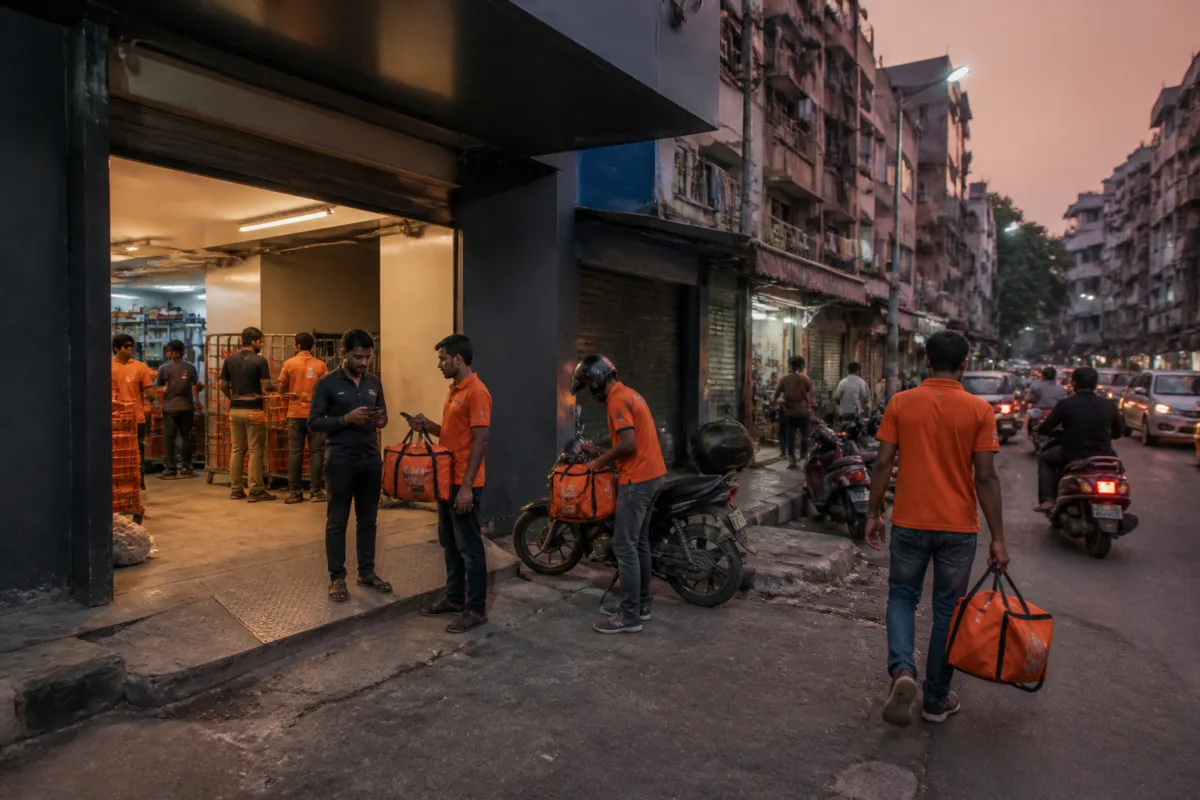
Swiggy’s second-quarter results show the central tension in India’s quick-commerce buildout: the company is reaching more customers and cities at a faster pace, but the infrastructure required to make rapid delivery possible continues to weigh heavily on profitability. Instamart’s gross order value rose 31% year on year to Rs 9,230 crore in the September quarter, while its adjusted EBITDA loss widened to Rs 895 crore.
That combination makes the results more than a corporate earnings update. It offers a view of how an increasingly important layer of urban commerce is being assembled. Swiggy added 69 net dark stores during the quarter, taking its network to 1,240 stores across 133 cities. These facilities, positioned close to customers, are the physical backbone of a model built around speed, product availability and frequent ordering.
The results also show that the model is not yet financially settled. Instamart’s adjusted EBITDA loss increased from Rs 849 crore a year earlier and Rs 778 crore in the preceding June quarter. Swiggy said the losses reflected higher investments to attract customers and improve order frequency. At the same time, the adjusted EBITDA margin improved to negative 9.7% of gross order value from negative 12.1% a year earlier, while the contribution margin improved to negative 1% from negative 2.6%.
The distinction between rising losses and improving margins is important. It indicates that the business generated stronger operating performance relative to the value of orders, even as the company continued spending to expand the network and build demand. The supplied results do not establish when Instamart will become profitable, but management said the adjusted EBITDA loss had peaked in the September quarter and expected operating margins to improve as customer retention and store utilisation increased.
The urban infrastructure behind quick commerce
Dark stores are not conventional retail outlets. They are fulfilment points designed to bring inventory closer to customers and reduce the distance between an order and its delivery. Swiggy’s network now spans 133 cities, but the company has not disclosed in the supplied results how these stores are distributed across cities, what types of properties they occupy or how their operating costs vary by location.
That missing detail matters because quick-commerce economics are closely tied to urban form. Store density, road connectivity, local demand, delivery distances and the availability of suitable commercial space all affect how quickly an order can be fulfilled and at what cost. Swiggy’s reported increase in store count confirms the expansion of this urban logistics layer, but the results alone cannot show whether the network is concentrated in dense metropolitan neighbourhoods or increasingly extending into smaller cities.
The company’s customer numbers indicate that the network is being used at scale. Monthly transacting users for Instamart reached 14.8 million, up 23% year on year. Net order value, which excludes discounts, rose 34.8% year on year to Rs 6,594 crore. Sequential growth accelerated to 13.4% from 2.5% in the preceding quarter.
These figures point to stronger engagement, but they also reveal why the company is continuing to invest. A quick-commerce platform requires not only stores, but also inventory, delivery capacity, technology and customer acquisition. Swiggy said higher customer retention, targeted pricing initiatives and an expanded product assortment supported growth. The reported improvement in store utilisation is therefore a key operational variable: more orders passing through each location can help distribute fixed costs across a larger base of activity.
Growth across the wider platform
Swiggy’s consolidated revenue from operations rose 36% year on year to Rs 7,571 crore in the quarter. Its consolidated loss after tax narrowed to Rs 922 crore from Rs 1,092 crore in the same quarter a year earlier, although the loss widened sequentially from Rs 792 crore in the June quarter. Consolidated adjusted EBITDA loss also widened year on year to Rs 760 crore from Rs 695 crore, while adjusted revenue increased 34% to Rs 7,909 crore.
Across its consumer-facing businesses, combined gross order value increased 24.6% to Rs 20,793 crore. This growth was not limited to quick commerce. Food delivery GOV rose 17.7% to Rs 10,054 crore, and the segment reported its highest quarterly adjusted EBITDA of Rs 341 crore, compared with Rs 240 crore a year earlier. Its adjusted EBITDA margin improved to 3.4% of GOV from 2.8%.
The food-delivery figures provide a contrast with Instamart. Swiggy attributed the improvement in the core business to advertising revenue, higher order density and greater delivery efficiency. Monthly transacting users rose to 19.8 million from 17.2 million in the year-ago quarter. While the food-delivery business still depends on a large delivery network, its higher quarterly adjusted EBITDA suggests a more mature operating profile than the company’s expanding quick-commerce arm.
Swiggy retained its full-year food-delivery growth guidance of 18-20%, excluding the Toing app. Toing, an affordable food-ordering platform, was available in more than 50 cities, and the company said two-thirds of its new users were either new to Swiggy or had been inactive for an extended period. This gives the company another route to widen its customer base, although the supplied results do not provide separate profitability figures for Toing.
Dineout and other out-of-home consumption services also reported growth. The business recorded a 35% year-on-year increase in GOV to Rs 1,508 crore and remained adjusted EBITDA-positive for the seventh consecutive quarter. Together, these segments show Swiggy using a common consumer platform across food delivery, quick commerce and dining, while the financial performance of each business remains different.
The cost of building convenience
The most significant evidence in the results is the trade-off between reach and cost. Instamart’s GOV grew strongly, its customer base expanded and its margins improved year on year, but its absolute adjusted EBITDA loss increased. The company is therefore growing into a larger urban service while still spending heavily to make that service more attractive and operationally efficient.
Swiggy’s consolidated cash balance stood at Rs 13,662 crore at the end of September, down from Rs 14,367 crore at the end of June. The results do not attribute the entire change to Instamart or provide a cash-burn breakdown for individual businesses. They do, however, show that the company entered the quarter with a lower consolidated cash balance while continuing to add stores and invest in customer acquisition and order frequency.
The company also agreed to sell its Lynks Logistics business to Udaan’s parent for Rs 500 crore. Along with a separate investment of Rs 75 crore, the transaction will give Swiggy a stake of around 3.2% in Udaan. This indicates a change in the composition of the company’s holdings and logistics interests, but the supplied announcement does not explain how the transaction will affect Swiggy’s operating network or future capital allocation.
For cities, the relevance of the results lies in the scale at which this commercial system is being normalised. A network of 1,240 dark stores and 14.8 million monthly transacting Instamart users represents a significant shift in how some households access everyday goods. The company’s expansion across 133 cities also indicates that the quick-commerce format is no longer confined to a small number of large urban markets.
Yet the results leave several urban questions unanswered. They do not disclose the land or floor-space footprint of the dark-store network, its impact on local traffic or loading activity, the nature of employment associated with the stores, or how local authorities regulate these facilities. They also do not show whether faster delivery is being achieved primarily through denser store networks, larger inventories, more efficient delivery operations or a combination of these factors.
What the results establish is narrower but still significant. Swiggy’s quick-commerce business is expanding in customers, order value, cities and physical fulfilment locations. Its reported margins have improved, but its absolute operating loss has widened as the company invests in growth. Management expects another quarter of double-digit sequential growth in Instamart’s net order value during the December quarter and expects operating margins to improve.
That next phase will test whether greater customer retention and higher store utilisation can convert network scale into financial efficiency. Until then, Swiggy’s results describe an urban convenience infrastructure that is growing faster than its profits, with the economics of the city-level network still being worked out.

