


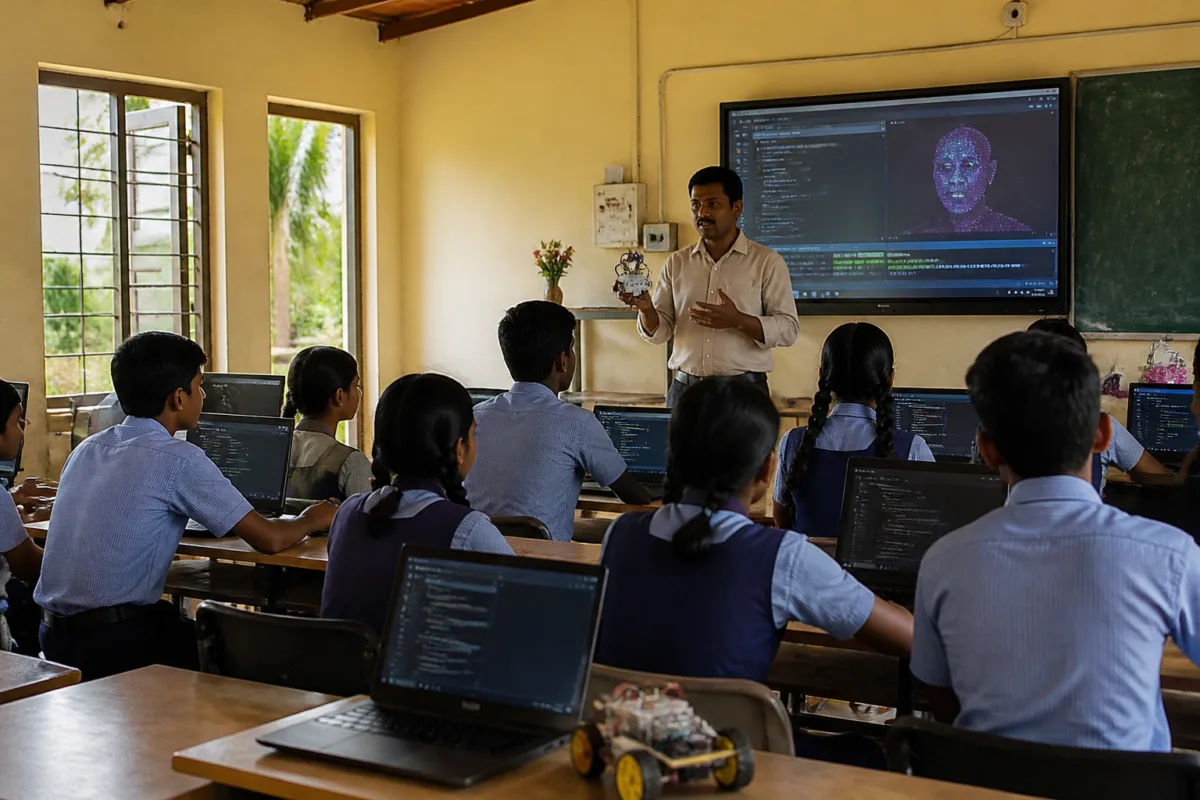
Goa AI Policy 2026 is not limited to promoting artificial intelligence among technology companies. Its most consequential commitment is to build an education-to-workforce pipeline, beginning with AI fundamentals for students in Classes VI to XII from the 2027-28 academic year and extending to teacher training, school laboratories, professional certification and public-sector adoption. The policy therefore places schools and institutional capacity at the centre of Goa’s attempt to become an AI-enabled state.
The policy was launched by Chief Minister Pramod Sawant and Information Technology Minister Rohan Khaunte. According to the Times of India report on the launch, it proposes introducing age-appropriate AI modules aligned with the National Curriculum Framework 2023, subject to curriculum approvals, teacher readiness and annual review. The stated objective is not simply to teach a technical subject, but to include responsible AI and media literacy in the learning process.
That distinction matters because the policy’s implementation challenge begins before students enter an AI laboratory. A curriculum can be approved on paper, but classroom delivery depends on trained teachers, suitable equipment, reliable institutional support and a mechanism for reviewing whether the material remains appropriate for different age groups. The policy itself acknowledges these dependencies by linking the school programme to curriculum approvals, teacher readiness and annual review.
The proposed AI laboratory network provides the clearest physical expression of the policy. Labs are to be introduced in up to 50 government schools in phases, beginning with 20 rural schools before expanding to 30 urban or semi-urban schools. The sequencing indicates that geographical access is a stated policy concern. It also suggests that the government is treating AI capability as an infrastructure and distribution question, not only as a specialised skill concentrated in advanced institutions.
Chief Minister Sawant has said colleges and higher secondary institutions should be converted into AI labs to expand student access. The policy also states that the proposed facilities will complement existing Atal Tinkering Labs and IndiaAI Future Skills infrastructure. The available account does not establish how many such existing facilities are operational in Goa, what equipment the new labs will contain, or how students from schools without laboratories will access them. Those details will be important in assessing whether the programme creates a functioning network or a set of isolated facilities.
The rural-first sequence also raises an administrative question about access. Establishing a laboratory is only one part of delivering a digital learning programme. The policy’s own reliance on teacher readiness points to the importance of staffing and training arrangements. It proposes training 500 teachers through IIT Goa, the National Programme on Technology Enhanced Learning and the State Institute of Education. It also proposes an AI Coach Network of 100 experts drawn from this pool.
This structure attempts to create an intermediary layer between policy and classroom practice. The trained teachers would provide internal capacity, while the coach network could support schools and educators with specialised guidance. However, the supplied report does not specify the distribution of these teachers across districts, the number of schools each coach would support, the training duration, or the performance measures that will be used. These are not minor operational details: they will determine whether the programme can be sustained beyond its launch phase.
The workforce target is equally ambitious in design. Goa aims to create 50,000 AI-certified professionals by 2030, with at least 25% women, 30% youth under 30 and 15% of participants from tier-2 and tier-3 talukas. The three-level certification framework—foundational, practitioner and specialist—is intended to define skill requirements at each stage. Together, these provisions show an attempt to connect school exposure with higher-level workforce readiness rather than treating AI education as a single course or one-time campaign.
The numerical targets also give the policy an inclusion framework. The women’s and youth targets identify demographic groups, while the taluka-based target introduces a geographical measure. The policy further commits to expanding AI skilling for students, graduates, government officials, professionals, micro, small and medium enterprises and citizens. Its stated inclusion focus covers language, location, gender, age, income and ability.
The report does not provide a baseline for the 50,000-professional target, nor does it explain whether certification will be delivered through government institutions, colleges, private providers or a combination of them. It also does not specify how the quality of the three certification levels will be assessed. Without those details, the target can establish direction but cannot yet demonstrate implementation capacity.
The policy extends beyond education and employment into public governance. It seeks to create governance and infrastructure for citizen-first, transparent and scalable AI use. That language places administrative systems alongside talent development. For citizens, the significance of AI adoption will depend not only on how many people receive certificates, but also on how public institutions use automated or AI-enabled systems, what safeguards apply and how transparency is maintained. The supplied material records the policy’s stated commitment to these principles but does not set out specific oversight procedures or accountability mechanisms.
Goa also plans to use AI to preserve linguistic and cultural heritage through multilingual tools, including Konkani large and small language models in collaboration with BHASHINI. This gives the policy a regional dimension. AI is being presented not only as a workforce technology but also as a means of extending access across language and cultural contexts. The report does not establish the development timeline, datasets, institutional responsibilities or public testing process for these tools, leaving those elements to be clarified as implementation proceeds.
Student-led innovation is another part of the framework. The policy proposes hackathons, challenges, AI laboratories and partnerships with educational institutions, with links to incubation and funding support under the Goa Startup Policy and other government schemes, subject to guidelines. This creates a possible bridge between classroom learning and entrepreneurship. Yet the success of that bridge will depend on whether students outside the largest urban institutions receive comparable access to mentors, equipment, funding and incubation support.
The policy’s institutional architecture is therefore spread across schools, higher secondary institutions, colleges, training bodies, technology agencies, government departments and potential industry or startup partners. That breadth can help create a pipeline, but it can also make responsibility difficult to track. The available account identifies several partners and programme components, but it does not specify a single implementation authority, annual budget, procurement model or public reporting system.
This is the central urban and regional planning question raised by the launch: can a state distribute advanced digital capability through its existing public institutions without reproducing the concentration of opportunity in better-connected urban areas? The proposed order of 20 rural schools followed by 30 urban or semi-urban schools suggests that the government recognises the risk of uneven access. Whether that intent translates into equal participation will depend on infrastructure, teacher deployment, connectivity and ongoing support—areas not detailed in the announcement.
The policy also links technology adoption to institutional readiness. AI fundamentals in Classes VI to XII will require age-appropriate content and annual review. AI laboratories will need equipment and maintenance. Teacher training will need to reach beyond an initial cohort. Certification will require credible assessment. Public-sector adoption will need governance mechanisms. Each component has a separate delivery requirement, making coordination as important as the headline targets.
The launch confirms the scale and breadth of Goa’s ambition: AI education from school level, laboratories in up to 50 government schools, training for 500 teachers, a 100-member coach network, 50,000 certified professionals by 2030 and dedicated inclusion targets. It does not yet establish how these commitments will be financed, sequenced in detail or independently evaluated. The next test for Goa AI Policy 2026 will be whether the government can convert its targets into a transparent implementation plan that shows which institutions are responsible, which milestones apply and how rural, urban and semi-urban students will participate.

