


Eternal’s plan to expand Blinkit to more than 3,500 dark stores by March 2027 and around 5,000 by March 2028 signals a further shift in how urban consumption is organised. The company’s latest results show that quick commerce is no longer being presented only as a metropolitan convenience service; its next phase is explicitly tied to building demand and supply in smaller cities.
Eternal, the parent company of Zomato and Blinkit, reported a consolidated net profit of ₹125 crore for the September quarter, up 92.3 per cent from ₹65 crore a year earlier. Consolidated revenue from operations rose 77.6 per cent to ₹24,138 crore. At the consolidated level, business-to-consumer net order value grew 54 per cent year on year to ₹35,644 crore.
The numbers place Blinkit at the centre of Eternal’s expansion story. Blinkit’s net order value grew 79.3 per cent to ₹20,940 crore, compared with 21.5 per cent growth in Zomato’s food-delivery business, whose net order value reached ₹11,445 crore. District, the company’s going-out business, reported 58 per cent growth in net order value to ₹3,259 crore.
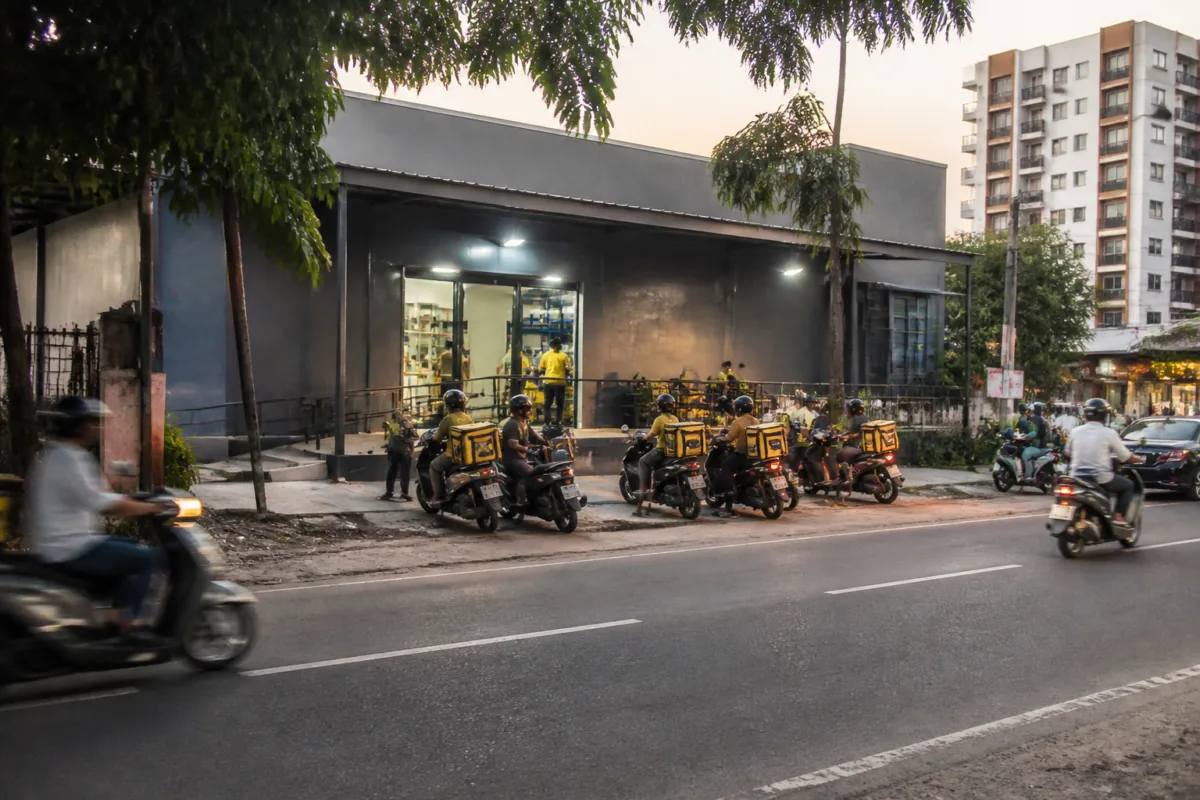
The significance of the Blinkit announcement lies not only in the number of outlets planned, but in the physical model behind them. Dark stores are local fulfilment facilities designed to serve online orders rather than conventional walk-in retail. Their expansion requires a network of neighbourhood-level premises, inventory movement, delivery workers and frequent replenishment. As the network grows, digital commerce becomes more closely tied to the everyday geography of cities.
Eternal’s management has described the expansion as an operating decision that must balance speed with store-level capacity and profitability. Albinder Singh Dhindsa, Group CEO of Eternal, said the company was focused on acquiring and retaining customers who order frequently, purchase across categories and are profitable to serve. He added that each store had a finite capacity and that a customer ordering only because of a deep discount used the same capacity as one ordering every week across categories.
That statement points to the central constraint in the dark-store model: a larger network does not automatically mean an unlimited ability to process orders. Each facility serves a defined catchment, and its performance depends on how many orders can be picked, packed and dispatched within that area. The company’s own description therefore links growth to the management of local capacity rather than simply to the addition of outlets.
The geographical emphasis is also changing. Dhindsa said that in metros, the company usually competed for a market that already existed. In smaller cities, he said, Blinkit was building both the market and the supply, which was the reason for the company’s bullishness.
This distinction is important for understanding how quick commerce may reshape urban systems outside the largest metropolitan markets. In an established metro market, a new dark store can be viewed as another layer in an already developed retail and delivery ecosystem. In a smaller city, the same facility may be part of the process through which demand is created, product availability is widened and residents become accustomed to rapid, app-based fulfilment.
The supplied results do not establish how many of Blinkit’s current stores are located in metros or smaller cities, nor do they provide a city-wise expansion plan. They also do not specify the size, location, lease structure or operating capacity of the planned facilities. What they do establish is the company’s stated intention to use smaller cities as a major growth frontier and to fund that expansion through its cash balance and profits from food delivery and quick commerce.
The financial results explain why the company can pursue that strategy. Blinkit’s net order value rose 79.3 per cent year on year, while Eternal reported strong growth at the consolidated level. Akshant Goyal, CFO of Eternal, said the company expected to cross 3,500 stores by March 2027 and reach about 5,000 by March 2028. He added that the company’s cash balance and profits from both food delivery and quick commerce would allow it to fund the pace of growth comfortably, while adjusted EBITDA margins were expected to keep improving through the expansion.
Those comments connect the physical spread of dark stores with the company’s financial model. Expansion is not being described as a standalone property strategy. It is being supported by the performance of multiple businesses within the group, particularly food delivery and quick commerce. The company is also signalling that future growth will be judged not only by the number of stores but by the quality of customers, order frequency, category breadth and the margins generated by each facility.
The comparison with Zomato’s food-delivery business adds another layer to the picture. Deepinder Goyal, Founder of Eternal, said food-delivery net order value had more than doubled over four years, from ₹18,160 crore in FY22 to ₹37,993 crore in FY26, representing a compound annual growth rate of about 20 per cent. He attributed part of the previous year’s slowdown to some ordering occasions moving to quick commerce as the latter scaled, while saying that the shift appeared to have settled and that recent growth was coming mainly from more people ordering and ordering more frequently.
This suggests that the company sees food delivery and quick commerce as related but distinct parts of urban consumption. A household may use one service for prepared food and another for groceries or other products, but both depend on local delivery networks and repeated digital transactions. The company’s results therefore show more than the performance of separate business verticals: they show an attempt to operate multiple forms of urban consumption through a shared platform and financial base.
The consequences for cities will depend on how this network is inserted into neighbourhoods. The source material does not provide evidence on traffic volumes, parking demand, delivery-worker conditions, municipal permissions, rents or the impact on conventional shops. It would be premature to draw conclusions on those issues from the quarterly results alone. However, the expansion target makes them relevant questions for city administrations and local communities as the number of facilities rises.
A dark store is small compared with a conventional shopping centre, but its urban role is different. It is designed around order processing, inventory storage and dispatch rather than browsing and walk-in sales. Its relationship with the surrounding area is consequently shaped by delivery movements, loading and unloading, access to roads and the concentration of short trips. Whether that arrangement reduces or increases pressure on neighbourhood infrastructure cannot be established from the information supplied by Eternal, but the scale of the planned network means the issue will become harder to treat as an isolated retail matter.
The company’s expansion into smaller cities also raises an institutional question about how urban supply systems evolve. Eternal says it is building both the market and the supply in these locations. That means the company is not merely responding to an already mature pattern of demand. It is investing in a distribution system intended to make rapid fulfilment available and commercially viable in places where the model is less established.
The results provide no details of the regulatory or planning framework that will govern these facilities. There is no city-wise information on approvals, land-use classifications, delivery access or coordination with local authorities. Nor is there data on whether the planned stores will be newly established locations, relocations or additions to existing clusters. These gaps matter because the urban effects of a dark store depend heavily on its location and operating intensity.
The available data does, however, show the scale of the company’s ambition. Blinkit’s net order value of ₹20,940 crore was nearly twice the ₹11,445 crore reported for Zomato’s food-delivery business during the quarter. Eternal expects the number of Blinkit stores to rise from its current level to more than 3,500 by March 2027 and approximately 5,000 by March 2028. The expansion is therefore being planned as a multi-year build-out rather than a short-term response to one quarter’s performance.
The broader urban question is whether digital convenience will remain concentrated in high-income metropolitan catchments or become part of the basic retail geography of smaller cities. Eternal’s stated strategy points towards the latter, but the evidence currently available is about planned capacity and reported order value, not the social distribution of access. It does not show which neighbourhoods will be served, which products will be stocked, how prices will compare with physical retail or how the model will affect local employment and businesses.
For planners and municipal administrations, the relevant unit of analysis may increasingly be the neighbourhood rather than the city as a whole. A city can record strong digital-commerce growth while the practical impact varies sharply from one locality to another. Store density, road design, residential-commercial land use, delivery patterns and the availability of suitable premises will shape how the network functions on the ground.
Eternal’s latest results confirm that quick commerce is becoming the group’s most rapidly expanding operating vertical by net order value and that smaller cities are central to its next phase. They do not yet establish the urban outcomes of that expansion. The developments to monitor are the location and pace of new dark stores, the company’s ability to improve margins while expanding, and how local authorities and neighbourhoods respond as digital fulfilment becomes a more visible part of the built environment.

