


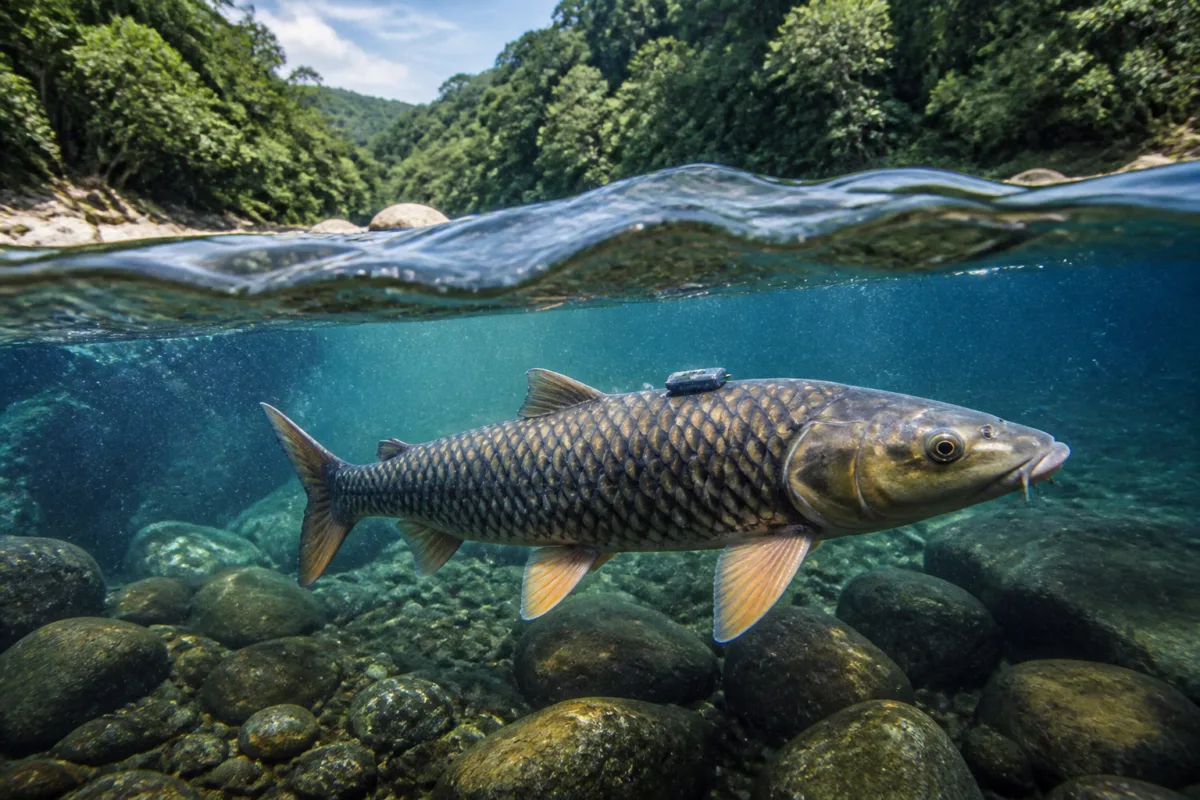
The struggle for humpbacked mahseer conservation in the Cauvery is revealing a larger problem in how South India’s rivers are managed. The critically endangered freshwater fish, once found across much of the Cauvery basin and its tributaries, now survives in a handful of isolated breeding populations, even as altered flows, dams, pollution, poaching and introduced species continue to reshape its habitat.
Known as the orange-finned mahseer or the Tiger of the Cauvery, Tor remadevii is endemic to the Cauvery River basin in the Western Ghats. It can grow to nearly the size of a human and weigh more than 50 kilograms. Yet there is no exact census of its remaining wild population. Experts cited in the supplied report agree that it has become locally extinct across much of its historic range, with the strongest remaining populations believed to be concentrated in protected areas such as the Cauvery Wildlife Sanctuary.
The fish’s decline is not only a wildlife story. It is also a record of how water infrastructure and seasonal water allocation have changed the river’s physical and ecological behaviour. The humpbacked mahseer evolved in high-flow, highly oxygenated and clean-water environments. Its breeding cycle is linked to rain and sudden floods, which trigger upstream movement and spawning. When flows are altered for agriculture and drinking water, those ecological signals can become irregular.
Sandeep Menon, secretary of the Karnataka-based Wildlife Association of South India, told The Indian Express that the fish is genetically programmed to swim upstream and spawn during rain or a sudden flood. According to Menon, artificially creating such flow events on a day-to-day basis can confuse the fish’s breeding behaviour. The issue is not simply whether water remains in the river. It is when water arrives, how quickly it moves, how much habitat remains connected and whether fish can reach suitable spawning areas.
That distinction matters for river governance. A water system can continue to serve human needs while becoming increasingly unsuitable for species whose survival depends on particular flow patterns. The report does not establish a single cause for the mahseer’s decline, but it identifies a combination of pressures: overfishing, poaching, dynamiting, dam building, water pollution and the fragmentation of populations. Together, these pressures reduce both the available habitat and the fish’s ability to move through it.
The effects of managed flows became visible through the tracking of a tagged female fish named Mara. In 2024, researchers tagged and followed the 24-kilogram fish for six months, during what was described as a drought year when water-related tensions between Karnataka and Tamil Nadu were also emerging. On May 15, a large release of water into Tamil Nadu prompted mahseer in deeper sections of the river to migrate. Mara could not be located for two weeks. Her tag was eventually recovered about 6 kilometres above her summer range in a shallow pool, leading the researchers to conclude that she had likely died after becoming stranded.
The episode illustrates the gap between a river’s administrative operation and its ecological operation. A release made for downstream water management can produce movement in the river, but that movement may not reproduce the gradual, connected and seasonally meaningful conditions on which fish depend. The supplied evidence does not show that the release alone caused Mara’s death. It does show how sudden changes in water conditions can interact with the movement patterns of a large migratory fish and make monitoring difficult.
The ecological role of the species adds another layer to the issue. Naren Sreenivasan, a biologist and mahseer researcher, described the humpbacked mahseer as a flagship species comparable to large terrestrial animals such as tigers, elephants and rhinos. Large mahseer are predators, while juveniles become prey for other fish and birds. Larger individuals may also be prey for crocodiles. Their disappearance can therefore affect relationships between species across the river system, although the report does not quantify the extent of any such cascading effects.
The absence of an exact population census is itself significant. Conservation agencies are attempting to protect a species whose historic distribution is known in broad terms but whose present population size remains uncertain. The fish was historically recorded across the Cauvery basin and tributaries including the Kabini, Bhavani, Moyar and Pambar, across parts of Karnataka, Kerala and Tamil Nadu. Today, experts describe only a few isolated breeding populations, making local protection and continued monitoring especially important.
Angling has become an unusual but important source of conservation data. Wildlife Association of South India records catches by its members from 1976, creating a long-term record that researchers can use to understand the species. Its members practise catch-and-release fishing, with fish photographed, weighed and released unharmed. Anglers and local community members have also helped radio-tag and track large mahseer through stretches of the Cauvery.
The conservation model depends on institutions that do not traditionally operate as a single river-management authority. WASI hires guards to prevent poaching and dynamiting, while the Fisheries Department and Forest Department participate in protection and breeding efforts. According to Menon, fees collected by the organisation support guards from local communities around three stretches of the Cauvery. Those stretches have been established as a fish sanctuary in collaboration with the Fisheries Department.
This arrangement places local participation at the centre of enforcement. The report says members of fishing communities are trained to radio-tag and track mahseer. Their involvement provides practical knowledge of the river while also creating a direct role in protecting fish habitat. It also reflects the limits of relying only on formal enforcement in a large and fragmented river landscape, where illegal fishing practices can be difficult to detect.
The Karnataka government is working with WASI and the Forest Department to breed the species in captivity at Harangi. Sachin SM, assistant director of fisheries in Kodagu district, said mature female and male brood fish are separated and given a hormone injection to induce breeding. Eggs are then collected and fertilised, while the resulting fingerlings are fed a diet rich in fats and proteins until a release site is selected.
Captive breeding can support recovery, but it does not resolve the underlying river conditions that caused the species to decline. The evidence supplied does not state how many fish have been bred, how many have been released or whether released fish have established viable populations. Those details will be important in assessing whether the programme is supplementing healthy wild populations or compensating for continuing habitat loss.
The legal position is another institutional gap. Although the humpbacked mahseer is listed as Critically Endangered on the IUCN Red List of Threatened Species, the report says it is not protected under Indian laws. Its conservation therefore depends on cooperation between government officials, expert anglers and non-profit organisations, as well as on existing rules against practices such as dynamiting. Sachin said awareness has improved and that people caught using dynamite can face imprisonment, but he also acknowledged that the practice has not disappeared entirely.
The Cauvery’s mahseer problem consequently connects biodiversity protection with the allocation and timing of water. Agriculture, drinking water, fisheries, conservation areas and interstate water management all operate within the same river system. The report does not provide a basin-wide flow policy or an ecological-flow allocation, so it cannot establish whether current management formally accounts for mahseer breeding requirements. It does, however, show that decisions made for one part of the basin can affect movement and survival elsewhere.
For cities and towns dependent on river systems, the lesson is broader than the fate of one fish. Water infrastructure is often assessed through storage, conveyance and supply reliability. River health also depends on seasonal patterns, habitat connectivity and the ability of species to move and reproduce. When those factors are omitted, infrastructure can continue functioning as designed while the ecological system around it becomes less resilient.
The available evidence confirms that the humpbacked mahseer’s decline is linked to multiple pressures rather than one isolated incident. It also shows that conservationists have developed monitoring, community protection and captive-breeding efforts, while the government has supported breeding work at Harangi. What remains unclear is the size of the remaining wild population, the measurable success of captive releases and the extent to which river-flow decisions incorporate the species’ breeding cycle. Those are the questions that will determine whether awareness and local protection can become recovery.

