


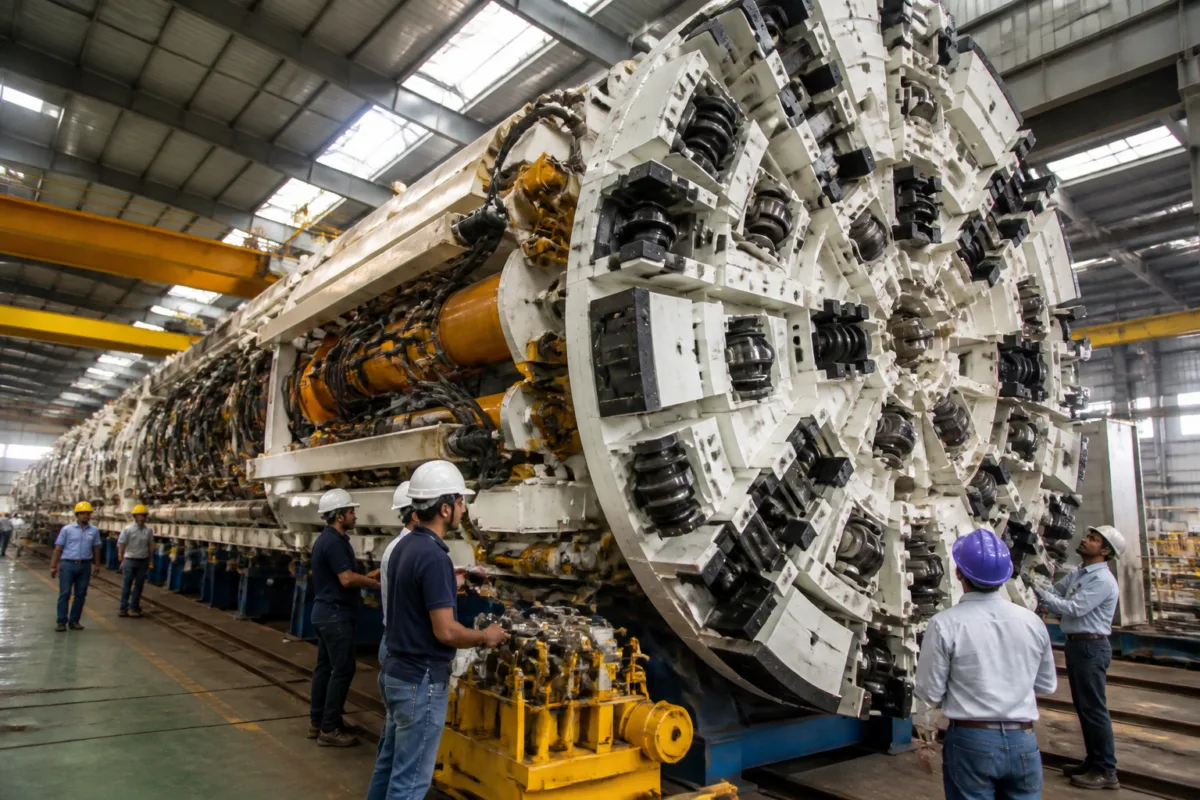
China’s decision to impose export controls on tunnel boring machines has exposed a vulnerability that India’s infrastructure boom cannot solve through project spending alone: the country still depends on overseas suppliers for several categories of specialised construction equipment. The proposed $1.2 billion incentive scheme for construction and infrastructure equipment manufacturing is therefore not just an industrial policy measure. It is a test of whether India can build the machinery, components and supply chains required to deliver its own roads, metros, railways, ports and mining projects reliably.
The controls, announced on October 19 and scheduled to take effect on November 18, require exporters of tunnel boring machines and other specified machinery to obtain licences under China’s dual-use export control framework. The measures also cover walking excavators and plateau-type wet shotcrete machines. Beijing has said the controls are intended to safeguard national security and interests. For India, however, the immediate concern is less about a single trade measure than about the structure of its infrastructure supply chain.
The vulnerability became visible in 2024, when Chinese customs clearances for tunnel boring equipment bound for India became a bottleneck. Some machines required for major projects, including the Mumbai-Ahmedabad bullet train corridor, were manufactured by German company Herrenknecht at facilities in China. This distinction is important. A machine may carry the technology and brand of a European manufacturer, but its country of manufacture can still determine whether it is accessible during a trade or licensing disruption.
India’s trade figures show the disruption in imports, although they do not capture the full cost of project delays. Imports of tunnelling machinery from China fell from $18 million in 2022-23 to $3 million in 2023-24. They declined to $500,000 in 2024-25 before rising to $800,000 in 2025-26, according to figures cited in the source report. The numbers indicate a sharp reduction in recorded imports, but they do not establish whether projects replaced Chinese supply with machinery from other countries, delayed procurement or used equipment already available in India.
The immediate effect on highway construction is not expected to be large. Industry executives cited in the report said India is largely self-sufficient in conventional construction equipment, while alternative import sources exist for some specialised machinery. The pressure points are more concentrated: tunnelling equipment, high-duty engines, heavy cranes and other high-value systems where domestic production remains limited or uneconomical.
That distinction explains why India’s proposed incentive package matters. The scheme, announced in the Union Budget for 2026-27 and nearing final approval after inter-ministerial discussions, is expected to provide $1.2 billion in incentives over seven years and attract $1.8 billion in additional investment. It may cover equipment ranging from tunnel boring machines and firefighting systems to elevators used in high-rise buildings. The proposed framework is also expected to include local value-addition targets for machinery that India currently imports almost entirely.
The central policy question is whether the scheme will support genuine industrial capability or merely encourage final assembly. India has established manufacturing capacity in conventional machinery. Domestic firms and the Indian operations of global companies such as Caterpillar, Komatsu and JCB already support production of widely used construction equipment. But localisation is uneven, particularly in components that determine the performance and resilience of specialised machines.
Overall localisation in construction equipment is estimated at around 50%, according to a Boston Consulting Group and Confederation of Indian Industry report cited in the source material. Backhoe loaders have reached localisation levels of 85-90%, while excavators are at 55-60%. Hydraulics, electronic controls and undercarriage systems remain heavily dependent on imports. These components may not attract public attention in the way a tunnel boring machine does, but they can become the point at which an apparently domestic supply chain fails.
This is why a machine assembled in India is not necessarily a fully secure domestic product. If its precision components, control systems, specialised powertrains or critical subassemblies are imported, an export restriction elsewhere can still affect availability, maintenance or replacement parts. The proposed scheme’s success will therefore depend on whether local value-addition targets measure the capabilities that matter, rather than only the share of final assembly completed within the country.
The demand required to support that shift already exists. India’s mining and construction equipment market was valued at about $17 billion in domestic demand in 2025, with annual growth estimated at 10-12%. The market is being driven by investment in highways, metro rail, freight corridors, airports, ports and mining. Capital expenditure across sectors linked to mining and construction equipment is estimated to rise from around Rs 5.5 lakh crore in 2025 to Rs 9-10 lakh crore by 2030.
Each part of that investment pipeline creates a different equipment requirement. Roads generate demand for earthmoving and paving machinery. Railways need tunnel boring machines, piling rigs and viaduct cranes. Ports and airports require specialised material-handling systems. Mining requires excavators, drilling systems, dump trucks, crushing machinery and digital fleet-management technologies. The expansion of domestic production of critical minerals for batteries, electric vehicles and renewable energy equipment could add to that demand.
The wider economic footprint makes the issue larger than an equipment procurement problem. The BCG-CII analysis cited in the report places India’s mining and construction output at around $430 billion, equivalent to nearly 11% of GDP, with more than 70 million people supported across the value chain. Equipment availability affects the productivity of these sectors, the timing of infrastructure delivery and the ability to maintain assets after construction.
But demand alone will not create a competitive manufacturing ecosystem. Companies need sufficient production volumes to justify spending on research, tooling and supplier development. Infrastructure agencies and project developers need procurement systems that provide predictable demand over time. Manufacturers need stable localisation milestones and clarity on how domestic content will be assessed. Without those conditions, an incentive programme could support isolated production lines without creating the deeper network of component suppliers needed for resilience.
The possibility of domestic production is already visible in some strategic areas. State-owned BEML has plans to manufacture tunnel boring machines domestically, while equipment companies including Larsen & Toubro and Johnson Lifts could benefit from a broader manufacturing push. The relevant test will not be whether particular firms can produce individual machines, but whether India can develop a dependable ecosystem around them, including component makers, testing facilities, maintenance networks and skilled technical personnel.
There is also an export opportunity. India’s exports of mining and construction equipment nearly tripled over the past decade to around $4.9 billion in 2025, according to the BCG-CII analysis. India now exports more equipment than it imports, although its position varies across product categories. The global industry is estimated at roughly $420-440 billion, with annual global imports of about $150 billion. India currently accounts for less than 4% of that import demand.
Developing markets in Southeast Asia, Africa, the Gulf and South America could provide room for expansion. These regions are investing in infrastructure and mining while relying heavily on imported machinery. China supplies nearly half of equipment imports in many of these markets, creating a potential opening for alternative suppliers. Capturing that opportunity, however, would require more than lower factory prices. Buyers also assess after-sales service, financing, spare-parts access, maintenance support and the ability of machinery to operate in local conditions.
The BCG report’s long-term projections are ambitious. It envisages India capturing at least 20% of the global export market by 2047, representing an annual opportunity of roughly $75 billion, while the domestic mining and construction equipment industry could reach $180-200 billion. These are targets rather than established outcomes. Achieving them would require a significant expansion in technology, manufacturing scale and international competitiveness.
China’s export controls have made the policy challenge more immediate, but they did not create it. The underlying issue is the gap between India’s infrastructure ambitions and the industrial depth needed to supply the machinery behind them. The proposed incentive scheme can address that gap only if it moves beyond replacing one import source with another and strengthens the components, capabilities and service networks that make infrastructure equipment dependable.
The evidence currently confirms three separate realities: India has strong and growing demand for construction and mining equipment; domestic localisation is substantial in some conventional categories but weak in several high-value components; and export controls can expose dependencies even when the equipment brand is not Chinese. The next important milestones are the final approval and design of the incentive scheme, the localisation standards it adopts and whether manufacturers commit to producing sophisticated equipment and critical components at commercial scale.

