


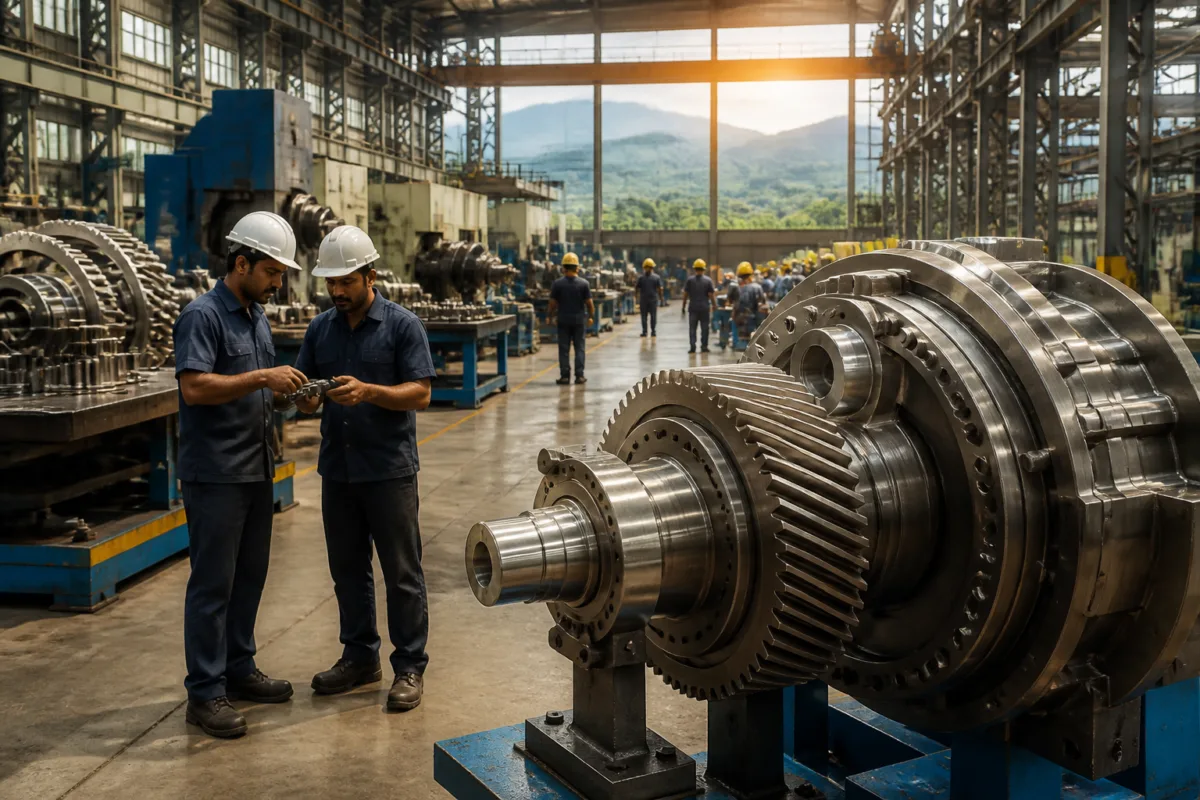
ZF Group’s plan to increase sourcing from India by 10–15 per cent annually over the next three to four years is more than a procurement decision. It shows how India is being positioned inside a global manufacturing network that spans commercial vehicles, passenger cars, construction equipment, industrial technology and wind power. It also reveals the limits of the low-cost manufacturing model: longer shipping times, rising electronics prices and the need to develop products specifically for local markets.
The German automotive components and industrial technology company has already increased its sourcing from India by around 20 per cent in three years. Andreas Moser, a member of ZF’s board of management, told Business Standard that Indian suppliers provide a cost advantage of approximately 20 per cent even after shipping expenses are included. The company sources steel, metal castings, fully machined components and complete units for its overseas operations.
ZF’s present sourcing value from India is approximately 600 million euros a year for its commercial vehicle business, 500–600 million euros for passenger vehicles and 150 million euros for industrial technology. Together, these figures indicate an annual sourcing base of roughly 1.25–1.35 billion euros, although the company’s businesses and categories are reported separately. The planned growth would make Indian suppliers more important to ZF’s international production system, but the numbers also show that the opportunity is distributed across multiple industrial segments rather than concentrated in one product line.
The larger shift is visible in ZF’s stated ambition for India. Moser said the company does not want the country to remain primarily a source of inexpensive materials, manufacturing and engineering services. Instead, Indian teams are expected to play a stronger role in determining the technologies and products needed by local customers, with the global organisation supporting their development.
That distinction matters because sourcing and product development create different kinds of industrial capability. Procurement can expand volumes and supplier relationships, while local engineering determines whether products are designed around the cost, operating conditions and purchasing power of the market in which they will be used. ZF’s India operations include around 20,000 employees, 17 production locations and thousands of engineers, according to Moser. The company’s stated direction suggests that these capabilities are increasingly being connected rather than treated as separate functions.
India sourcing growth is moving beyond a low-cost proposition
ZF’s example of a transfer case illustrates the challenge of adapting global products to Indian price levels. A transfer case developed for European requirements costs around 3,000 euros, while the acceptable price level in India is approximately 1,500 euros, Moser said. The company’s conclusion is that an existing European product cannot simply be made cheaper indefinitely. A separate product has to be developed around local technical requirements and sourced in India.
This approach changes the meaning of localisation. It is not limited to assembling an imported design or replacing a few components with local alternatives. It requires engineering decisions, supplier capability and manufacturing processes to be planned together. In sectors such as agricultural machinery and construction equipment, where ZF is working on transmissions, axles and related systems, the ability to meet local price and performance requirements can determine whether advanced components are adopted at scale.
The construction equipment connection is particularly relevant to the built environment. Machines used for roads, buildings and other infrastructure depend on reliable transmissions, axles and power systems. The source material does not establish the volume of construction equipment sold in India or quantify the effect of ZF’s products on project costs. It does, however, show that the company sees Indian development and sourcing as part of its strategy for products used in industrial and equipment markets.
ZF’s industrial technology business in India generates approximately 300–400 million euros in annual revenue, excluding wind power, and is expected by the company to grow by 5–10 per cent annually over the next few years. That forecast is an internal company assessment rather than an independently verified market estimate. Its significance lies in the range of activities involved: India is being used not only to supply components but also to support industrial products and engineering-led businesses.
### The Coimbatore wind-power plant shows the scale of the manufacturing base
India’s role is even more pronounced in ZF’s global wind-power business. The company’s Coimbatore plant accounts for around 60 per cent of its global production of wind-turbine transmissions, according to Moser. The plant was operating at a capacity level of 12 gigawatts, with further investment planned to raise that figure to 14 GW. Around 75 per cent of its production is supplied to international markets.
These figures make the Coimbatore facility an example of export-oriented industrial infrastructure embedded within a regional manufacturing ecosystem. The plant is not described merely as a domestic supplier. Its output supports ZF’s worldwide wind-power operations, which generate around one billion euros in annual revenue.
The company expects global wind-power revenue to grow by approximately 6–7 per cent annually. Moser also said the industry could not sustainably maintain the 10–20 per cent annual growth rates previously anticipated because developing and commissioning new wind farms takes time. This qualification is important. Manufacturing capacity can be expanded ahead of demand, but the deployment of energy infrastructure depends on project development, approvals, construction and commissioning. Factory growth and infrastructure delivery therefore do not always move at the same speed.
For Indian industrial centres, the Coimbatore example also highlights the value of producing specialised equipment for global markets. The source does not provide details on local employment, supplier counts or public incentives connected to the plant, so those aspects cannot be assessed from the available evidence. What is established is that a plant in India has become a major production location for a global component category and sends most of its output abroad.
Electronics shortages expose the vulnerability of industrial expansion
ZF’s growth plans are unfolding alongside rising pressure on electronic components. Moser said printed circuit board prices could rise by 30 per cent from one day to the next because AI data centres were competing aggressively for electronics. The company is also facing semiconductor shortages, while some customer contracts were negotiated three to five years ago and make it difficult to pass higher costs through quickly.
This creates a structural tension in the manufacturing model. India may offer a cost advantage in metals, castings, machined components and complete units, but a product’s final cost can still be affected by globally contested electronic parts. A company can localise mechanical manufacturing while remaining exposed to international shortages in semiconductors and printed circuit boards.
ZF is responding by seeking alternative suppliers and materials and negotiating price increases with customers. These are company-level responses, but they also show why industrial competitiveness cannot be measured only by factory wages or procurement prices. Supplier depth, component availability, contract structures and the ability to redesign products all influence whether a sourcing advantage can be sustained.
The shipping equation is also changing. Moser said sea freight transit time from India to Europe had increased from approximately six weeks to eight weeks since the conflict under discussion began. Longer transit times tie up working capital in goods in transit and reduce a manufacturer’s ability to respond quickly to changes in demand. They also weaken some of the advantage created by lower production costs.
ZF is therefore continuing to source from multiple countries instead of depending entirely on India. That decision places a limit on how India’s sourcing growth should be interpreted. The company expects purchases from India to rise, but it is not replacing geographic diversification with a single-country model. Resilience, rather than maximum concentration, remains the operating principle.
The policy question is capability, not only volume
The evidence in ZF’s account points to a broader question for India’s manufacturing and infrastructure ambitions: can the country move from supplying competitively priced components to shaping products, technologies and production systems for global markets?
ZF’s stated strategy provides some indicators of that transition. India has a large operating base within the company, with 20,000 employees, 17 production locations and thousands of engineers. The country supplies products to overseas businesses, manufactures wind-turbine transmissions at significant scale and is developing equipment-related products for local customers. At the same time, the company still faces higher logistics times, volatile electronics costs and the need to maintain suppliers across multiple countries.
The available material does not establish which government programmes, tax arrangements or local industrial policies support ZF’s expansion. It also does not quantify the number of Indian suppliers involved or identify how much of the value in the sourced products is generated domestically. Those gaps matter because sourcing growth alone does not show how deeply an industrial ecosystem has developed.
What the evidence does confirm is a two-track model. India is being used as a cost-competitive export base, while ZF is also trying to build products around Indian requirements and use local engineering for global operations. The success of that model will depend on whether the country can support both sides: high-volume manufacturing and the design, electronics, logistics and supplier capabilities needed to make that manufacturing resilient.
ZF’s projected 10–15 per cent annual sourcing growth therefore signals opportunity, but not a completed transformation. The company’s India operations are expanding across automotive, industrial technology, construction equipment and wind power, yet exposure to shipping delays and globally scarce electronics remains. The next developments to monitor are the planned sourcing growth, the expansion of the Coimbatore plant from 12 GW to 14 GW, and the extent to which products developed in India become part of ZF’s wider global portfolio.

