


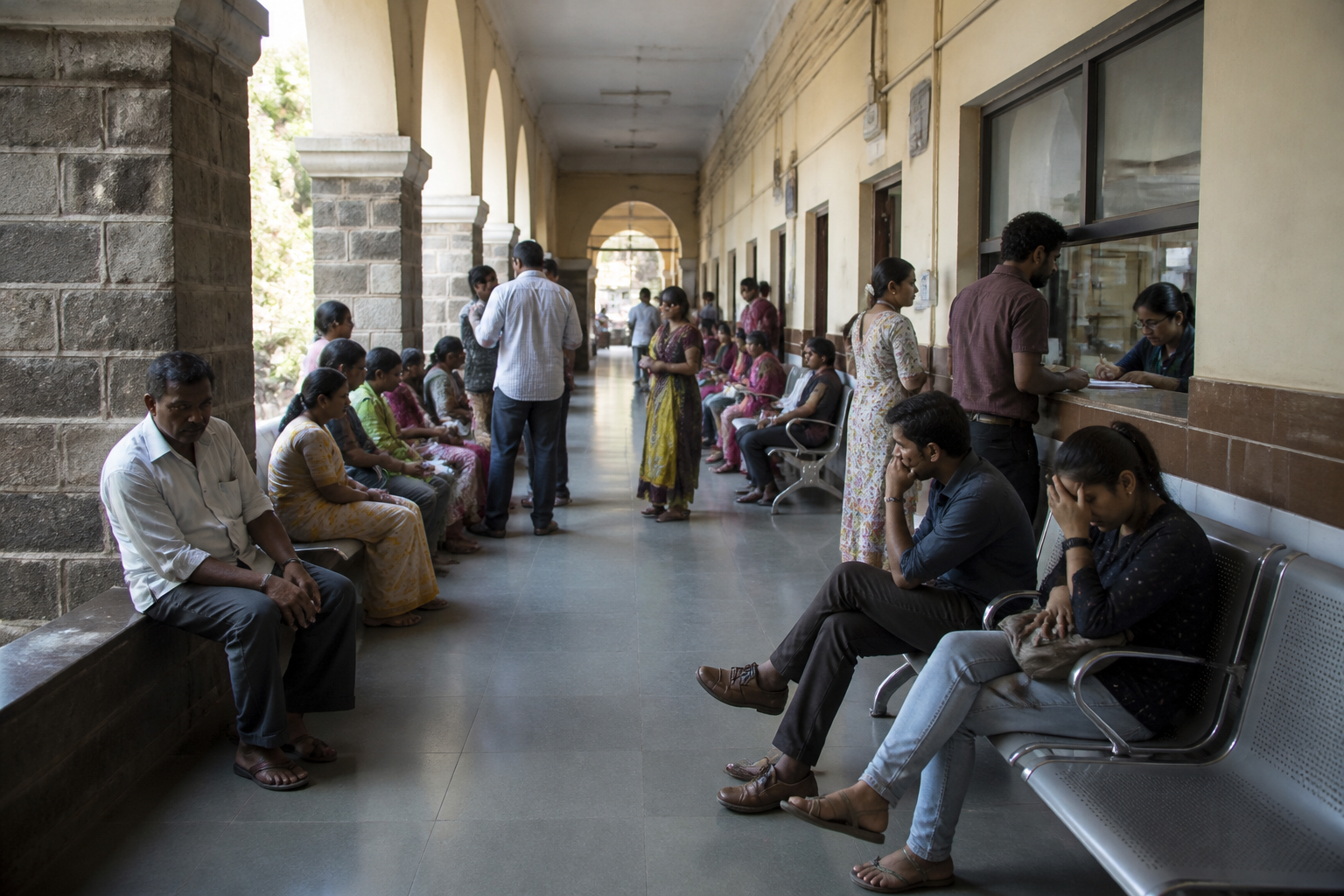
More than 31,000 people sought treatment at the psychiatry outpatient department of Pune’s Sassoon General Hospital between January and September 2026, according to figures reported by Lokmat. The number is not, by itself, proof that the prevalence of mental illness has risen by the same proportion. It does, however, show the scale of demand reaching a public hospital system that serves people across Pune and surrounding urban areas.
The report places the Sassoon figures alongside a sharp increase at Yashwantrao Chavan Hospital in Pimpri-Chinchwad. The hospital recorded 4,429 psychiatry patients in 2021 and 11,985 in 2025, an increase of about 171 per cent over five years. At Sassoon, 51,416 patients used the psychiatry outpatient department during 2025. In the first nine months of 2026, the department recorded 31,655 patients: 18,159 in Unit One and 13,496 in Unit Two.
Taken together, these numbers reveal a public-service challenge rather than a simple count of individual cases. Government hospitals are often the most visible and accessible point of care for residents who cannot afford private treatment or who require continuing clinical support. A rise in outpatient attendance therefore reflects several forces at once: the level of distress in the population, greater awareness of mental-health treatment, willingness to seek professional help and the availability of services. The report itself cautions that the increase cannot be attributed to a single factor.
That distinction matters for how city administrations and health institutions read the data. More patients at a hospital may indicate worsening mental-health conditions. It may also indicate that stigma is declining and more people are entering the formal health system. It can additionally reflect the concentration of specialist services in a limited number of large public hospitals. The numbers establish growing demand, but they do not independently measure the prevalence of depression, anxiety or other mental-health conditions across Pune.
The social pressures identified in the report are closely connected to urban life. Young people are described as facing pressure related to examinations, careers and employment, alongside unemployment, indebtedness and substance dependence. Older residents may experience loneliness when children move away for work or business, when a spouse dies, when physical limitations reduce independence or when social contact declines.
These pressures do not operate separately from the city’s institutions. Education, employment, housing costs, family structures, mobility and access to healthcare shape how distress develops and whether people can obtain help. Yet the available figures capture only those who reach a hospital outpatient department. They do not show how many people remain untreated, delay care, seek help from informal networks or are unable to travel to a specialist facility.
The report’s account of addiction illustrates another layer of the problem. Some people may use alcohol, tobacco or other substances as an attempt to obtain temporary relief from psychological stress. The report notes that dependence can worsen family relationships, household finances and physical health without resolving the original mental-health difficulty. This creates a service requirement that extends beyond a single consultation. Medical treatment, counselling and family support may need to work together, particularly when substance use and mental-health symptoms overlap.
For public hospitals, this overlap can complicate both diagnosis and continuity of care. A patient may arrive with a physical complaint, substance-related harm or a crisis at home rather than with a clearly identified psychiatric condition. The report does not provide staffing, waiting-time or bed-capacity data for Sassoon or Yashwantrao Chavan Hospital, so it cannot establish whether the rise in attendance has produced a measurable capacity shortfall. It does show that the outpatient system is handling a large and growing volume of demand.
The Sassoon data also have to be read carefully. The 31,655 patients recorded from January to September 2026 represent nine months, while the comparison figure of 51,416 is for the full year of 2025. A direct year-on-year conclusion cannot be drawn until the remaining months of 2026 are included. The available figures nevertheless indicate that the department is already handling a substantial caseload, with the two units accounting for more than 18,000 and 13,000 patients respectively during the period reported.
The Yashwantrao Chavan Hospital figures offer a clearer multi-year comparison. Patient numbers rose from 4,429 in 2021 to 11,985 in 2025. The reported 171 per cent increase is significant, but it still does not answer the question of what changed inside the service system. Possible contributors identified in the report include rising mental-health problems, increased awareness and improved availability of healthcare. Without additional information on staffing, service expansion, referral patterns and population growth, the figures cannot distinguish among these explanations.
This is where public-health governance becomes important. The report states that free treatment for mental-health problems is available at government hospitals through the Mahatma Jyotirao Phule Jan Arogya Yojana. That provision can reduce the financial barrier to seeking care, but affordability is only one part of access. People also need to recognise symptoms, reach a facility, obtain an appointment, continue treatment and receive support when their condition affects work, education or family life.
The report identifies persistent sadness, changes in sleep or appetite, withdrawal from social contact, increasing substance use and negative thoughts about life as signs that should not be ignored. It quotes Dr Manjeet Santre, a psychiatrist at Yashwantrao Chavan Hospital, as saying that timely psychiatric advice, counselling and emotional support from family can help a person cope with the situation. The emphasis on communication is significant because the first response to distress often occurs within the household or social circle, before a person enters the formal health system.
For older residents, the institutional question extends beyond hospital treatment. Loneliness can be associated with reduced social interaction, loss of independence and difficulty maintaining daily routines. The report recommends regular communication with older people, involving them in decision-making and seeking specialist help when necessary. These are not substitutes for clinical care, but they indicate that mental-health support is also shaped by family arrangements and social participation.
For young people, the pressures described in the report point to a different access challenge. Examination, career and employment stress can be episodic, while unemployment, debt and addiction can persist over longer periods. A hospital outpatient department can provide diagnosis and treatment, but the report does not establish whether counselling or support is available through educational institutions, workplaces or community-level services. That gap in the available evidence is important: hospital attendance shows demand at the point of care, not the full network of prevention and early intervention.
The central lesson from the Pune and Pimpri-Chinchwad figures is therefore institutional rather than merely clinical. Public hospitals are becoming important points of entry for residents experiencing psychological distress. Their records can help identify changing demand, but the numbers need to be paired with information about staffing, referral systems, treatment continuity, waiting times and the geographic distribution of services before policymakers can assess whether the system is keeping pace.
The evidence currently confirms three facts. Sassoon recorded 31,655 psychiatry outpatients in the first nine months of 2026; it recorded 51,416 during 2025; and Yashwantrao Chavan Hospital’s reported patient count rose from 4,429 in 2021 to 11,985 in 2025. The evidence also shows that the causes of rising attendance are mixed and cannot be reduced to a single explanation. The next useful public record would be a clearer account of how hospitals are responding to this demand and how mental-health support is being made available before distress becomes a hospital-level crisis.
