


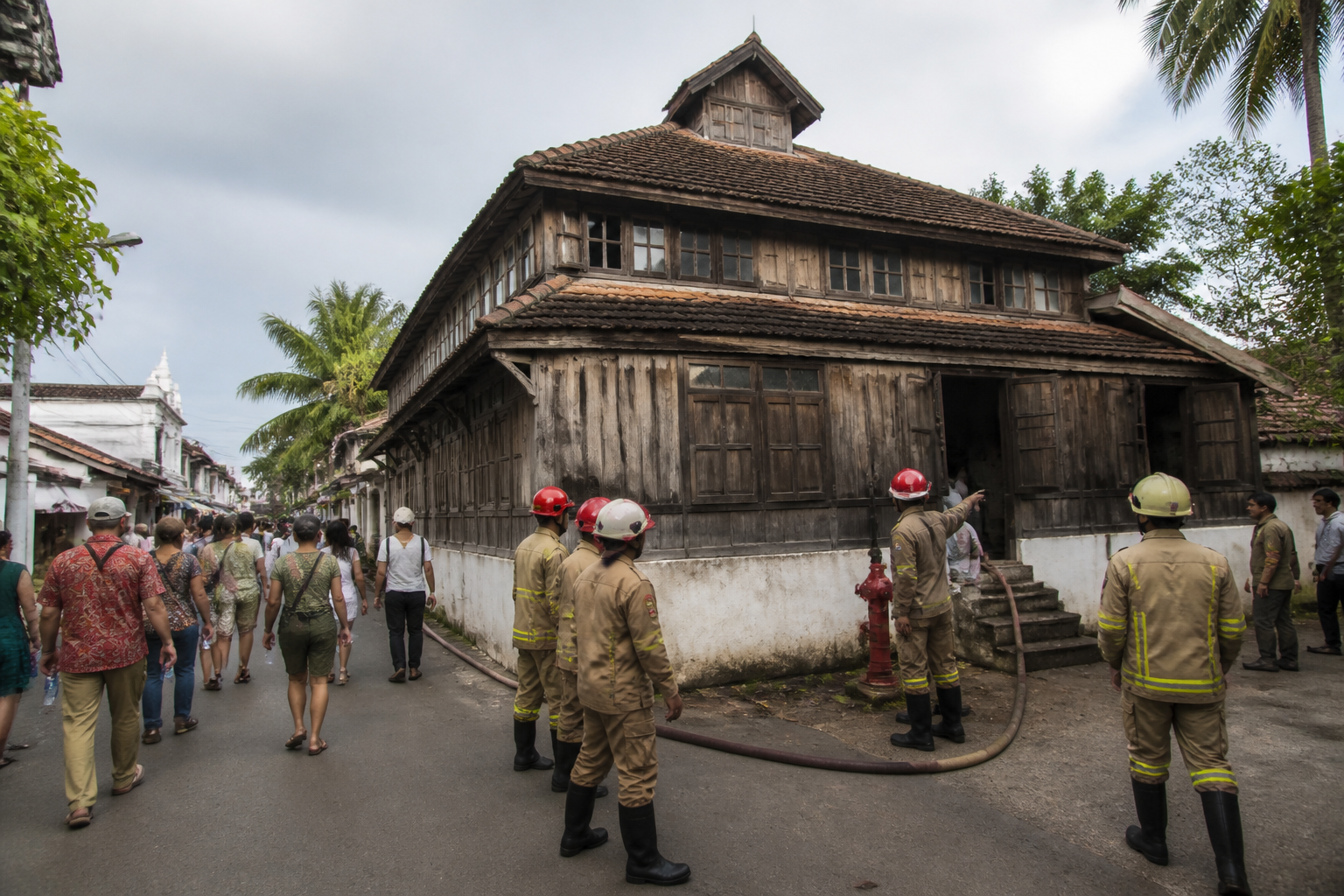
A fire at the Coder House hotel in Fort Kochi last month exposed a risk that remains unresolved across the city’s heritage precinct: historic buildings that attract thousands of visitors continue to operate with little more than standalone fire extinguishers, according to a report by Madhyamam – Kochi. The concern is not limited to one damaged property. It involves a wider mismatch between the preservation of old buildings, their present-day commercial and tourism uses, and the fire-safety systems needed in a dense urban neighbourhood.
The report says the Coder House hotel caught fire on the 29th of last month. Questions were raised both about shortcomings in firefighting operations and the absence of adequate fire-safety precautions at the hotel. It also says that, even after the incident, authorities had not inspected the heritage buildings, institutions and monuments in Fort Kochi, despite the presence of hundreds of such structures in the Mattancherry and Fort Kochi areas.
That gap matters because many of the buildings are substantially made of wood. Floors, ceilings and roofs in several heritage structures use old timber elements that can burn rapidly once a fire takes hold. These buildings are not preserved as empty architectural shells. They accommodate hotels, art galleries, museums, places of worship and other visitor-oriented activities. The result is a built environment in which combustible historic fabric and high daily footfall exist together.
The evidence cited in the report is particularly revealing at three prominent sites. David Hall, a Dutch-built structure associated with the work of Hendrik Adriaan van Rheede during the Dutch period, now functions as an art gallery and hotel. Despite receiving many visitors, the building reportedly has only one six-kilogram fire extinguisher for fire protection.
St Francis Church, described in the report as India’s first European church and another major tourist destination, reportedly has only one four-kilogram fire extinguisher. The district heritage museum operates from Bastion Bungalow, a Portuguese-built bastion of the former Emmanuel Fort, described as the first European fort in the country. The museum has a fire-alert system, but the report says its other safety provision includes only one six-kilogram extinguisher. Much of the structure is made of wood.
These examples do not establish that every heritage building in the precinct has identical deficiencies. They do, however, show why a site-by-site inspection is important. The report says that many historic monuments have only one extinguisher installed nominally. An extinguisher can be useful during the initial stage of a fire, but it is not a substitute for a broader system capable of detecting fire, supplying water, allowing emergency access and supporting evacuation in a crowded building.
The physical setting makes the issue more difficult. Bastion Bungalow is close to the sea and is exposed to persistent coastal winds, according to the report. Wind can make fire control more demanding, while the historic construction and the presence of visitors increase the consequences of a delayed response. The report also identifies congestion around the Mattancherry synagogue area, where the concentration of shops can obstruct rescue operations.
The area’s fire-safety problem is therefore not only about equipment inside individual buildings. It is also about the infrastructure of the precinct. Residents have called for an emergency fire unit in Fort Kochi, which is both a heritage zone and a densely populated area. Their demand reflects the importance of response time in an urban district where narrow or crowded streets, tourism activity and older structures can complicate the movement of fire engines and rescue teams.
Mattancherry fire and rescue station officer Jehufar told the newspaper that heritage buildings, including historic monuments, require a yard hydrant system as part of their fire protection. Such a system uses valves installed in courtyards or open spaces to make water available quickly near the building. The recommendation shifts the focus from isolated portable equipment to shared, fixed infrastructure that can support firefighting across a heritage compound.
That distinction is central to understanding the institutional problem. A portable extinguisher places responsibility on occupants to identify a fire, reach the equipment, operate it correctly and contain the incident before it spreads. A hydrant network, fire alarms, emergency access and inspection regime require coordination between building managers, the fire and rescue department, heritage authorities, tourism institutions and local administration. In a precinct with multiple ownership and operating arrangements, the absence of a clearly enforced common standard can leave safety provision fragmented.
The report does not provide a consolidated audit of all heritage properties in Fort Kochi, nor does it state how many buildings currently comply with fire-safety requirements. It also does not quantify the number of visitors at each site or specify the response time of the nearest fire station. Those gaps are themselves significant. Without a publicly available inventory and risk assessment, authorities and citizens cannot easily determine which buildings are most vulnerable, which properties have active commercial use, or where investment in shared safety infrastructure should begin.
The heritage character of Fort Kochi adds another layer to the challenge. Historic buildings cannot always be altered in the same way as modern structures. Installing wiring, alarms, water lines or access infrastructure may require careful design to avoid damaging architectural features. But conservation constraints cannot become a reason to leave buildings without effective protection. The report’s account suggests that the current approach in some sites has stopped at the most basic visible provision rather than creating a system suited to the buildings’ actual risks.
The economic role of the precinct also raises the stakes. Tourism guides quoted in the report have called for a special heritage-conservation package. The buildings support visitor activity and accommodate public-facing uses, but their continued operation depends on the safety of people who enter them. A fire in one prominent building can damage not only the structure itself but also the wider confidence in a heritage district that depends on access, tourism and daily commercial activity.
The policy question is consequently broader than whether a particular monument has an extinguisher. It is whether heritage management in a living urban area includes safety planning as a core responsibility. A functioning plan would need to identify the buildings, assess their construction and occupancy, map access routes, install suitable detection and water systems, train staff, maintain equipment and conduct regular inspections. The source report establishes the need for such attention but does not say that a comprehensive plan is currently in place.
Fort Kochi’s situation also illustrates the difference between preserving buildings and managing a heritage neighbourhood. Individual monuments can be protected through restoration projects, while the surrounding streets remain congested and emergency infrastructure remains inadequate. Fire risk travels across property boundaries, particularly where timber buildings stand close to shops, hotels and public institutions. That makes a precinct-level response more relevant than isolated compliance by individual establishments.
What the available evidence confirms is a serious safety deficit at several well-known heritage sites, the absence of reported inspections after a recent hotel fire, and a demand from residents and fire officials for stronger local infrastructure. What remains unclear is the full extent of non-compliance across the precinct, the responsibilities of each authority, and the timeline for installing systems such as yard hydrants. The next meaningful step is therefore not another isolated equipment placement, but a documented inspection and coordinated fire-safety plan for Fort Kochi and Mattanchery’s heritage buildings.
