


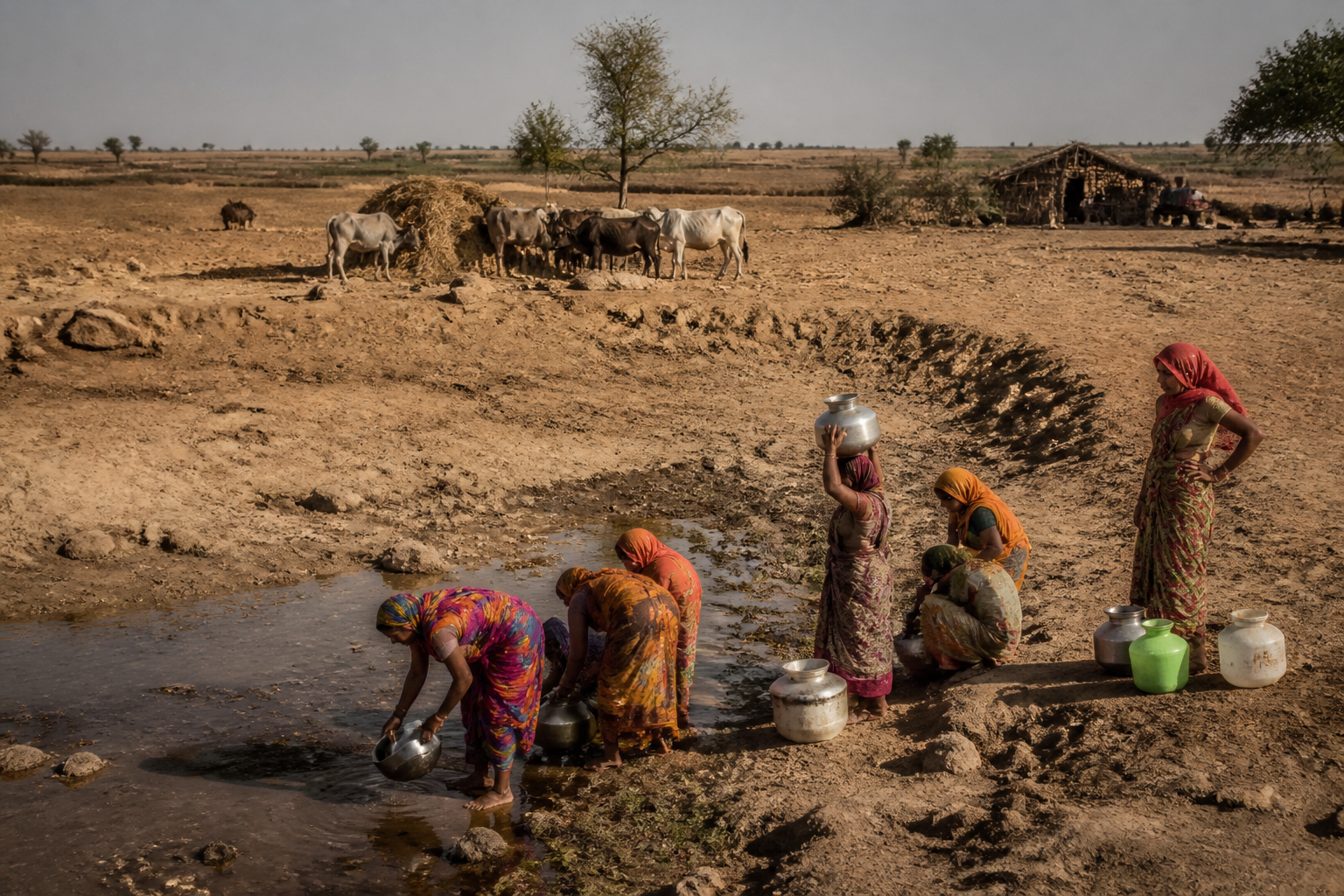
A meeting of agriculture, water conservation, education and administration experts in Pune has placed drinking water, livestock survival, employment and farmer support at the centre of Maharashtra’s response to the ongoing drought in Marathwada. The recommendations discussed at the meeting are significant not because they represent an approved government plan, but because they expose how drought relief in the region is tied to several systems at once: water supply, rural livelihoods, crop choices, employment guarantees and the movement of affected people to cities.
The meeting was organised in Navi Peth by the SM Joshi Socialist Foundation and the Marathwada Coordination Committee, a Pune-based group. Participants said they were preparing an action plan to be submitted to the state government. The proposals included ensuring drinking water through the summer, arranging fodder for cattle, implementing updated employment schemes, considering tax waivers and providing financial support to farmers.
The immediate issue is relief. The larger issue is whether drought can be managed through a series of short-term measures or whether the region’s development and agricultural systems need to be reconsidered at a more localised level. The discussion in Pune brought together people with connections to Marathwada as well as experts working on agriculture, water conservation, education and administration. That combination reflects the breadth of the crisis described by the participants.
The relief system is being asked to address several forms of vulnerability simultaneously. Drinking water is a direct public service obligation. Fodder is essential to the survival of cattle and the continuity of rural livelihoods. Employment support becomes critical when agricultural work declines. Farmer assistance and possible tax waivers address the financial consequences of crop stress. None of these measures operates independently: a failed agricultural season can increase demand for wage work, pressure household finances and encourage people to move in search of employment.
Subhash Ware, president of the SM Joshi Socialist Foundation, said residents of Marathwada living in Pune were concerned about the situation and wanted to contribute to solutions. He described the drought as more acute than usual and said the experts were formulating long- and short-term recommendations for the state government. His comments also point to an important urban connection. Pune is not only the location where the meeting took place; it is also a city with a Marathwada-origin population that remains connected to conditions in the region.
That connection matters for how drought is understood. A drought is often reported as a rural or agricultural emergency, but its effects can extend into cities through migration, remittances, labour markets and the demand for public services. The meeting did not provide figures on migration or urban population pressures, so the scale of these effects cannot be established from the available material. It did, however, explicitly raise the question of employment for people affected by drought who may move to cities.
Vivek Ghotale, director of Unique Foundation, proposed that work under the Mahatma Gandhi National Rural Employment Guarantee Scheme should be started in cities for migrants. Advocate Santosh Mhaske called for changes to the employment guarantee programme, including revisions based on the nature of jobs and the level of wages. These suggestions shift the employment discussion beyond the conventional division between rural drought relief and urban administration.
The proposal also raises an institutional question: which government level is responsible when a drought-affected person leaves a rural area and arrives in a city? The report does not state whether any city-level employment programme has been approved or whether the proposed changes have been considered by the government. It records the participants’ demand for a broader and updated employment response. The distinction is important because a proposal discussed at a meeting is not the same as a notified policy or funded programme.
The emphasis on employment is also linked to the changing nature of work. Mhaske said the employment guarantee scheme should be updated in view of the nature of jobs and wages. The supplied report does not identify the specific occupations or wage levels under discussion. It does show, however, that participants consider the existing framework insufficient for the conditions faced by affected people. The question is therefore not only whether work is available, but whether the design of the programme corresponds to the way drought-affected households now earn, migrate and support themselves.
Water management formed another central part of the discussion. Water expert D M More called for a ban on sugarcane cultivation and sugar factories in drought-affected areas, arguing that sugarcane uses large quantities of water. This was presented as an expert proposal, not as an existing government decision. It brings crop choice and industrial location into the drought debate, rather than treating water scarcity only as a failure of rainfall or emergency supply.
Gajanan Khatu, a senior socialist leader who attended the meeting, identified dryland agriculture as the root issue behind the drought. He described it as cultivation carried out entirely under rain-fed conditions without irrigation. Khatu also argued that the region’s development plan should be implemented with the taluka as the unit of planning, allowing a more focused approach.
These two interventions point to different but related ways of looking at the crisis. More’s proposal focuses on the water intensity of crops and the industrial activity associated with them. Khatu’s argument focuses on the vulnerability of farming systems that depend on rainfall and on the scale at which public planning is undertaken. Together, they suggest that drought mitigation is being debated not only as an emergency response but also as a question of land use, agricultural risk and administrative design.
A taluka-level approach, as proposed at the meeting, would represent a more granular planning framework than a broad regional response. The report does not specify how such plans would be prepared, which department would lead them, or how funding and implementation would be monitored. It does establish that participants believe conditions and needs may vary within Marathwada and that a smaller administrative unit could provide a more focused basis for action.
The proposal for a study committee follows the same logic. Participants said a committee would be formed to advise the government on measures to address the crisis. The committee’s membership, mandate, timeline and reporting process were not provided in the report. Those details will determine whether the exercise becomes a formal policy input or remains a consultation document.
The immediate priorities identified at the meeting are clear. Subhash Lomte, secretary of the SM Joshi Socialist Foundation, said the government had the main responsibility for providing drought relief because its administrative network was extensive. He highlighted drinking water, animal fodder and employment as issues likely to become serious in the coming period. His statement places the responsibility for coordinating relief with the state system rather than with voluntary organisations or affected communities alone.
That division of responsibility is important in a drought because the measures discussed sit across multiple administrative functions. Water supply, livestock support, employment, agriculture and financial relief may involve different departments and delivery mechanisms. The source report does not detail the existing coordination arrangements. The meeting’s recommendations nevertheless indicate that participants see fragmented responses as inadequate to the combined nature of the problem.
The proposed tax waivers and financial support for farmers add another layer to the response. No details were given on the taxes concerned, the eligibility criteria, the amount of assistance or the source of funding. These omissions mean that the financial proposal cannot yet be assessed as a programme. Its significance at this stage is that the participants view drought as a household and farm-income crisis, not only as a water-supply emergency.
The same applies to drinking water and fodder. The meeting called for water to be provided through the summer and for cattle fodder to be made available. The report does not include information on the number of affected villages, the current status of water tankers, fodder depots or local storage. It therefore cannot establish the operational scale of the requirement. It does show that relief planning is expected to continue beyond the immediate moment and cover the period when local water and agricultural resources remain under pressure.
The discussion also makes visible the limits of an event-driven response. Government action is essential during a drought, as Lomte said, but several participants were asking for changes that would operate before the next emergency: a review of crop and industrial water use, a stronger approach to dryland agriculture, taluka-level development planning and a redesigned employment guarantee framework. These are structural proposals, although their feasibility and consequences remain unexamined in the supplied material.
For cities, the most direct lesson is that drought governance cannot be separated completely from urban governance. Pune hosted the discussion and is home to residents from Marathwada who remain concerned about conditions in their region. The proposal to extend employment support to migrants in cities explicitly connects rural distress to urban administration. Yet the report does not identify a city agency, funding mechanism or legal framework that would deliver such a programme.
That uncertainty is central to the next stage. The experts are expected to prepare recommendations and form a study committee, but no government acceptance, notification or implementation schedule has been reported. The difference between discussion and execution will depend on whether the state government receives the proposed action plan, assigns responsibility, identifies funding and establishes measurable relief milestones.
The available evidence confirms three things. First, participants regard drinking water, cattle fodder and employment as the most immediate pressure points. Second, they connect the drought to deeper questions about rain-fed agriculture, water-intensive cultivation, sugar factories and the scale of development planning. Third, they see migration and urban employment as part of the drought response rather than as a separate issue.
What remains uncertain is equally important: the geographic extent of the drought described, the number of households and animals affected, the current government relief measures, the funding required and the status of the proposed committee. The next meaningful development will be whether the action plan is formally submitted and whether the Maharashtra government converts these recommendations into department-wise, funded and time-bound measures.

