


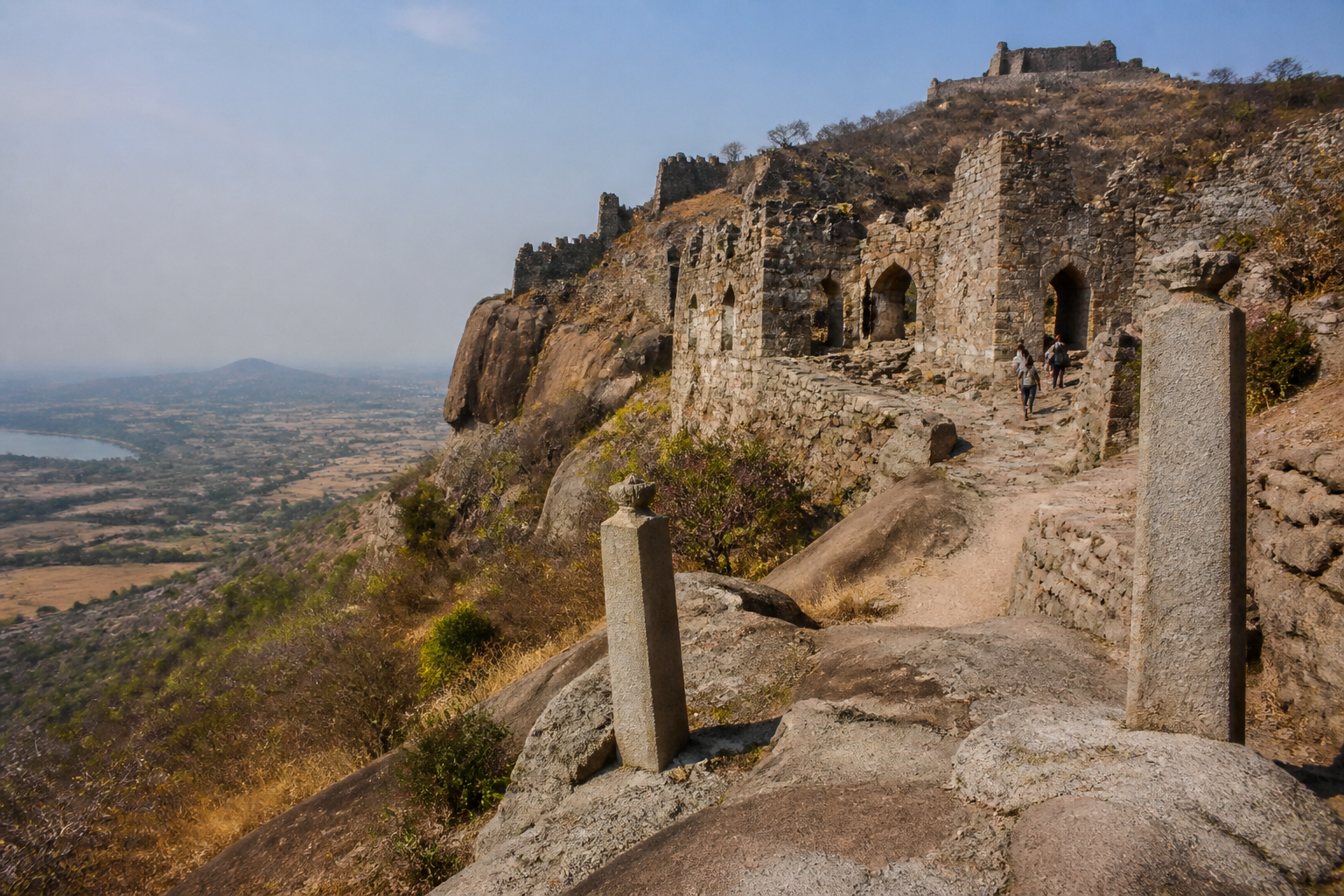
Rachakonda Fort, less than a two-hour drive from Hyderabad, has the physical ingredients of a strong heritage and adventure-tourism destination: a hilltop setting, rocky terrain, historic structures and local stories that have already created public interest. Yet the site remains difficult to visit, poorly supported and largely absent from the region’s organised tourism infrastructure. The problem is not a lack of attraction. It is the unresolved institutional question of who will develop, regulate and maintain the site.
The fort is located at Rachakonda Thanda in Sansthan Narayanpur mandal of Yadadri-Bhongir district. The report places it about 60 kilometres from Hyderabad, while describing the journey as roughly a 90-minute drive. That proximity gives Rachakonda a potential urban-region role: it could function as a short-distance heritage and nature destination for residents of Hyderabad and surrounding districts. But proximity alone does not create a visitor economy. Access, permissions, safety, interpretation and basic facilities determine whether a place can move from local landmark to functioning destination.
Rachakonda Fort was constructed by Recherla Anapotanayaka around 1360 CE and was abandoned in 1430 CE for historical reasons. The surviving structures include ancient arches, monolithic pillars, beams and lintels. Its walls use stone cuts and are described as having a distinctive arrangement, with the outward-facing side built differently from the interior slopes. These features make the fort more than a scenic hillock. They provide the material basis for a heritage site whose value depends on conserving the remains while allowing people to understand and experience them.
The physical experience of reaching the fort is also part of the site’s appeal. The trekking trail is about four kilometres long and passes through rocky terrain and steep slopes. Completing it takes an estimated two to three hours. That places Rachakonda closer to an organised outdoor and heritage experience than to a conventional roadside tourist stop. It also means that the site requires a different form of planning: route management, visitor safety, permissions, trained personnel and information about the terrain cannot be treated as optional additions.
Instead, the report describes a location where even minimum visitor facilities are lacking. This gap is especially significant because the fort lies within a reserve forest. The forest setting creates an environmental and administrative condition that any tourism plan must address from the beginning. It limits what can be built and how activities can be conducted, but it also makes coordination between departments essential. A tourism department may be able to promote a destination, while the forest department controls activities and permissions within the reserve forest. Without a shared operating framework, promotion can create interest without creating a legal or safe way for visitors to access the site.
Chikkula Yadagiri, a member of the Kotha Telangana Charitra Brundam, told Deccan Chronicle that adventure-tour operators cannot conduct trekking trips and camps at Rachakonda without permission from the forest department. His account identifies the practical bottleneck clearly. The issue is not simply that private operators have failed to arrive. Operators require an authorised framework before they can organise activities, set up camps or take responsibility for visitors. The report says the tourism and forest departments should jointly launch trekking and camping packages.
That recommendation points to a broader administrative pattern visible in many heritage and nature destinations. Public agencies may announce the intention to develop a site, but the implementation responsibility remains divided. One agency may focus on tourism promotion, another on forests, another on archaeology or heritage conservation, and local authorities may remain responsible for approach roads, sanitation or other civic services. Unless the roles are defined, a destination can remain caught between departments. Each institution may have a legitimate mandate, but no single operating system exists for the visitor.
Rachakonda’s history of official promises reflects this gap. The report says successive governments have promised to develop the fort as a tourism destination and film-making hub, but that no action followed. The supplied material does not specify the number, dates or financial value of these proposals. It also does not identify an approved master plan, tender, budget allocation or implementation schedule. That absence matters because a promise to develop a heritage site is not the same as a funded, permitted and accountable project.
The proposed film-making role adds another layer to the site’s development question. A location may attract producers because of its rocky landscape, historic remains and distinctive atmosphere, but film activity would still need to be managed within the reserve forest and around vulnerable heritage structures. The source report does not establish whether any filming infrastructure, conservation protocol or approval system currently exists. The evidence therefore supports the conclusion that the film-making ambition remains a stated possibility rather than an operational programme.
Local stories have helped keep Rachakonda visible. One account attributes the fort’s present condition to the curse of a woman killed by local kings. Another refers to the king spilling food mixed with the blood of enemy soldiers after a victory. These stories are described as circulating among local people and as having the kind of mystery that could interest visitors. They should be understood as folklore rather than established historical explanations. Their tourism value lies in the way they connect the landscape to oral memory, but presenting them responsibly would require a clear distinction between documented history and local legend.
That distinction is important for heritage tourism. The fort’s documented physical remains and its historical association with the Recherla rulers provide one kind of evidence. Local narratives provide another kind of cultural value. A functioning visitor experience could bring both together through interpretation, but the supplied report does not indicate that signage, guided tours or interpretive facilities are currently available. Without such systems, visitors are left to encounter the site without context, while legends may circulate without any explanation of what is known, believed or contested.
The available numbers show why Rachakonda needs planned management rather than occasional publicity. The fort is close enough to Hyderabad for a day visit, yet the four-kilometre trail and two-to-three-hour walking time make it physically demanding. The site is not merely a monument that can be reached, photographed and left. It is a landscape experience involving a hill, a reserve forest, steep slopes and historic masonry. The distance from the metropolitan region creates potential demand, but the terrain and regulatory setting create obligations for whoever seeks to convert that demand into tourism.
The key institutional question is therefore not whether Rachakonda Fort is attractive. The source material already establishes why it could be attractive. The question is whether the state can create a joint system in which conservation, forest protection, visitor access and local economic activity are planned together. Tourism development that ignores forest permissions could be legally unworkable. Forest management that ignores visitor demand could leave the site inaccessible and unmonitored. Heritage promotion without conservation safeguards could increase pressure on the fort without improving its condition.
The report does not provide evidence of visitor numbers, existing public expenditure, conservation assessments or a current management plan. It is therefore not possible to establish from the supplied material how much demand already exists or what investment would be required. What is clear is that the present arrangement has not converted repeated government promises into a functioning destination. The fort remains a case of potential without delivery.
For Hyderabad’s expanding urban region, the issue extends beyond one historic site. Short-distance destinations are part of the wider relationship between cities, surrounding landscapes and regional heritage. They can offer residents access to history and outdoor recreation, but only when public agencies treat them as managed places rather than isolated attractions. Rachakonda’s reserve-forest status makes that coordination more difficult, while its proximity to Hyderabad makes the absence of coordination more visible.
The next meaningful test will be whether the tourism and forest departments move from general promises to a defined, jointly approved programme for trekking and camping. That would require, at minimum, clarity on permissions, responsibility, visitor management and the protection of the fort’s structures. Until those steps are documented, Rachakonda Fort will remain an example of how a destination can possess history, landscape and public interest, yet still fail to become a viable and responsibly managed tourism site.
