


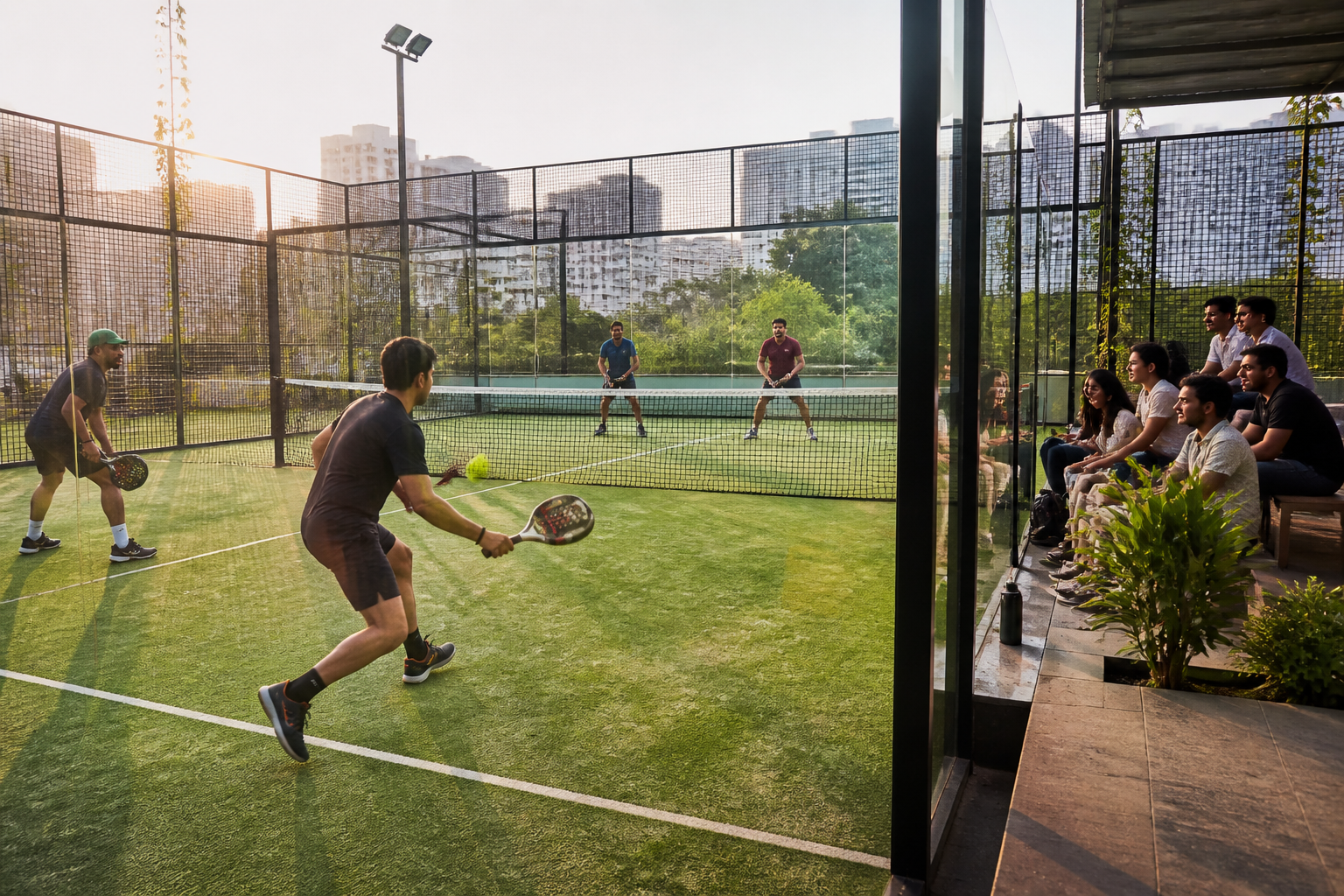
Hyderabad’s padel boom is turning a relatively unfamiliar racquet sport into a new form of urban social infrastructure, with glass-walled courts bringing together former professionals, actors, entrepreneurs, adult beginners and families. The change is not only about the popularity of a game. It also shows how privately operated sports venues are becoming places where residents meet, exercise, compete and build communities outside traditional clubs or formal public spaces.
The trend has been documented by Deccan Chronicle through interviews with players, club founders and entrepreneurs involved in Hyderabad’s emerging padel ecosystem. The report points to the upcoming Hyderabad launch of 7 Padel, associated with former India captain MS Dhoni, as another source of attention for the sport. It also describes the growth of venues and competitions including White Horse Padel Club, the Hyderabad Padel League and the Hyderabad DPL.
The evidence available in the report is qualitative rather than statistical. It does not provide the number of courts operating in Hyderabad, the total number of players, the investment committed to new venues or the rate at which facilities are being added. That limitation matters. A set of enthusiastic accounts can show how a trend is experienced by participants, but cannot by itself establish the full size of a citywide market. What the accounts do reveal is the type of urban demand these facilities are beginning to serve.
The first feature is social mixing. Srikanth Reddy, founder of White Horse Padel Club and associated with the Hyderabad Padel League, describes the court as a place where people can arrive as strangers and leave having made new friends. For Mohd Asaduddin, a former professional cricketer, the attraction is the ability to catch up with friends while doing an activity rather than simply sitting together. Anam Mirza describes the sport as a community that brings people from different age groups and professions together.
These descriptions place padel within a broader shift in how urban leisure is organised. A sports facility is no longer used only for scheduled training or formal competition. It can also function as a social venue, a networking space and a recurring weekend destination. In that model, the court is the anchor, but the value of the venue comes from the relationships and routines that form around it.
This makes the design of the facility important. Padel is played on an enclosed court with glass walls, and the walls change how players use space. Bhaskar Paramatmuni, an actor and former professional tennis player, says the game requires a different understanding of patience, angles and positioning compared with tennis. Vivek Reddy Priyadarshini, founder-director of PAD Play, describes the sport as a combination of behaviours associated with tennis, squash and other racquet games.
The court therefore creates a distinct built environment rather than simply adapting an existing tennis format. Players use the walls to keep rallies alive, while the enclosed layout makes the playing area visually prominent. The architecture is not a neutral container for the sport: it shapes the tactics, the pace of play and the experience of watching from outside. As the sport becomes more visible in Hyderabad, these courts also become recognisable markers of a new leisure landscape.
That landscape is being built through private and community-led initiatives rather than through the formal public sports system described in the report. Club founders and entrepreneurs are presented as the main actors developing facilities, leagues and participation pathways. Their focus is on stronger infrastructure, grassroots programmes and competition. This suggests that the early growth of padel is being organised as an ecosystem of venues, leagues, coaching and social networks.
The institutional structure remains less clear. The report does not identify a municipal sports policy for padel, a public funding programme or a citywide plan for distributing courts across neighbourhoods. It also does not establish whether access is concentrated in particular parts of Hyderabad or whether facilities are available to residents beyond established sporting and professional networks. Those unanswered questions are central to understanding whether padel is becoming a broadly accessible urban activity or primarily a premium lifestyle offering.
The participants’ backgrounds underline that question. The report features former tennis players, a former cricketer, actors, entrepreneurs and people connected through family and professional networks. Their experiences show how the sport can attract participants with prior exposure to racquet sports or organised competition. Priyadarshini notes that some level of racquet-sport experience may be needed to enjoy padel fully, while Rama Rishabh says beginners can learn the basics and begin enjoying the game relatively quickly.
This creates a tension between accessibility and entry barriers. Padel may be easier to begin than a sport requiring years of formal training, but participation still depends on access to a court, equipment, playing partners and a venue. The report does not provide pricing or membership information, so it cannot establish the affordability of the sport. Yet the emphasis on private clubs, entrepreneurs and organised leagues indicates that access is shaped by the availability and business model of commercial facilities.
The sport’s appeal also extends beyond first-time participation. Rishika Sunkara, a former India No. 1 tennis player, returned to competitive play through padel after stepping away from tennis following the birth of her daughter. Her account shows how the sport can provide a second pathway into competition for people whose relationship with traditional sport has changed because of age, family responsibilities or career transitions.
For adult beginners, the attraction may be similarly linked to structured participation. Asaduddin says people entering sports and fitness want competition and want to train towards an objective. That observation points to demand for amateur formats that are more organised than casual exercise but less exclusive than elite sport. Leagues and tournaments can give players a reason to return, measure progress and build regular social routines.
This is where the city’s sports infrastructure and its social infrastructure overlap. A league requires courts, scheduling, organisers and a stable participant base. A club requires more than a playing surface: it needs a system that can convert occasional interest into repeat participation. The Hyderabad Padel League and the Hyderabad DPL, as described in the report, represent early attempts to create that continuity. Their significance lies not only in competition but in making the sport legible as a recurring urban activity.
The potential talent pipeline is another part of the emerging model. Reddy says India could become an important market for padel and identifies infrastructure, grassroots programmes and competition as priorities. The report also includes participants who moved into the sport from tennis, pickleball and other athletic backgrounds. This cross-pollination can help padel grow quickly among people who already understand racquet-sport movement, although it may also leave open the question of how new players without that background will be introduced to the game.
The expected Hyderabad launch of 7 Padel adds a commercial and celebrity dimension to the trend. Its association with MS Dhoni is likely to increase visibility, but visibility alone does not create a durable urban sports network. Long-term growth would depend on whether new venues support regular play, coaching, amateur leagues and participation across different age groups and skill levels. The supplied report does not provide details of the launch’s location, court capacity, pricing or operating model, so its eventual effect cannot yet be assessed.
What the available evidence confirms is narrower but still significant. Hyderabad is developing a padel culture in which courts function simultaneously as sports facilities, social venues and community-building spaces. The trend is being carried by private operators, player networks and organised amateur competition. It is also drawing people back into competitive sport after breaks caused by professional transitions, family responsibilities or changing interests.
What remains uncertain is the scale and inclusiveness of this transformation. No citywide participation data, facility map, cost information or public-sector framework is provided in the report. Those details would determine whether padel is becoming part of Hyderabad’s wider sports infrastructure or remaining a concentrated lifestyle activity for residents with the time, money and networks to access it. The next phase of the story will therefore be measured not simply by the number of new courts, but by whether the ecosystem can build durable, affordable and geographically wider participation.
