


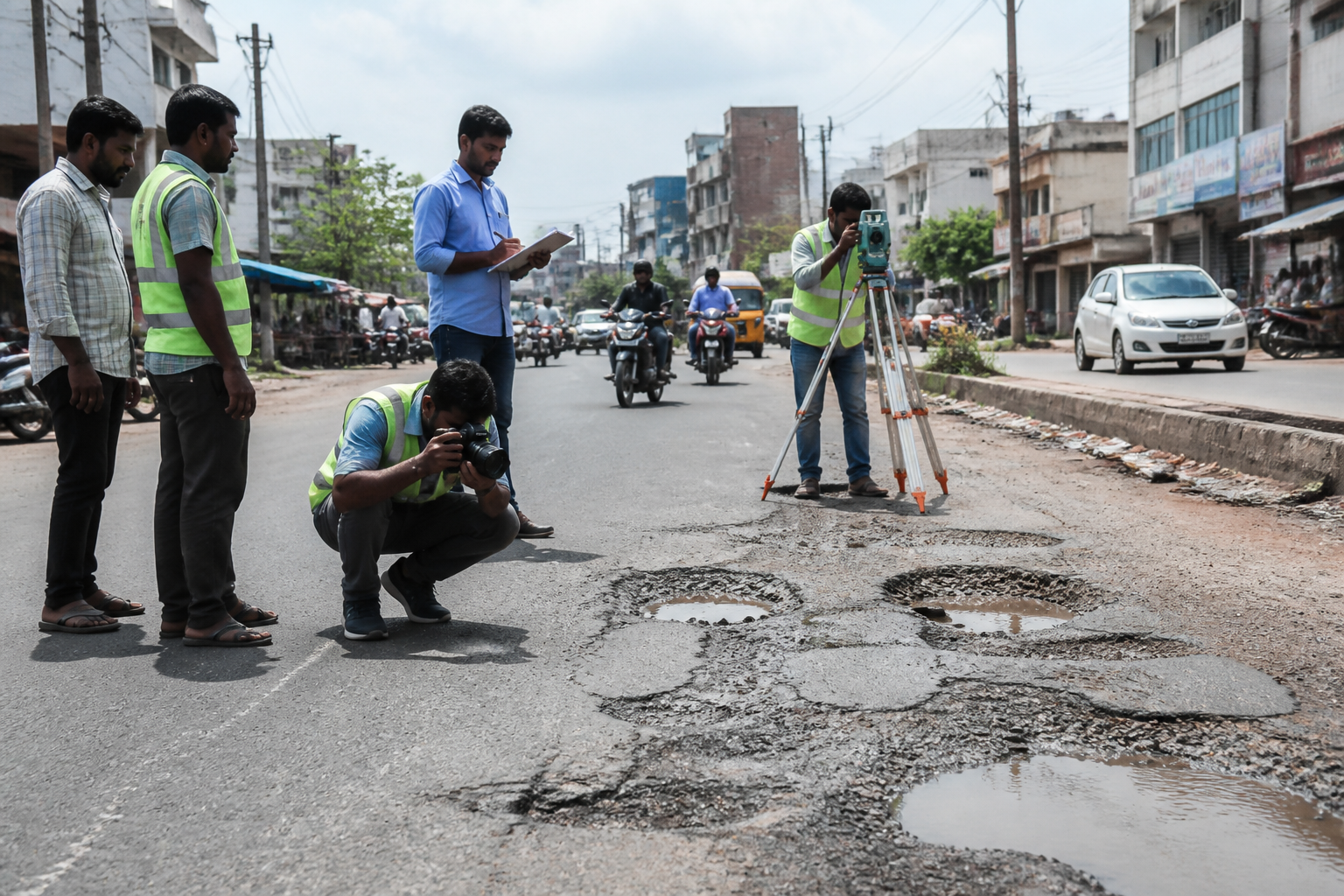
Tamil Nadu’s municipal road projects are facing tighter approval checks, with local bodies being asked to submit photographs at 30- or 50-metre intervals so authorities can assess whether a full road renewal is necessary, according to a report by Dinamalar.
The reported process covers corporations and municipalities across the state. Officials from the Directorate of Municipal Administration are seeking visual details along proposed road stretches before allowing new road works. The submitted photographs are also being checked through satellite imagery, the report said.
The stated objective is to prevent public funds from being spent on repeated or unnecessary road resurfacing. Under the process, a proposal for a new road must provide evidence of the road’s condition at regular intervals instead of relying only on a general project description.
Where damage is limited to a small pothole, authorities are reportedly advising local bodies to undertake patchwork rather than replace the entire road. Similarly, if photographs show that only one section of a road is damaged while the remaining stretch is in good condition, a full renewal may not receive approval.
The change places greater emphasis on condition-based assessment before a project is sanctioned. It also gives approving authorities a way to compare the photographs submitted by municipalities with satellite imagery of the same road corridor. The report did not specify the satellite platform, technical standards or a formal timeline for completing the verification process.
Tamil Nadu’s urban local bodies receive loans and financial assistance through institutions including the Tamil Nadu Urban Development Fund, the Tamil Nadu Urban Infrastructure Financial Services and the Tamil Nadu Urban Finance and Infrastructure Development Corporation. These financing channels support civic infrastructure projects undertaken by corporations and municipalities.
The reported scrutiny comes against the backdrop of efforts to control government expenditure amid financial pressure on the state exchequer. According to Dinamalar, the tighter approach is being applied as part of broader policy decisions intended to reduce unnecessary spending.
The process could change how municipal engineering departments prepare road proposals. Instead of seeking approval for an entire stretch based on broad assessments, local bodies may have to document damage section by section and distinguish between roads requiring reconstruction and those that can be repaired through limited patchwork.
The report also describes a difficulty for municipal administrations: proposals for new roads and bridge works are not receiving approvals as readily as before. At the same time, it says unnecessary road renewals are declining and that roads in areas with a genuine need are more likely to receive approval after photographic assessment.
The reported system therefore links road funding to evidence of physical deterioration. Its implementation will depend on the consistency of field photographs, satellite verification and the criteria used to decide whether a road qualifies for patchwork or complete renewal.
