


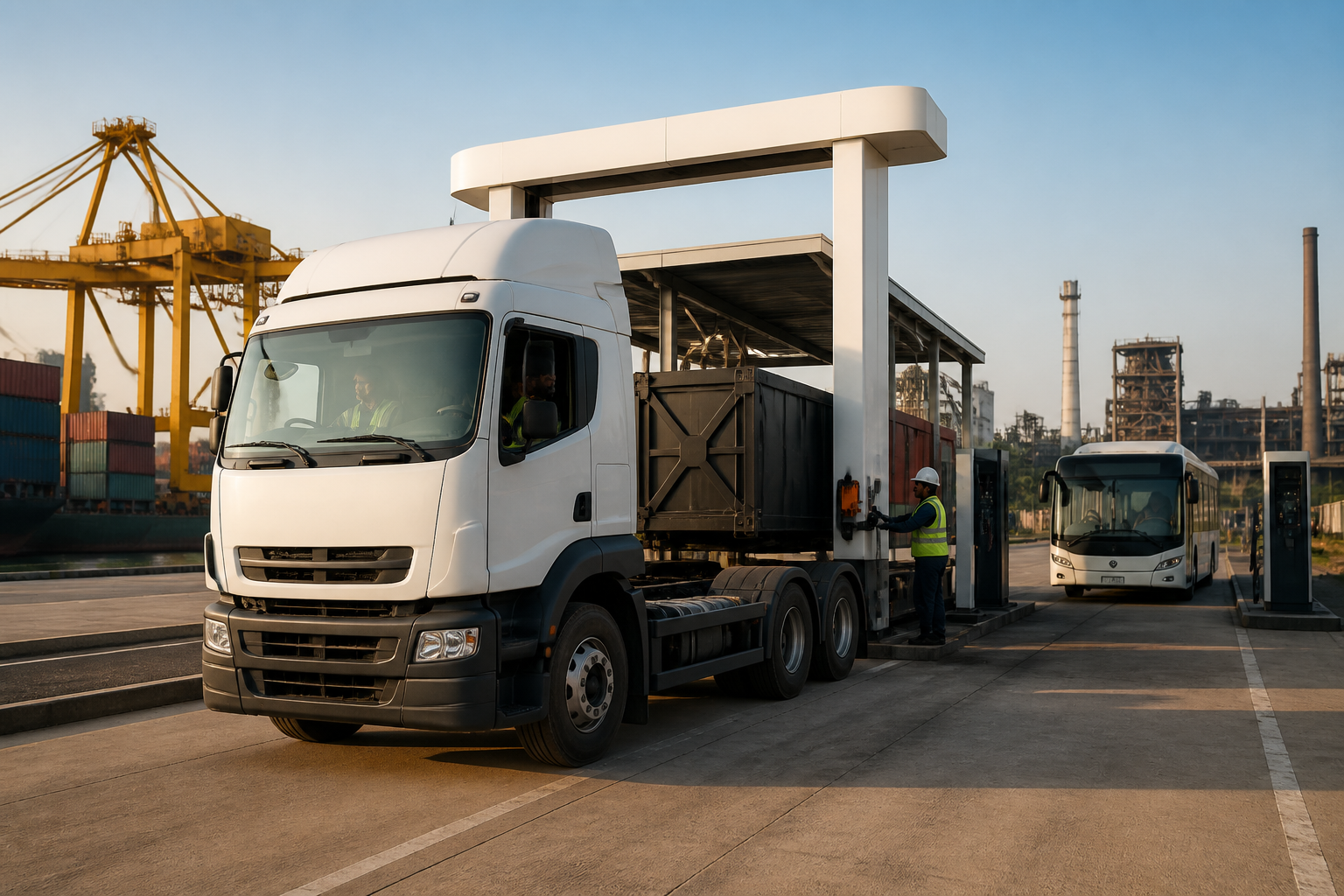
JSW Group’s decision to create a separate financing company for electric trucks and buses points to a problem that vehicle technology alone cannot solve: the economics of replacing diesel freight fleets. The company is attempting to close the gap between an electric truck that costs about ₹85-88 lakh and a diesel equivalent priced at roughly ₹25 lakh by shifting attention from purchase price to lifetime operating cost.
That calculation is central to the future of urban and industrial freight. Electric trucks require substantially higher upfront investment, but JSW says their total cost of ownership could be 15-20 per cent lower than diesel. The gap between these two numbers is where financing, battery ownership, charging infrastructure, route planning and guaranteed utilisation become decisive.
The development also shows that the transition to electric freight may begin in controlled logistics systems rather than on open-market trucking routes. JSW plans to start with closed-loop operations linking factories, mines and ports, where journeys are predictable, vehicles can be used intensively and charging or battery swapping can be planned around known routes.
The financing barrier is not being treated as a conventional vehicle-loan problem. JSW Greentech CEO Sumit Mittal said electric trucks and buses are already being financed at roughly an 80:20 loan-to-equity ratio, similar to diesel vehicles. ICICI Bank, HDFC Bank, Canara Bank and State Bank of India have approved JSW’s products for financing, according to the report.
JSW Group Chairman Sajjan Jindal said that “money is the last thing that is a problem”, while Mittal said banks and global investors were looking at the sector. Those comments indicate that the company sees capital availability as less important than structuring a business model that gives lenders confidence in future cash flows.
That distinction matters. A bank financing a diesel truck can rely on a familiar resale market, established maintenance networks and a long history of fuel-cost patterns. An electric truck carries more uncertainty around battery life, residual value, charging access, technology changes and the ability of operators to keep the vehicle in service. A financing company linked to the vehicle manufacturer can attempt to bundle those risks with operating contracts and energy services.
JSW has said the new company will finance vehicles as well as gross-cost-contract operations. It will also offer Battery-as-a-Service, wet leases and outright battery purchases. Each model allocates the cost and risk of the battery differently between the manufacturer, operator and financier.
Under a conventional purchase, the operator carries the burden of the higher vehicle price and battery investment. A Battery-as-a-Service model separates the battery from the vehicle purchase and could make the initial transaction easier to finance. A wet lease, meanwhile, can shift more responsibility for the vehicle and its operation to the service provider. The report does not establish which model will become dominant, but the range of options shows that JSW is designing a financial and operational platform rather than selling only a truck.
The company’s calculation depends on utilisation. JSW estimates that a diesel truck travelling about 100,000 kilometres a year consumes around 40,000 litres of fuel. At ₹100 a litre, that would mean approximately ₹40 lakh in annual diesel expenditure, or about ₹4 crore over a 10-year life. Against that expense, the higher upfront cost of the electric vehicle can potentially be recovered through lower energy and operating costs.
The figures are based on JSW’s calculations and are not presented in the report as an independent industry-wide benchmark. Their importance lies in the way they define the commercial argument for electrification. The electric truck does not need to be cheaper at the time of purchase if it can remain in operation for long hours, travel predictable distances and generate lower costs over its working life.
This is why the first deployment is planned for a captive route. JSW is preparing battery swapping for trucks and will initially deploy 100 vehicles on such a route. The trucks will offer up to 500 kilometres of range, while battery size can be varied according to the route and application.
Battery swapping changes the operating logic of freight vehicles. Instead of waiting for a large battery to recharge, an operator can exchange it at a designated facility. That requires investment in swapping infrastructure, battery inventories, standardised systems and operational planning. It may be more viable for a company-controlled fleet than for independent operators moving across a fragmented road network.
The proposed first use cases—factories, mines and ports—also have an institutional advantage. These locations are connected to an identifiable owner or operator, and vehicle movements may be easier to monitor than those of trucks working across multiple customers and routes. Predictability can improve vehicle utilisation and make energy demand easier to plan.
JSW already has approximately 17,000 trucks operating across its steel, cement and ports ecosystem. Mittal estimates that 40-50 per cent of current use cases could potentially be electrified relatively quickly, with other applications becoming possible as charging infrastructure expands.
This existing fleet is more than a potential customer base. It is also a testing environment. A captive industrial network can allow the company to collect operating data on range, charging, battery swapping, maintenance and route economics before offering electric trucks to a wider market. The report does not say that all 17,000 trucks will be replaced, but it establishes the scale of the ecosystem in which JSW can begin.
The approach reflects a broader difference between electrifying passenger vehicles and electrifying heavy freight. Passenger vehicles often sit idle for long periods and can be charged at homes or offices. Heavy trucks earn revenue through movement, and any extended downtime affects the operator’s ability to repay the loan. Financing therefore depends not only on the vehicle but also on how quickly it can return to work.
That makes charging and swapping infrastructure part of the credit decision. A truck with a nominal range of up to 500 kilometres may still be unsuitable for a route if the vehicle cannot access reliable energy at the right time. Conversely, a smaller battery may be sufficient on a fixed route if swapping or charging is integrated into the operation. JSW’s plan to vary battery size by route suggests that vehicle specification will be tied closely to the logistics system in which it operates.
The company also expects captive demand to support lending. Jindal said banks are willing to finance vehicles once JSW commits to using them. In effect, the operational contract can provide lenders with greater visibility over revenue than a standalone vehicle purchase would offer.
This is a significant institutional feature of the transition. The financing company is not working in isolation from the manufacturer and fleet operator. It is being developed alongside vehicle production, energy services and committed demand. The model attempts to reduce the information gap between technology providers, fleet owners and banks by linking the asset to a known route and a potential user.
JSW expects Greentech to reach break-even at 3,000-4,000 units, according to Mittal. The company’s new plant is expected to have annual capacity of 15,000 units, meaning the stated break-even threshold would represent approximately 20-27 per cent of that capacity. The report does not provide the plant’s location, investment cost or production timeline, so the financial threshold cannot be assessed against those factors.
Even so, the break-even figure reveals the scale required before the business becomes financially self-sustaining. Electric commercial vehicles cannot depend only on isolated pilot projects if their manufacturers are to reach this level. They require repeat orders, predictable routes and financial products that convert future operating savings into present purchasing capacity.
The availability of external capital could accelerate that process. Mittal said private-equity capital was waiting on the sidelines and that large global investors were examining the sector. JSW plans to incubate the platform and bring in external capital after it reaches a certain level. This indicates a staged approach: establish the operating model internally, demonstrate demand and performance, then use that evidence to attract outside funding.
However, the report also shows what remains unresolved. The stated total-cost advantage depends on utilisation, fuel prices, electricity costs, maintenance, battery performance, financing terms and infrastructure availability. The supplied information does not provide a detailed cost comparison covering each of these variables. Nor does it establish how the economics would change on irregular routes, for smaller operators or where swapping stations are unavailable.
Those gaps are important because India’s freight system is not made up only of large industrial ecosystems. A model built around factories, mines and ports may be well suited to JSW’s own operations, but its wider relevance will depend on whether similar arrangements can work for independent fleet owners and mixed-use logistics networks.
The immediate evidence supports a narrower conclusion. Electric freight adoption may advance first where one institution controls the route, the vehicle demand, the energy infrastructure and at least part of the financing structure. In such settings, the higher upfront price can be evaluated against high annual utilisation and identifiable fuel savings.
JSW’s financing arm therefore represents more than a new lending channel. It is an attempt to reorganise the ownership model around the entire operating life of an electric truck. The company is combining vehicle finance with battery services, leasing, swapping and captive demand to address the risks that make heavy-freight electrification harder than passenger-vehicle adoption.
The next test will be whether the first 100 battery-swapping vehicles can operate reliably on a captive route and whether the platform can scale towards the stated 3,000-4,000-unit break-even threshold. Those milestones will show whether the claimed total-cost advantage can be converted into a repeatable commercial model for industrial freight.
