


JSW Greentech’s plan to build a ₹15,000-crore annual business from electric trucks and buses is not simply a new vehicle launch. It is a test of whether India’s commercial electric-vehicle market can move from experiments by large industrial groups to repeatable operations across logistics, public transport and infrastructure fleets.
The company, JSW Group’s electric commercial-vehicle arm, expects vehicle sales to contribute about ₹12,000 crore at scale, with after-sales services adding another ₹2,000-3,000 crore. The target is based on full utilisation of its 15,000-unit plant in Chhatrapati Sambhajinagar. Chief executive Sumit Mittal said the company expects to reach that scale in five to seven years, while indicating that JSW’s chairman has set a faster internal expectation.
That timeline matters because commercial vehicles are where electrification meets the hardest operational constraints. Trucks and buses generally run longer distances, carry heavier loads and lose earning capacity when they are unavailable. Their transition therefore depends less on consumer enthusiasm and more on route economics, financing, charging or swapping access, maintenance networks and the ability of fleet operators to absorb higher upfront costs.
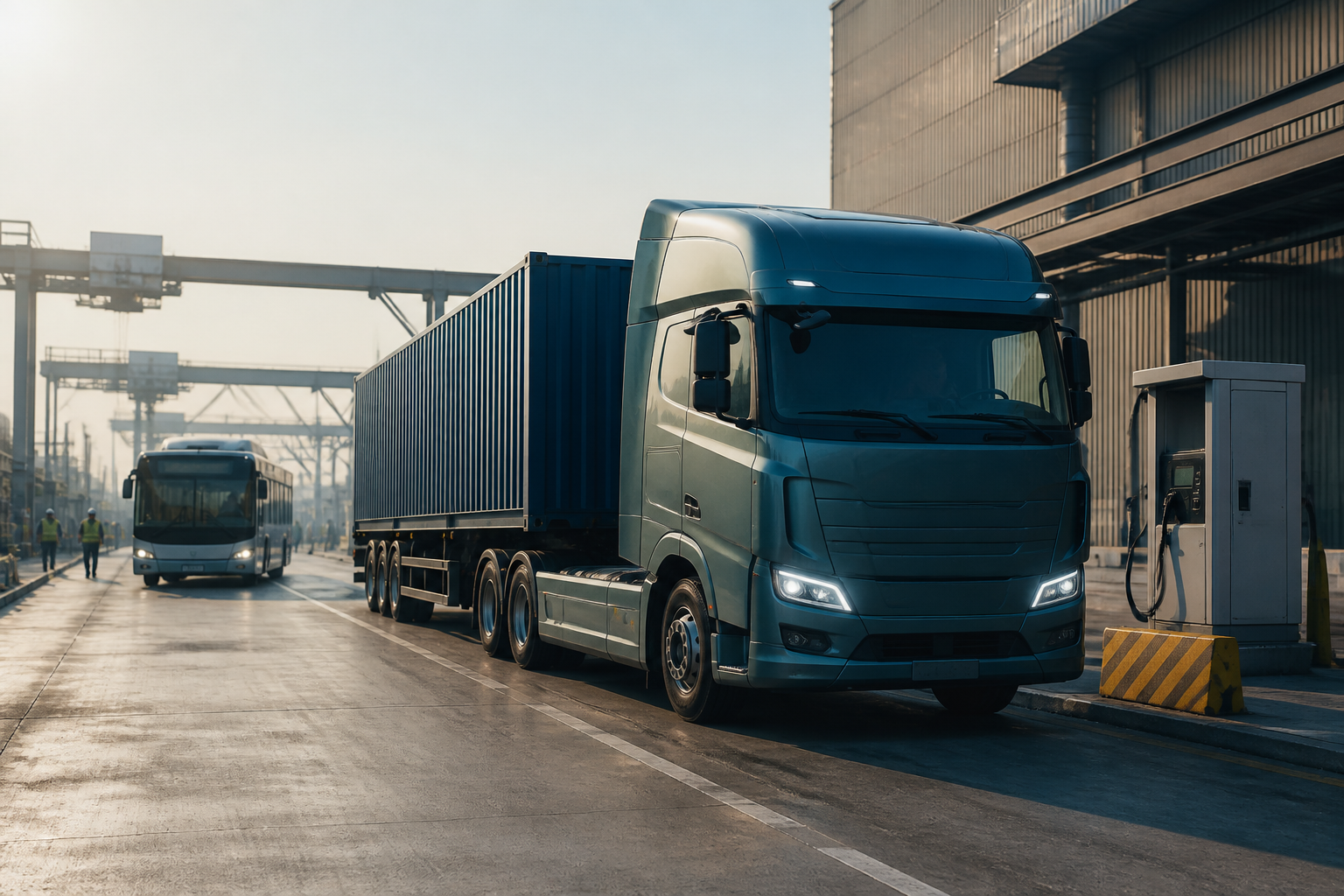
JSW is beginning with applications where vehicle use can be more closely controlled. AMPSTAR’s first truck is a 55-tonne tractor-trailer aimed at ports, steel, cement and infrastructure operations. These sectors are also closely connected to JSW’s existing businesses, giving the company access to internal use cases before it seeks to build a sizeable third-party market.
That approach gives JSW a potential advantage, but it also reveals the commercial-vehicle transition’s central challenge. A company can demonstrate an electric truck more easily within its own industrial ecosystem than across India’s fragmented logistics market. Internal operations can provide predictable routes, known loading points and coordinated charging facilities. External fleet operators need a business case that remains viable under less controlled conditions.
Mittal said JSW is in discussions with logistics companies, industrial groups and government customers. The company is pursuing a largely business-to-business contract model rather than beginning with a dealership-led distribution network. It initially plans to use its own operations to establish the vehicles, while building a larger third-party business over time.
The product range is also being designed around institutional demand. AMPSTAR plans to add tippers and fixed-body dumpers after its initial tractor-trailer, while its bus portfolio will range from seven metres to 18 metres. The buses are intended for staff transport, city, intercity and school applications. The breadth of these segments suggests that JSW is not relying on one transport niche, but it also means that the company will eventually face different operating requirements, procurement processes and service expectations.
The most important part of the strategy may be localisation. JSW’s buses are already about 70-75 per cent localised, according to Mittal. The company aims to take trucks to around 50 per cent localisation within six months and approximately 75 per cent within nine to 12 months. Battery cells and permanent magnets remain among the principal imported components.
Localisation is not only an industrial policy metric. It affects eligibility for incentives, exposure to import costs and the ability to manage supply disruptions. JSW does not currently meet the localisation threshold required to access the Centre’s ₹500-crore PM E-DRIVE incentive pool for electric trucks, but expects to become eligible in about six to nine months. The timing of that transition could influence vehicle pricing and the company’s ability to compete for early fleet contracts.
The numbers offered by JSW point to a clear operating proposition. Mittal estimates energy costs at roughly ₹40 per kilometre for diesel trucks compared with about ₹10 per kilometre for electric vehicles, implying a saving of around ₹30 per kilometre. For a heavily utilised commercial vehicle, such a difference can materially affect operating costs. But the saving is realised over time, while the purchase price is paid or financed at the beginning.
That gap between upfront cost and operating savings is why JSW is combining vehicles with financial and service models. The company is considering financing, leasing, Battery-as-a-Service and pay-per-use arrangements. It is also offering battery swapping in under seven minutes and fast charging in under an hour. These models attempt to shift the purchase decision from a simple vehicle comparison to a broader calculation involving cash flow, uptime and energy access.
The approach is especially relevant for fleet operators that cannot afford long charging downtime or large capital commitments. Battery-as-a-Service may reduce the initial cost of the vehicle, while leasing can spread expenditure across the operating period. Pay-per-use models could further link payments to actual deployment. The supplied information does not establish how these models will be priced or structured, but their inclusion shows that financing is being treated as part of the vehicle product rather than as a separate customer decision.
Charging and swapping infrastructure will initially be designed around fixed freight corridors. This is a significant institutional choice. A corridor-based network is more manageable than attempting to provide universal access from the outset, particularly when early customers are likely to have known routes and concentrated operations. It also places the burden on the company and its partners to identify corridors where vehicle utilisation, energy demand and customer density can support infrastructure investment.
For buses, the infrastructure question will vary by application. Staff and school buses may return to designated depots, making scheduled charging more straightforward. City and intercity buses may require different charging patterns, depot planning and route-level coordination. The company’s planned range from seven to 18 metres therefore represents not just a product ladder, but a set of distinct operational environments.
India’s public and private fleet procurement systems will shape whether this model expands. Government contracts can create demand at scale, but they also involve tender conditions, delivery schedules and performance requirements. Industrial customers may move faster when the vehicles support their own decarbonisation or cost objectives. Logistics companies, however, must evaluate electric trucks against utilisation, resale, maintenance, payload and route reliability.
JSW’s own industrial operations can serve as a first market for this evaluation. Ports, steel plants, cement facilities and infrastructure projects often involve repeat movements between defined locations. Those conditions may allow the company to measure energy consumption, turnaround time, maintenance requirements and battery performance before attempting more complex long-haul applications.
The company’s revenue ambition also shows the scale required for commercial viability. At full plant utilisation, 15,000 units would support about ₹12,000 crore in vehicle sales, implying an average sales value of roughly ₹80 lakh per vehicle across the planned mix. That is an indicative calculation based on the figures disclosed by the company, not a stated price for any particular model. The product portfolio’s mix of heavy trucks and buses will determine how that average is realised.
After-sales revenue is expected to contribute another ₹2,000-3,000 crore. This indicates that JSW sees the business as more than a manufacturing operation. Service, maintenance, batteries, energy systems and fleet support may become important revenue streams as commercial EV ownership develops. It also means that customer confidence will depend on the company’s ability to support vehicles after delivery, particularly outside its own industrial network.
The transition will therefore be judged at several levels. The first is whether the vehicles can deliver the operating-cost savings claimed by the company under real fleet conditions. The second is whether financing and energy-service models can address the upfront-cost barrier. The third is whether localisation can progress quickly enough to meet incentive requirements and reduce dependence on imported components. The fourth is whether charging and swapping networks can expand in step with vehicle deployment.
JSW’s stated plan—prove the vehicles internally, widen the product range, increase localisation, seek incentives and build external contracts—offers a structured route into the market. It does not yet establish how many vehicles will be delivered, which outside customers have committed, or how the infrastructure network will be financed. Those details will determine whether the company’s target becomes a manufacturing expansion story or a broader shift in how India buys and operates commercial vehicles.
For now, JSW Greentech’s launch places the next phase of electric mobility firmly in the commercial fleet space. The company’s progress towards its localisation targets, eligibility for the PM E-DRIVE truck incentive pool, customer contracts and corridor-based charging plans will show whether India’s electric transition can move from demonstration projects to dependable, high-utilisation transport systems.
