


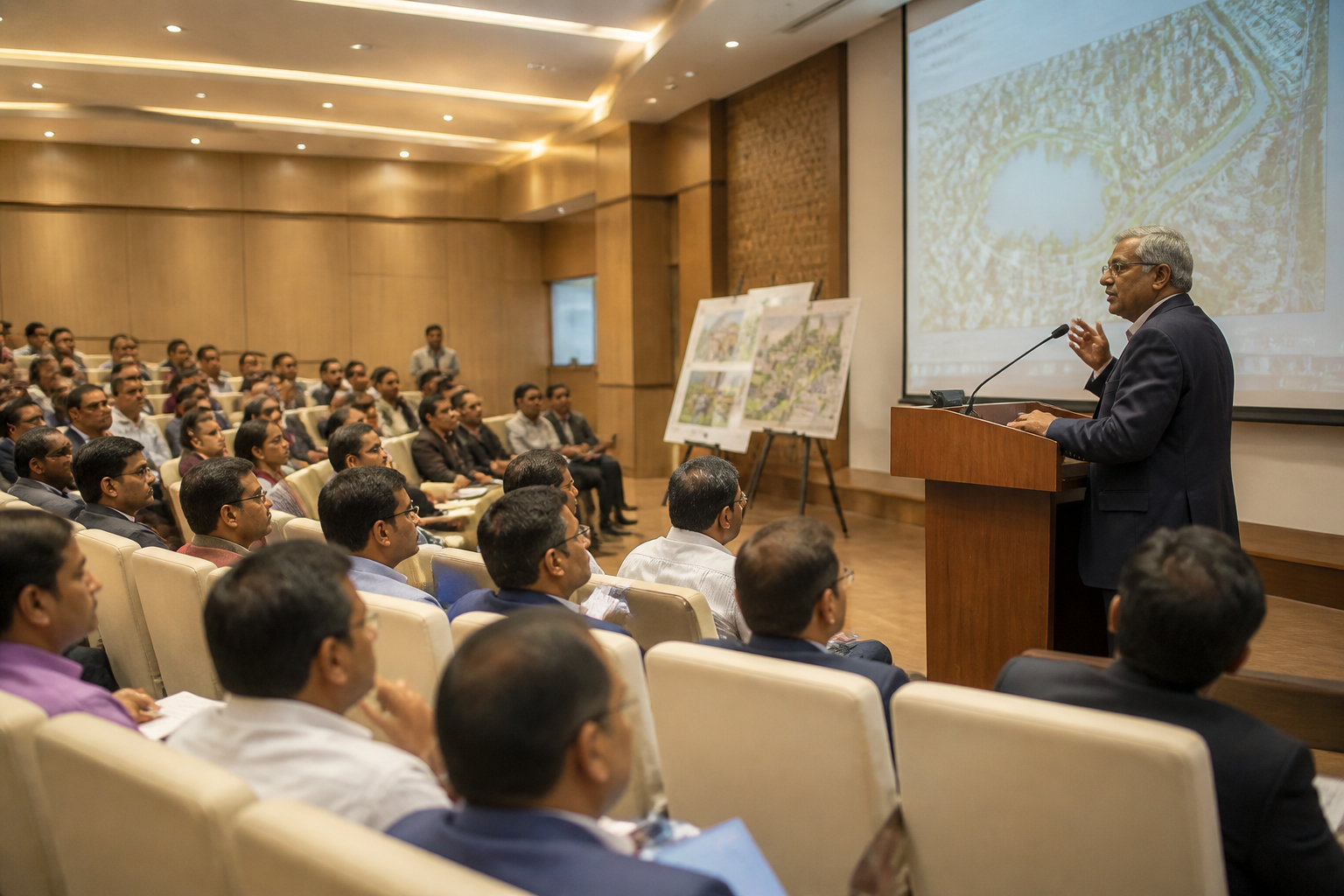
The central argument made by former Intelligence Bureau special director Yashovardhan Jha Azad at a Hyderabad policy lecture was not that India lacks anti-corruption laws. It was that the institutions created to enforce those laws have not consistently earned public credibility. That distinction matters for cities, where the consequences of weak oversight are often visible in unfinished hospitals, defective roads, unsafe bridges, compromised recruitment and public contracts decided without a level playing field.
Speaking at the Venugopal Rao Memorial Oration at the Administrative Staff College of India in Hyderabad, Azad said India had spent decades creating laws, investigative agencies and institutional mechanisms to fight corruption. Yet, he argued, the battle remained unfinished because the system continued to face shortcomings in independence, impartiality, competence, timelines, accountability and effectiveness.
He described these six areas as tests of institutional credibility. Together, they shift the focus from the number of laws or agencies to the way those bodies function. For urban administration, that is an important distinction. Municipal corporations, development authorities, public works departments, transport agencies and state-level departments routinely exercise discretion over land, contracts, permissions, procurement and enforcement. The quality of those decisions depends not only on the legal framework but also on whether oversight institutions can act independently and within a reasonable time.
The urban cost of weak credibility is not abstract. Azad said corruption could result in hospitals not being built, roads being constructed below specification, bridges collapsing, undeserving candidates securing jobs and deserving candidates losing opportunities. He also said contractors who competed on merit could be disadvantaged, while honest officials could find their integrity becoming an obstacle to professional advancement.
These examples connect corruption to the everyday functioning of the built environment. A road constructed below specification can increase maintenance costs and reduce safety. A hospital project that is delayed or compromised can limit access to public healthcare. A recruitment process distorted by bribery can weaken the institutions responsible for planning, operating and maintaining urban services. In each case, the immediate loss is financial, but the longer-term damage is institutional: citizens begin to doubt whether public systems are capable of delivering fairly.
Azad’s argument also places procurement at the centre of the urban governance problem. Cities are built through contracts. Roads, bridges, public buildings, water systems and other civic assets depend on decisions about tendering, technical standards, supervision, payments and maintenance. When contractors cannot compete on merit, the effects can travel through the entire project cycle. The issue is therefore not limited to an individual bribe or an isolated official. It concerns whether the administrative chain can protect public value from the moment a project is designed until the time it is completed and maintained.
The institutional history cited at the Hyderabad event shows that India has repeatedly responded to corruption scandals by creating or strengthening formal mechanisms. Azad referred to the 1948 Jeep scandal as one of the first major corruption scandals in independent India. Subsequent scandals contributed to the setting up of the Santhanam Committee, after which the Central Vigilance Commission and the Central Bureau of Investigation emerged in 1964-65.
His account points to a recurring pattern: public concern produces new rules or institutions, but institutional multiplication does not automatically produce effective enforcement. The presence of several agencies may create the appearance of oversight while leaving unresolved questions about jurisdiction, coordination, accountability and operational capacity. For citizens dealing with a delayed service or a failed public project, the relevant question is not how many agencies exist. It is whether one of them can investigate, establish responsibility and secure corrective action.
Azad cited Transparency International’s 2025 Corruption Perceptions Index, saying India scored 39 out of 100 and ranked 91st among 182 countries. He used the figure to reinforce his argument that the existence of laws and organisations should not be confused with credible outcomes. The index, as cited in the speech, provides a broad perception-based measure, while the urban consequences described by Azad are experienced through specific services and projects. The two levels are connected by public trust: when citizens repeatedly see poor delivery without visible accountability, perceptions of institutional weakness can deepen.
The time taken to resolve cases is another part of this credibility problem. Azad cited Central Vigilance Commission figures that, according to him, showed 2,447 anti-corruption cases pending for 10 to 20 years at the end of 2025, with another 409 pending for more than 20 years. Such timelines can weaken the deterrent effect of investigations. They can also make it harder to establish responsibility as officials transfer, records become difficult to retrieve and projects move through successive administrative stages.
For urban infrastructure, delay has a particular significance. A road or bridge project is not static while an investigation continues. Costs can change, construction standards can deteriorate, contracts can be renegotiated and citizens can continue to use an unsafe or incomplete facility. A case that remains unresolved for years may therefore fail to answer the immediate administrative question: what should happen to the project, the contractor, the supervising officials and the affected public while the legal process continues?
The Lokpal became another example in Azad’s institutional critique. Parliament enacted the Lokpal law in 2013, but he said the institution became operational only in 2019. The gap, as presented in the speech, illustrates the difference between legislative creation and institutional functioning. A law can establish a framework, but appointments, procedures, staffing, jurisdiction and operating capacity determine whether that framework becomes a working public institution.
Azad argued for a simpler institutional structure and said the number of anti-corruption bodies should be reduced. He proposed that the CBI should have clearly defined powers and functions, along with parliamentary oversight. He said similar principles should apply to the Enforcement Directorate. His position places institutional design and oversight together: agencies require sufficient authority to act, but that authority must be bounded by transparent rules and accountable supervision.
He also questioned whether an investigative institution can examine a powerful person without worrying about the consequences. This question goes to the independence test he identified. Independence does not mean the absence of accountability. Rather, the institutional challenge is to create arrangements in which investigators can act without political or administrative pressure while remaining answerable for the legality, competence and fairness of their work.
The competence test is equally important for cities. Azad said public debate often focused on how much power should be given to the CBI, vigilance agencies, secretaries and senior police officers, while insufficient attention was paid to the capabilities of investigators themselves. Complex urban contracts require technical, financial and administrative understanding. Investigating them may involve examining tender conditions, cost estimates, quality records, payment certificates, design changes and chains of approval. Without capable investigators, formal powers may not translate into effective scrutiny.
His emphasis on reducing unnecessary discretion is particularly relevant to urban administration. Discretion is unavoidable in government, but opaque or weakly supervised discretion can create unequal access to permissions, contracts and services. Azad called for stronger rule of law, greater transparency and mechanisms that enable citizens to hold governments accountable. These measures address the conditions in which corruption can flourish rather than focusing only on punishment after an offence is alleged.
The speech does not establish that any particular Hyderabad project or agency has failed the six tests. Nor does it provide a city-level audit of corruption, procurement or pending cases. Its value lies instead in offering a framework for examining how public institutions affect the delivery of urban services. Independence, impartiality, competence, timelines, accountability and courage can be applied to questions about infrastructure decisions without assuming wrongdoing in advance.
The larger urban question is whether cities can deliver reliable public goods when oversight is slow, fragmented or viewed as lacking credibility. India’s experience, as described by Azad, shows a long institutional response to corruption, but also a continuing gap between formal mechanisms and public confidence. For residents, that gap is measured through the quality of roads, the safety of bridges, access to hospitals, fairness in recruitment and the ability to obtain answers when public systems fail.
What the evidence supplied from the Hyderabad lecture confirms is that the anti-corruption challenge is not simply a question of adding more laws or agencies. It concerns whether existing institutions are independent enough to act, competent enough to investigate, accountable enough to command trust and timely enough to produce consequences. The developments that deserve monitoring are the functioning of these institutions, the duration of investigations and the transparency of decisions affecting public contracts and urban infrastructure.
