


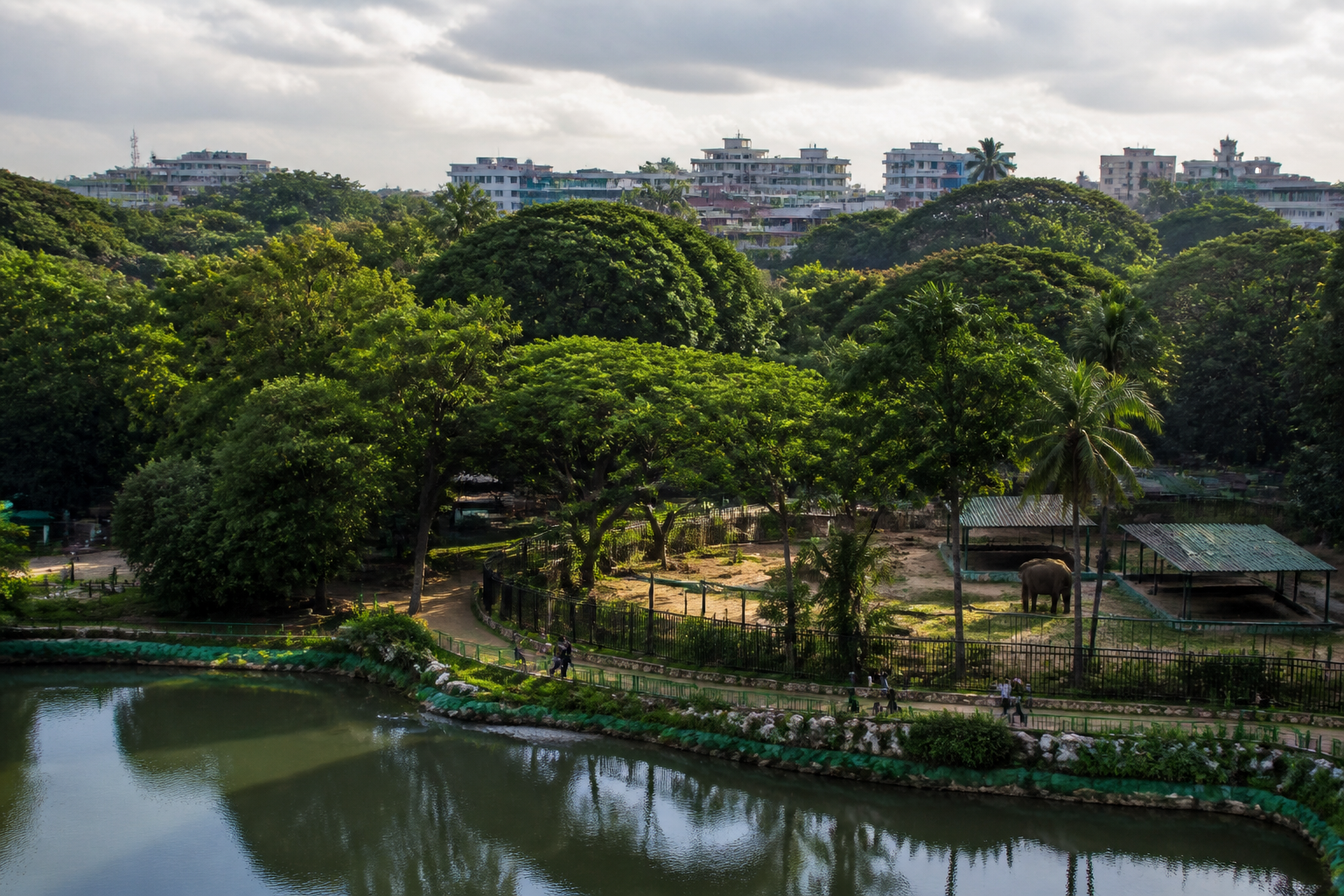
The proposed relocation of the Thiruvananthapuram Zoo to Neyyar has exposed a difficult urban question: can a city move one of its oldest public institutions without also moving the ecological, cultural and civic relationships that have grown around it? The zoo, which began functioning in 1859, is now at the centre of a debate involving the state government, local political leaders and the Thiruvananthapuram Corporation.
The Congress-led UDF government is moving towards shifting the zoo to the forest-fringe area of Neyyar. Chief Minister V D Satheesan has suggested Neyyar or another forest location, arguing that wild animals should be kept closer to their natural habitat. State Health Minister K Muraleedharan has said the zoo would be shifted to Neyyar and that implementation would follow consultations with those concerned.
The proposal has also received support from BJP leader and Thiruvananthapuram Corporation Mayor V V Rajesh. He has argued that relocation could provide better facilities for animals and support the development of a modern zoological park. The government has separately proposed turning the existing central-city site into a major public space, with Satheesan comparing the idea to Madison Square in the United States.
Opposition to the proposal has come from former Thiruvananthapuram mayor and CPI(M) leader V K Prasanth, who has renewed his campaign to retain the zoo at its present location. In a Facebook post, he described it as the city’s “Emerald island” and argued that the zoo is not simply an animal facility that can be transferred from one site to another.
That disagreement defines the urban character of the controversy. Supporters of relocation are presenting the issue primarily as one of animal welfare, habitat quality and modern zoo management. Opponents are describing the existing site as an integrated heritage landscape in which the zoo, museum, gardens, trees, open spaces and other institutions have developed together. Both positions relate to the future of the city, but they measure value differently.
The current zoo occupies a large green area in the middle of Thiruvananthapuram, where traffic and concrete development have expanded around it. According to figures cited by Prasanth, it receives around 14 lakh visitors annually and houses more than 1,000 animals belonging to nearly 100 species. Its compound also includes a natural lake and supports birds and smaller fauna. He has cited 387 rare species of trees as part of the site’s ecological character.
These figures, as presented in the report, connect the zoo to two different forms of public infrastructure. It is an institution for animal care and conservation, but it is also a widely accessible urban destination. Its location allows ordinary residents and visitors to reach it within the city, alongside the museum, galleries, gardens and other heritage institutions. Moving the zoo could therefore improve the physical setting available to animals while changing who can easily use the institution and how the surrounding civic landscape functions.
The debate also shows why the meaning of urban open space cannot be measured only by its proposed replacement use. The government’s suggestion to develop the existing property as a major public space indicates that the land would remain publicly significant after relocation. But the present site’s value, according to the opposition to the move, comes from the combination of mature vegetation, animal enclosures, water, heritage institutions and long-established public use. A new park may provide open space, but it would not automatically recreate that accumulated relationship.
Prasanth’s argument draws heavily on the history of the capital. His account links the zoo’s beginnings to the period of the Travancore rulers, when Thiruvananthapuram was developing many of the landmarks associated with its modern identity. He says the zoo began functioning in 1859 during the reign of Uthram Thirunal Marthanda Varma Maharaja, while the museum and related institutions were established and expanded around the same period. The Napier Museum was later completed under the leadership of architect Robert Chisholm during the reign of Visakham Thirunal Rama Varma.
The significance of this history is not only commemorative. The zoo forms part of a connected institutional landscape rather than standing as an isolated attraction. Its proximity to the museum, gardens and galleries has made the area one of the most recognisable heritage zones in the capital. The relocation proposal consequently raises a question about whether urban heritage should be protected as individual monuments or as larger networks of institutions, landscapes and public movement.
The animal-care argument remains central to the government’s position. Satheesan has said wild animals should be kept closer to their natural habitat, while Rajesh has argued that a new location could offer better facilities. The proposed move is also being compared with the relocation of the Thrissur Zoo to Puthur, which supporters cite as an example of creating a larger and more natural habitat for animals.
However, the report indicates that Thiruvananthapuram’s opponents do not consider the Thrissur example directly transferable. Their argument is that the capital’s zoo is embedded in an urban heritage landscape that cannot be reproduced simply by moving animals to a larger or greener site. The difference is therefore not only geographical. It concerns the institutional model of the zoo: whether it should primarily function as a conservation facility located near natural habitat, or continue as a central-city public institution with conservation, education, heritage and recreational roles combined.
Prasanth has also pointed to the zoo’s record of conservation and animal care. He says it was established as India’s first zoo, is now classified in the large category and has received an award from the Biodiversity Board. He further says that the animals were shifted to open enclosures in 2004 in accordance with Central Zoo Authority standards. These claims are part of his argument that the existing institution has already undergone changes intended to improve animal welfare.
The report also records his claim that there has been no reported transmission of disease from the zoo to humans in its history, apart from a recent incident involving a lion-tailed macaque that escaped from its enclosure. These assertions are attributed to Prasanth and are being used in the political debate to defend the existing site; the supplied material does not provide an independent assessment of them.
What is established is that the proposal involves more than a construction project. It would require decisions about animal habitats, the future use of the existing land, public access, heritage conservation, ecological management and the relationship between state authorities and the city corporation. The health minister’s statement that consultations will take place suggests that the final shape of the move has not been fully settled in the material supplied for this report.
The governance structure is also visible in the positions already stated. The state government is driving the relocation proposal and would be responsible for its implementation. The corporation’s mayor has expressed support, while a former mayor has opposed it. The controversy is therefore unfolding across different levels of urban administration, with the state focusing on the zoo’s future location and facilities, and local political voices emphasising the institution’s place in the city’s public and historical fabric.
For residents, the most important unresolved issue is whether the benefits of a forest-fringe location would outweigh the loss of a central, accessible urban institution. The supplied report does not establish the proposed site’s area, design, funding, construction schedule, transport access or animal-transfer plan. Nor does it specify how the existing heritage landscape would be protected if the zoo were moved. Those details will determine whether the proposal becomes a managed transition or simply a change in land use.
The Thiruvananthapuram Zoo relocation debate thus brings two legitimate urban objectives into direct conflict. One is the pursuit of improved animal facilities and habitats. The other is the preservation of a rare central-city landscape where biodiversity, public access and institutional memory coexist. The government’s consultation process will need to clarify how those objectives are to be reconciled, especially what will happen to the existing zoo site and how the proposed Neyyar facility will function.
At present, the evidence confirms that the relocation has political support but remains contested, that Neyyar is the stated destination, and that the present site carries both ecological and heritage value for its defenders. The next significant developments will be the consultations promised by the government, the formal decision on the relocation site and the details of both the proposed zoological park and the future public use of the existing compound.
