


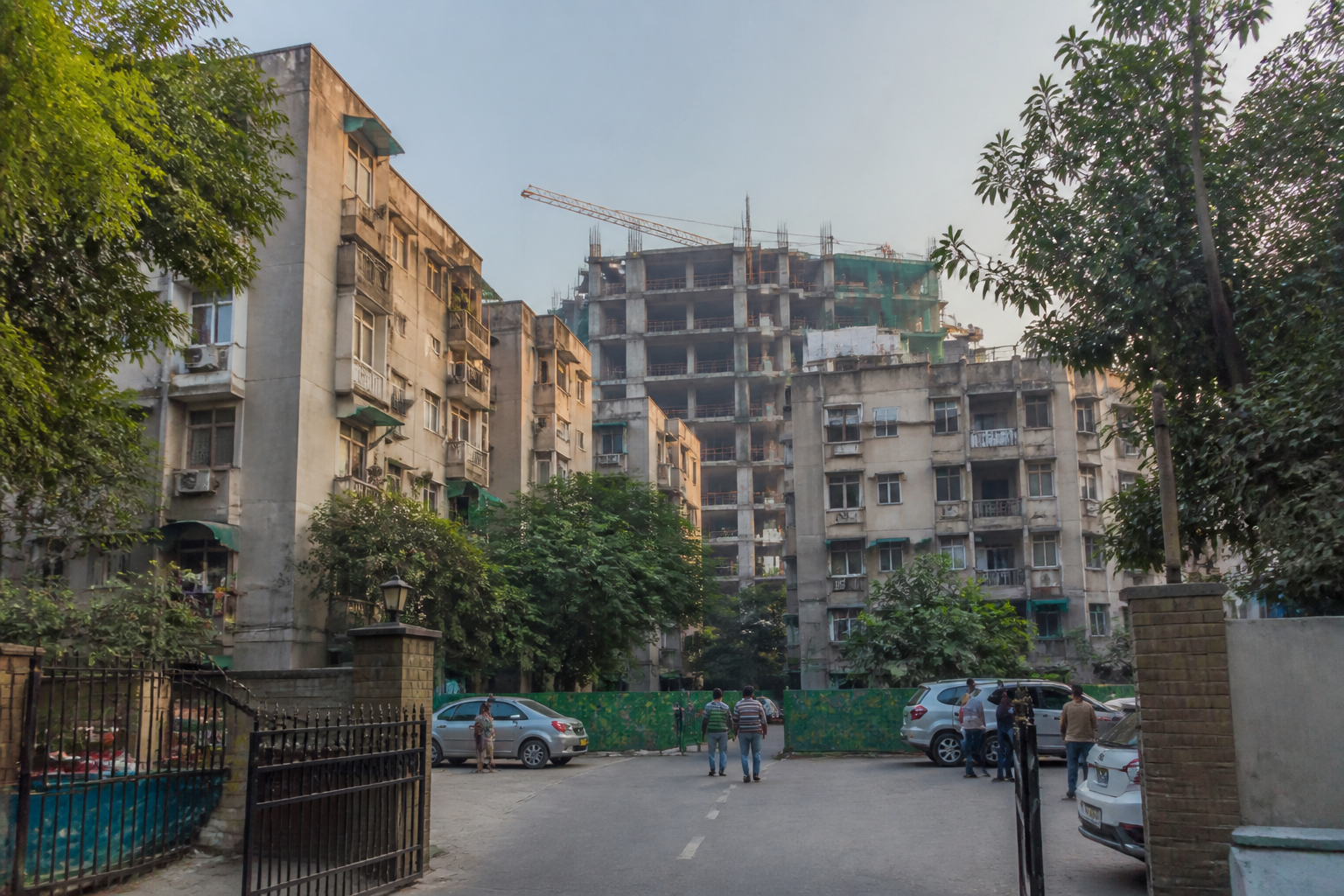
Delhi housing redevelopment is moving towards a framework that could bring nearly 1,200 cooperative group housing societies into a more flexible redevelopment regime. The reported changes include a higher permissible floor area ratio (FAR), a single-window approval system, a lower minimum plot-size threshold and a 70% consent requirement from society members. Together, they could change how ageing or inadequate housing stock is renewed across the capital, although the final impact will depend on the detailed guidelines still awaited from the Delhi Development Authority (DDA).
The proposals were discussed during a meeting between a delegation of the Rohini Federation of Cooperative Group of Housing Societies and the DDA vice-chairperson at the authority’s INA office, according to a report by Jagran – New Delhi. Federation president Arya Muni and senior vice-president Harsh Jindgar said the meeting covered provisions linked to the redevelopment of cooperative societies under Master Plan Delhi-2047.
The most significant proposed change is the increase in FAR from 160 to 300. FAR determines the total floor area that can be built on a plot in relation to its size. A higher FAR can allow more construction within the same site, creating room for additional homes or better-planned replacement buildings. In the reported framework, the increase could raise the number of residential units by about 50% compared with existing capacity.
That additional capacity is central to the redevelopment model. Existing residents may need replacement homes during construction, while the project also needs enough saleable or transferable development potential to make rebuilding financially viable. The report does not establish how individual projects will be financed, how construction costs will be divided or how temporary relocation will be handled. Those details will be important in determining whether the higher FAR translates into completed projects or remains only a planning provision.
The proposal also removes the earlier four-hectare minimum area condition, according to the report. Societies with an area of about 3,000 square metres could become eligible, subject to prescribed conditions. This would bring smaller cooperative housing sites into the potential redevelopment pool rather than limiting the policy to large land parcels.
The change matters because cooperative housing in Delhi is not organised around a single developer-owned property. The land, buildings, common areas and individual flats are connected through the society’s ownership and management arrangements. The reported condition that all flats must be freehold therefore becomes a basic eligibility requirement. Societies that do not meet that condition may not be able to use the proposed route unless the final rules provide another mechanism.
Consent is another major threshold. At least 70% of society members would have to agree to redevelopment. This requirement attempts to create a workable balance between collective decision-making and the difficulty of securing unanimity in large housing complexes. It also means that the project process will begin inside the society, before construction permissions or other departmental approvals are sought.
The reported framework would allow not only complete redevelopment but also phased or partial redevelopment, depending on the needs of a society. This is significant for buildings where the entire complex may not require demolition at the same time. A phased approach could allow societies to address the most vulnerable or inadequate structures first, although the report does not specify how common infrastructure, access, services or resident rights would be managed during different stages.
The proposed single-window system is intended to address one of the most persistent administrative problems in redevelopment: the need to approach several departments separately. The DDA is reported to be preparing a system through which societies can submit applications for different redevelopment-related approvals at one place. The stated objective is to simplify the approval process and reduce the need for repeated applications to different agencies.
A single-window portal, however, is not the same as a single approval. The supplied report establishes the proposed application mechanism but does not provide details on the departments that would be integrated, the time limits for decisions, the documents required, or the authority responsible for resolving objections. The effectiveness of the system will therefore depend on whether it coordinates decision-making across agencies rather than merely creating a common submission point.
The policy also includes a social housing obligation. Fifteen per cent of the area in a redevelopment project would have to be reserved for economically weaker sections (EWS), according to the report. The available account does not clarify whether this percentage refers to land area, built-up area or dwelling units, nor does it explain how the EWS component would be allocated and managed. The detailed DDA guidelines will need to establish those operational conditions.
Responsibility for construction and related work would remain with the society’s management committee under the proposed arrangement. This places the cooperative body at the centre of project execution rather than assigning the redevelopment automatically to a government agency or a private developer. It also raises questions about technical capacity, procurement, contractor selection, financial oversight and accountability, none of which are detailed in the report.
For residents, the framework could offer an opportunity to replace buildings described as dilapidated, condemned or in need of major improvement. It could also apply to societies where the buildings are not formally unsafe but residents believe that substantial renewal is required. That broader eligibility is important because housing distress does not always begin with a formal declaration that a building is dangerous. In many older complexes, the problem may involve inadequate layouts, deteriorating services, limited common facilities or the inability to undertake major repairs within existing rules.
At the same time, redevelopment changes more than the physical structure. It affects the number of homes, the intensity of occupation, the use of common spaces and the demand placed on internal services. A potential 50% increase in residential units could alter parking requirements, water demand, waste generation, access arrangements and emergency movement within a society. The supplied report does not provide project-level infrastructure assessments or citywide capacity calculations, so the consequences cannot yet be quantified.
The policy’s connection to Master Plan Delhi-2047 places cooperative housing redevelopment within a broader planning framework. Yet the report provides no further details on how the redevelopment provisions fit with local road capacity, public transport access, open-space requirements or neighbourhood-level infrastructure. Those links will determine whether higher FAR produces efficient urban renewal or simply concentrates more built area within existing enclaves.
The proposed model therefore combines four different objectives: enabling renewal of ageing housing, increasing development capacity, simplifying approvals and retaining resident control through society-level consent. These objectives can support one another, but they can also create tensions. More FAR may improve project viability while increasing pressure on infrastructure. Society-led execution may protect resident participation while creating administrative and financial burdens. A single-window system may reduce procedural friction while leaving substantive approvals unchanged.
The immediate next step is the release of detailed guidelines, which the DDA is reported to have indicated could come within about two months of the meeting. Those rules will establish the conditions under which the framework operates, including eligibility, freehold documentation, consent procedures, phased redevelopment, EWS obligations, approval coordination and the responsibilities of management committees.
For now, the evidence confirms a proposed shift in Delhi’s approach to cooperative housing redevelopment, not the completion of any individual project. The policy’s significance lies in its potential scale and in the attempt to connect higher FAR with institutional simplification. Whether it produces safer and more functional housing will depend on the final rules, the capacity of societies to execute projects and the extent to which redevelopment is matched by adequate neighbourhood infrastructure.

