


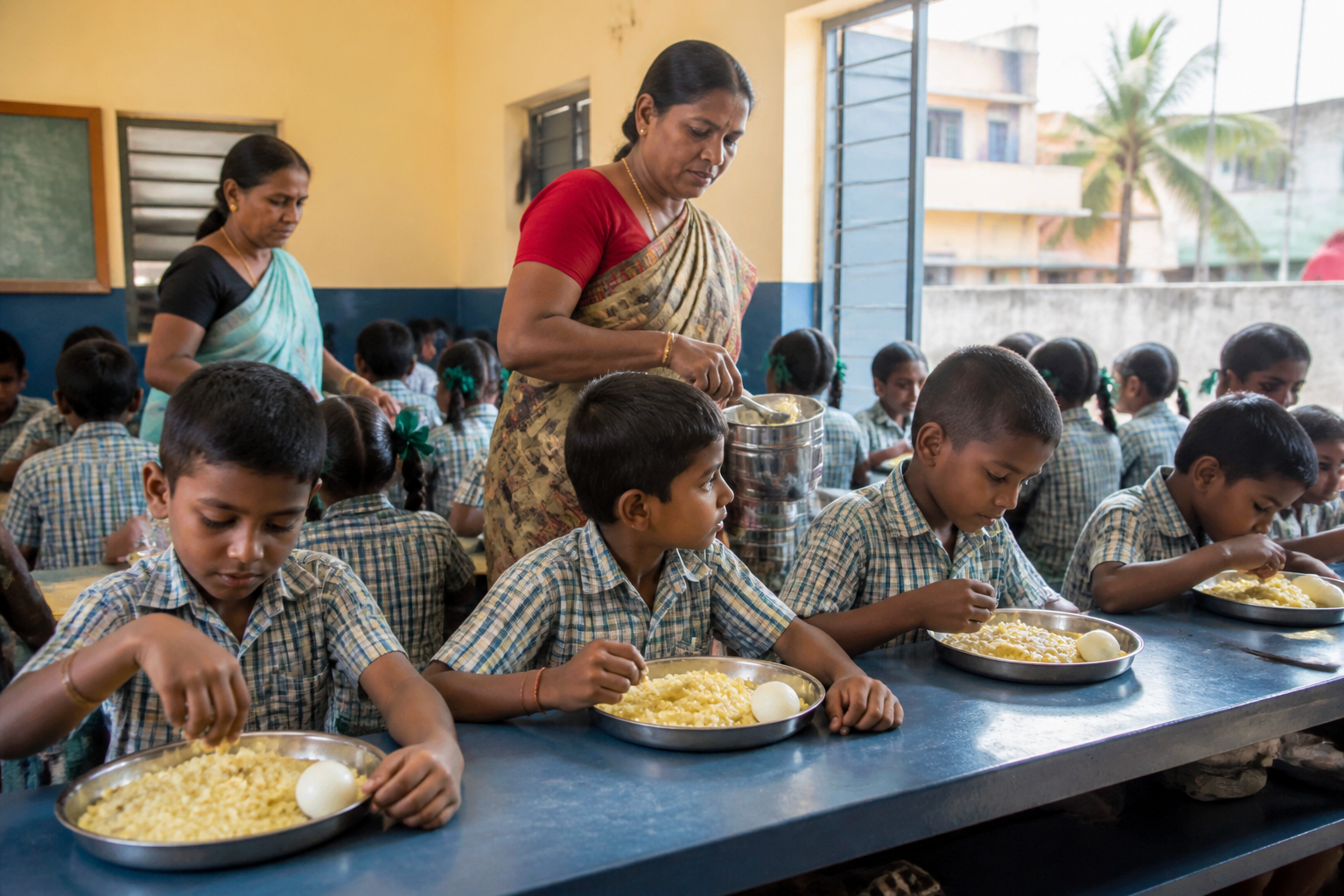
Tamil Nadu’s expansion of its free breakfast scheme to Classes 6 to 8 is more than an increase in the number of meals served. It is the latest stage in a century-long evolution of state-supported school feeding, and it places the state’s education and local administration systems under a much larger operational responsibility. With the latest expansion, 34.64 lakh students in Classes 1 to 8 across 44,984 government and government-aided schools are covered, at a total allocation of Rs 724 crore.
The expanded Perunthalaivar Kamarajar Breakfast Scheme was launched at the Chennai Middle School in Gandhigramam, Thiruvanmiyur, where Chief Minister C Joseph Vijay had breakfast with students. The extension covers 7,537 additional government and government-aided schools and carries an additional allocation of Rs 217.63 crore in the current financial year. About 15.30 lakh children have joined the programme through the latest expansion.
The state government has framed the scheme around three connected objectives: improving children’s nutritional status, preventing them from attending classes hungry and helping them concentrate better during lessons. That framing matters because the programme is not being treated only as a food-distribution exercise. It is being positioned as an intervention at the intersection of nutrition, attendance and learning, with the school acting as the delivery point.
## From targeted meals to universal school infrastructure
Tamil Nadu’s current breakfast programme builds on a much older public system. The roots of state-supported school meals in the state go back to 1922, when P Theagaraya Chetty, then president of the Corporation of Chennai, introduced meals for underprivileged children in selected Corporation schools. The initiative benefited about 800 students between 1922 and 1925 and was reintroduced in 1927.
In 1956, Chief Minister K Kamaraj expanded the idea across Tamil Nadu through midday meals for children from poor families for 200 days a year. Chief Minister M G Ramachandran expanded it substantially in 1982 through the Nutritious Meal Programme, initially targeting malnourished children aged two to nine in rural preschools and primary schools before its reach widened to urban areas and older students.
Successive governments added new food and nutrition components. Eggs were introduced in 1989 and increased progressively, while bananas were offered to children who did not eat eggs. Variety meals were introduced in 2013. Local experiments included millet ladoos in Ariyalur and cookies and chikki for malnourished children in Perambalur. The history shows that Tamil Nadu’s school meal system has developed incrementally, with each expansion adding either a new age group, a new geography or a new nutritional component.
The breakfast scheme introduced in 2022 represents a further shift in that trajectory. The programme began with primary school students and was announced on May 7, 2022, during the first anniversary of the government led by M K Stalin. Its first phase covered about 1.14 lakh children in 1,545 schools at a cost of Rs 33.56 crore. The menu included upma, kichadi, pongal and, on some days, rava or semiya kesari.
The programme then expanded through a sequence of administrative decisions: to Corporation and municipal schools in February 2023, all government schools in August 2023, rural government-aided schools in July 2024 and government-aided primary schools in urban areas in August 2025. By then, the government said 17.53 lakh children across 34,987 schools were covered. Coverage of Classes 1 to 5 later reached about 19.34 lakh students before the latest extension to middle-school children.
## What the attendance evidence shows
The strongest evidence cited in the supplied material concerns attendance. An early evaluation by the Tamil Nadu State Planning Commission examined 1,543 schools after the scheme began in September 2022. In January and February, 1,319 of those schools recorded increased attendance compared with the preceding June-July period.
The changes were not uniform. Attendance increased by up to 20% in 1,086 schools, while 22 schools recorded increases exceeding 40%. The evaluation also reported that all beneficiary schools studied in Tirupathur, Perambalur, Ariyalur and Tiruvarur districts recorded gains. A comparison involving 414 neighbouring schools located within one to two kilometres found a stronger positive attendance trend among schools covered by the breakfast programme.
These figures do not, by themselves, establish that breakfast provision caused every recorded attendance increase. They do, however, offer a basis for examining the programme as an education-access intervention rather than only a welfare measure. The comparison with nearby schools is particularly relevant because it attempts to place beneficiary schools alongside similar schools in the same broader local environment.
The evidence also points to the importance of timing. The stated rationale for the programme was that some children reached school without eating because they travelled long distances or faced economic difficulties at home. Breakfast served at school therefore addresses a gap before the school day begins. Its potential administrative significance lies in linking an immediate household constraint to an existing public institution that children already attend.
The supplied material does not provide a separate learning-outcome assessment for the expanded Classes 6 to 8 cohort. Nor does it establish the long-term effect of the programme on attendance, academic performance or household food security. Those remain areas that future evaluations would need to examine if the programme is to be judged beyond its current coverage and early attendance indicators.
## Nutrition and the scale of delivery
The expansion also reflects the nutritional pressures that school systems are expected to address. NFHS-5 data for 2019-21 showed that 57.8% of Tamil Nadu children aged six to 59 months were anaemic. The article also cites studies reporting high anaemia prevalence among school-age children and links poor dietary diversity with micronutrient deficiencies, including iron, vitamin A and zinc.
The breakfast programme cannot be treated as a complete response to those conditions. Its stated purpose is narrower: ensuring that children receive a meal before classes and supporting their ability to participate in school. But its scale means that even a routine daily intervention becomes a significant public-health and education operation. The latest allocation of Rs 724 crore and coverage of nearly 45,000 schools show the extent to which food provision has become part of the public education infrastructure.
The delivery challenge is therefore not limited to preparing meals. It includes reaching schools across urban and rural areas, incorporating government-aided institutions, maintaining a rotating menu and ensuring that the service is available to older children as coverage expands. The move from 1,545 schools and 1.14 lakh children in the first phase to 44,984 schools and 34.64 lakh students changes the administrative character of the programme from a limited intervention into a statewide system.
## The institutional question behind the scheme
The programme also illustrates how social policy is delivered through multiple layers of urban and rural administration. Schools are the visible point of contact for students, but the scheme’s expansion depends on state-level budget allocations, education department decisions, local institutions and the functioning of individual schools. The inclusion of Corporation, municipal, rural government and government-aided schools shows that coverage has been built through successive administrative extensions rather than a single uniform launch.
That history creates both an advantage and a management requirement. The advantage is an existing institutional network that can be extended over time. The requirement is that every new category of school and age group must be integrated without weakening the reliability of the service. The supplied material confirms the scale of the expansion and the budget allocated for it, but does not provide detailed information on kitchen capacity, staffing, procurement, food waste, monitoring or district-level delivery performance.
Those details will determine how the scheme functions in practice. The state’s own rationale connects food with concentration and learning, while the attendance evaluation connects the programme with school participation. To establish the wider claim, future monitoring would need to track whether meals are consistently served, whether children receive the intended portions and menu, and whether improvements persist across different school types and districts.
Tamil Nadu’s approach also shows how welfare programmes can become embedded in the physical and administrative geography of cities. In Chennai, for example, the launch took place in a municipal school in Thiruvanmiyur. In other parts of the state, the programme’s reach depends on government and aided schools serving communities with different distances, household conditions and local capacities. The school is therefore not merely a place where a policy is announced; it is the infrastructure through which the policy is experienced.
The immediate fact is that the breakfast programme now covers Classes 1 to 8, 34.64 lakh students and 44,984 schools, with a total allocation of Rs 724 crore. The larger evidence shows a programme that has grown through repeated institutional expansion and that has produced an early positive attendance signal in the schools studied. What remains less established is how the latest expansion will affect nutrition, learning and attendance over time, and how consistently the enlarged system will operate across the state. Those outcomes will depend on the next phase of implementation and evaluation.
