


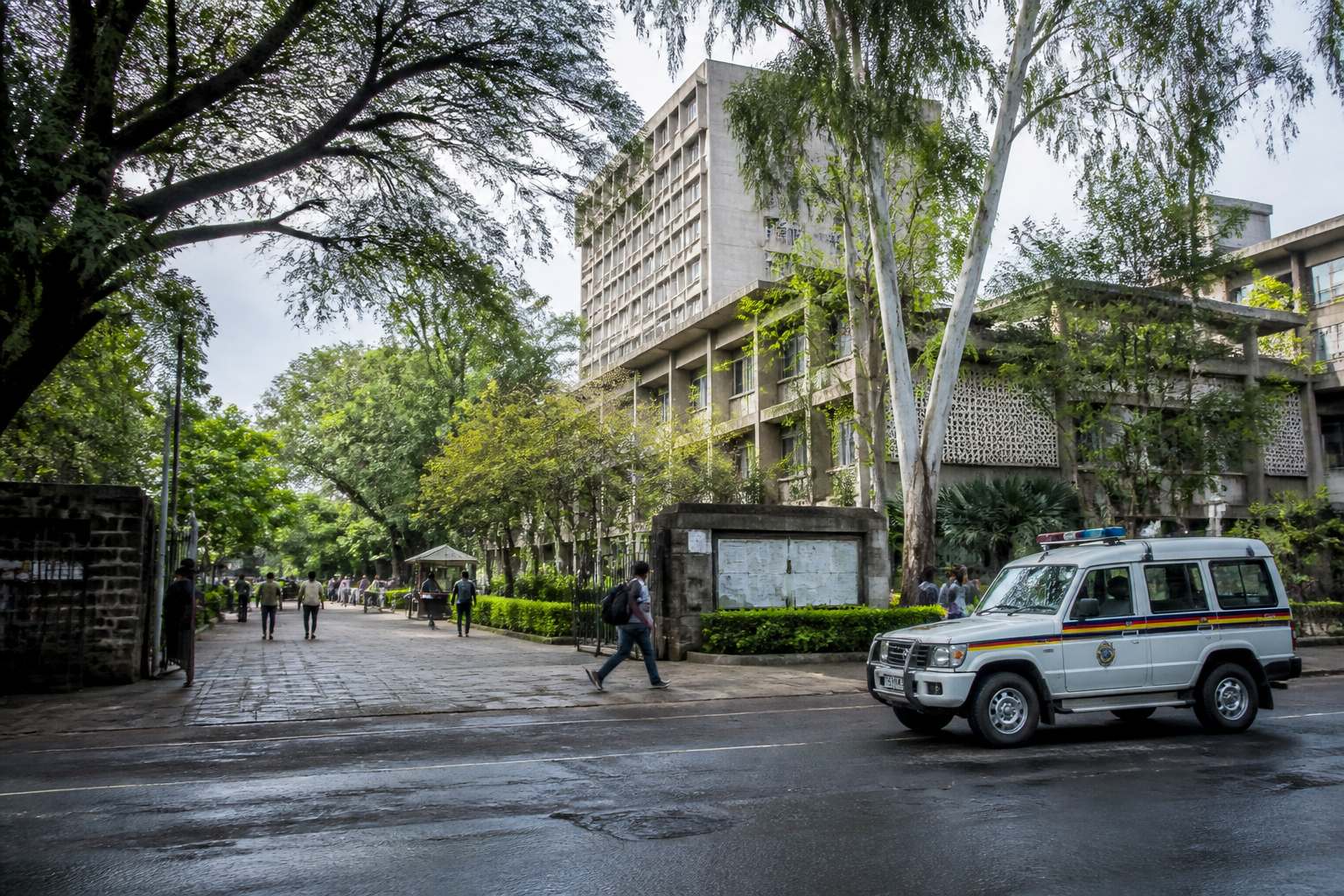
The death of IIT Bombay BTech student Sahil Wakode, and his parents’ allegations that he faced casteist remarks and “torture” on campus, have placed the institute’s systems of student support, disciplinary procedure and institutional accountability under scrutiny. The family says Sahil had spoken to them about the remarks days before his death, while the Mumbai Crime Branch is investigating the circumstances surrounding the case.
Sahil, a second-year BTech student, allegedly died by suicide on September 18. His parents, Ravindra and Sonali Wakode, travelled to Mumbai on September 22 to meet Crime Branch officials investigating the death. Speaking outside the Crime Branch office in Bandra, they said Sahil had discussed casteist remarks during their meeting with him on September 13.
The parents said they had advised their son to ignore the remarks and concentrate on his studies. Ravindra said the family had told Sahil that gaining admission to an IIT was difficult and that he should focus on his education. Sonali similarly said the family had tried to strengthen his morale by asking him to disregard the remarks and continue with his studies. They now say they regret having offered that advice.
That account raises a difficult institutional question: when a student reports caste-based hostility, what mechanisms exist to receive the complaint, assess the risk and provide protection or support before the problem escalates? The material available in the report does not establish whether Sahil made a formal complaint to the institute, whether any internal inquiry was initiated before his death, or what support was offered to him. Those questions remain part of the wider investigation and cannot be answered by the allegations alone.
According to his father, Sahil’s first year at IIT Bombay had passed without difficulty, and the problems began during his second year. That distinction is significant because it places the reported conflict within the student’s transition to a new academic phase rather than presenting it as a continuous experience from the beginning of his time at the institute. The supplied report does not identify the individuals alleged to have made the casteist remarks or describe the number, duration or specific setting of the incidents.
The case also involves an examination-related dispute. Sahil was allegedly found using a mobile phone in an examination hall on the day he died. The invigilator identified by the family is Professor Suryanarayana Doolla. The family has also demanded the arrest of IIT Bombay director Professor Shireesh Kedare and Doolla, holding them responsible for their son’s death. These are demands made by the family, not established findings of the investigation.
Ravindra said the institute had initially spoken about Sahil cheating and later apologised for doing so, stating that the matter was under investigation. He argued that the allegation should be established through the investigation. He described Sahil as a bright student who had secured admission to IIT Bombay. The account presents two competing elements that investigators will have to examine together: the allegation concerning the examination and the family’s claim that Sahil had been subjected to caste-based discrimination.
The distinction between an allegation and a finding is central to the case. The family’s statements provide an account of what Sahil allegedly told them and of the events surrounding the examination. They do not, by themselves, establish the conduct of any individual, the reason for Sahil’s death or legal responsibility. At the same time, the existence of an ongoing Crime Branch investigation means that these claims are now part of a formal inquiry rather than only a private family account.
The institute’s reported apology over the cheating claim adds another institutional layer. If an accusation was made before the facts were established, the sequence would raise questions about how examination violations are communicated, how students are treated during an inquiry and whether corrections are issued with the same clarity as the original allegation. The supplied material does not provide the wording of the apology, the date on which it was issued or the institute’s full account of the examination incident. Those details will matter in assessing whether due process was followed.
The family has referred to “various instances from the past” at IIT Bombay and asked why, in their view, many Dalit students are dying by suicide. The report does not provide figures, dates or an independently verified trend to substantiate that broader claim. It should therefore be treated as a question raised by the family, not as an established statistical conclusion. The absence of those figures also highlights an important limitation in public discussion: claims about patterns of student deaths require documented data, clear definitions and examination of the circumstances of each case.
The available timeline is compact but important. Sahil’s parents say he spoke to them on September 13 about casteist remarks. He allegedly died on September 18. On September 22, his parents met Crime Branch officials and spoke publicly about their allegations, their regret over advising him to ignore the remarks and their demand for action against institute officials. The timeline does not establish what occurred between those dates, whether any complaint was made or what immediate institutional responses took place.
For a large higher-education institution, these unanswered questions concern more than one examination or one student. They concern the channels through which students report discrimination, the threshold for intervention, and the safeguards available when a student is simultaneously facing an academic dispute and alleged social hostility. The source material does not identify IIT Bombay’s relevant grievance, anti-discrimination or student counselling procedures, so no conclusion can be drawn here about whether those systems were available or used in Sahil’s case.
The case also illustrates why institutional communication can shape the public understanding of a student death. An initial statement about alleged cheating, followed by an apology and a clarification that the matter was under investigation, can become a major part of the narrative surrounding the student. The family’s objection is that such a claim should not be treated as proven. The Crime Branch investigation will have to establish what happened in the examination hall, what communications were issued, and whether those events had any connection to the circumstances of Sahil’s death.
The institute director and the invigilator have been named by the family in their demand for arrest. The report does not state that either has been arrested, charged or found responsible. Nor does it record a detailed response from IIT Bombay to the allegations beyond the reference to an apology concerning the cheating claim. That distinction is essential: an investigation into institutional conduct must proceed through evidence and due process rather than through public conclusions drawn from either the family’s allegations or the institute’s initial account.
The broader urban dimension of the story lies in the relationship between residential campuses and the institutions that govern them. IIT Bombay is not only an academic setting; it is also a daily living environment in which students study, reside and interact within a concentrated institutional system. When allegations of caste discrimination arise in such a setting, the adequacy of internal reporting, welfare and accountability mechanisms becomes a matter of public concern. In this case, however, the available evidence establishes the allegation and the investigation, not the performance or failure of any specific system.
The next stage is therefore evidentiary. Investigators will need to establish what Sahil reported, to whom he reported it, what occurred during the examination, what the institute communicated, and whether any formal or informal support was offered. The family has said justice will require action against those they hold responsible. The Crime Branch inquiry remains the process through which those claims, the institute’s conduct and the circumstances of Sahil’s death must be examined.
