


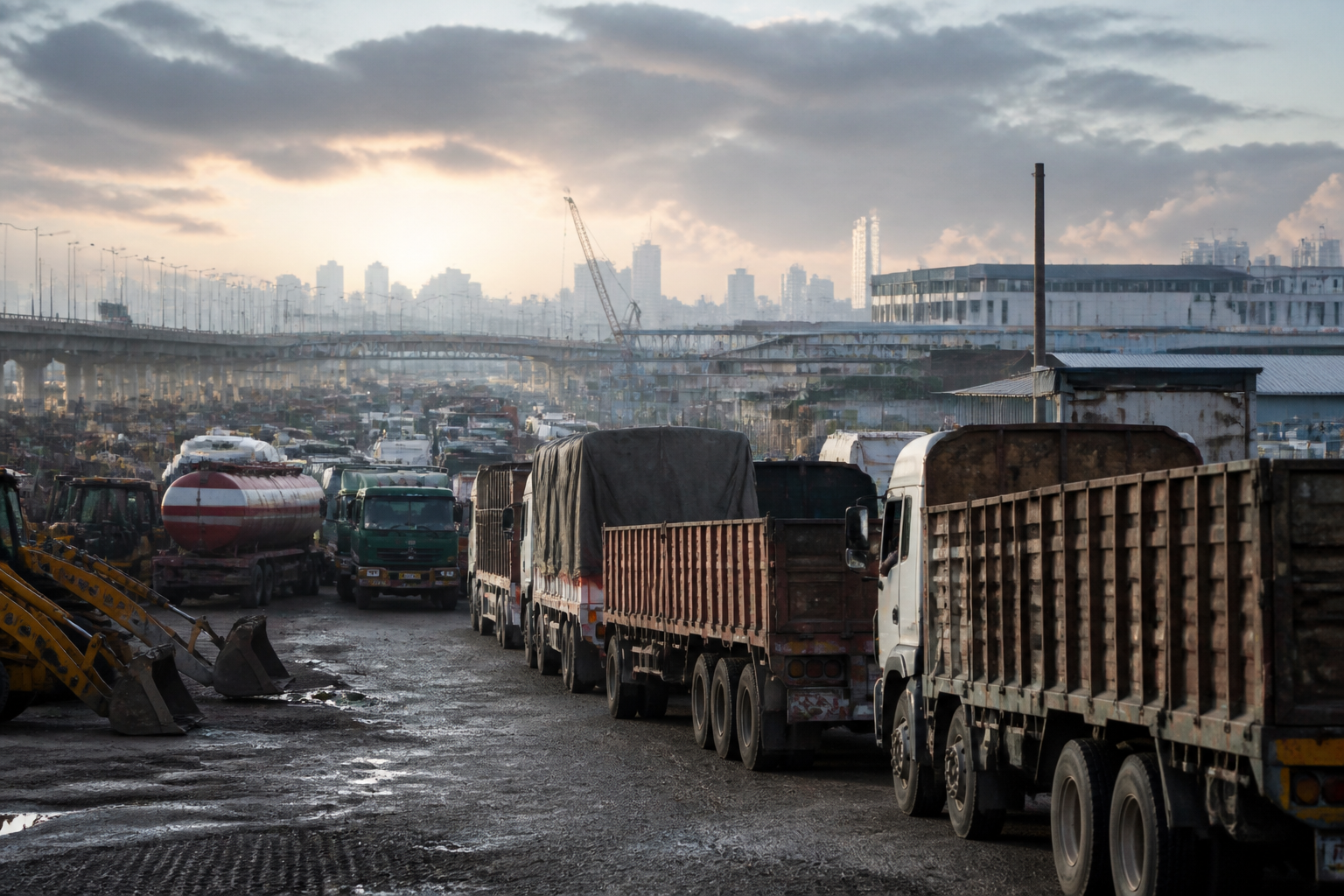
Diesel prices have reached record or near-record levels across major markets as wars, refinery damage, export restrictions and depleted inventories combine to tighten supplies. For cities, the issue is not limited to what motorists pay at fuel stations: diesel is embedded in the movement of food, construction materials, industrial goods and waste, making the current squeeze a test of how resilient urban supply chains really are.
European diesel futures more than doubled from the beginning of 2026 before closing at an all-time high last week, according to the report. Average retail diesel prices in the United States crossed $6 a gallon for the first time on record this month, reaching $6.52 a gallon on Monday, according to the Automobile Association of America. France recorded an average diesel price of €2.41 per litre on Sunday, while Asian benchmark prices remained close to record levels.
The immediate cause is a combination of supply disruptions rather than a single failure. Refineries in the Middle East and Ukraine have been damaged during the wars, while attacks on Russian energy infrastructure have reduced production. Disruptions have also affected the Red Sea, where Saudi Arabia loads much of its diesel. At the same time, refineries elsewhere are operating at high rates to compensate for lost supply, leaving little spare capacity.
The International Energy Agency said US refineries were operating at their highest level in eight years in late August. But the agency also warned that many refineries globally were already stretched to capacity, leaving few available options to prevent further tightening and higher prices in the coming months. That distinction is important for cities: the problem is not simply whether refineries can produce more fuel, but whether additional crude, processing capacity and transport routes can be mobilised quickly enough.
The diesel supply chain is particularly exposed because demand is concentrated in activities that cannot be easily paused or switched to another fuel. Trucking fleets, construction equipment, agricultural machinery and industrial operations all depend heavily on diesel. A rise in the fuel price therefore travels through the urban economy even when households do not own diesel vehicles. It can appear in the cost of moving vegetables to wholesale markets, transporting cement and steel, excavating for infrastructure or collecting and transferring waste.
That transmission is likely to be uneven. Large logistics operators may be able to renegotiate contracts, consolidate trips or use fuel surcharges. Smaller transport operators have fewer options and may absorb higher costs temporarily, reduce journeys or pass the increase directly to customers. The supplied report does not establish how much of the international increase has reached Indian retail prices or freight contracts, but the structure of the diesel economy means that transport-intensive urban services remain exposed to global disruption.
The evidence points to a supply system with very little slack. Middle Eastern diesel exports fell by half between March and August compared with the previous year, averaging 800,000 barrels per day, according to shipping data from Kpler. The region supplied nearly 41% of Europe’s diesel imports in 2025. Any further disruption to Red Sea flows would therefore affect not only local availability but also the redistribution of cargoes between regions.
Russia has added another constraint. The country, described in the report as the world’s second-largest diesel exporter after the United States, banned diesel exports in July after Ukrainian drone attacks reduced refinery production. Russia had supplied significant volumes to markets including Turkey and Brazil before the ban, forcing importers to seek alternative supplies. In Europe, diesel stocks at the Amsterdam-Rotterdam-Antwerp refining and storage hub were at their lowest level for that period of the year on September 10, according to Insights Global.
The US market illustrates why high refinery utilisation does not automatically resolve a shortage. US diesel inventories increased by about 600,000 barrels in the latest week cited, but stood at 96.97 million barrels, nearly 15% below the five-year average for the second week of September. Refineries can be running hard while available stocks remain below normal if demand is strong and replenishment is constrained.
Asia faces a related problem. Diesel prices rose sharply as Middle Eastern and Russian supplies were disrupted. The benchmark diesel swaps price had eased from a March record above $200 a barrel but remained around $180 a barrel on September 18. That was still about twice its pre-war level. China’s diesel exports fell 26% year-on-year in April-June after the government limited refined-product exports, tightening international supplies. Exports later recovered to about 320,000 barrels per day in August, their highest level in nearly two and a half years, even as domestic stocks declined.
These figures reveal a market being stabilised partly through extraordinary effort rather than through comfortable capacity. Refineries are operating at high levels, inventories are being drawn down or remain below seasonal norms, and exporters are adjusting policy in response to domestic requirements. Such a system can continue functioning, but it has less protection against another disruption.
For cities, the institutional question is who absorbs the risk when fuel markets tighten. National governments and energy agencies influence strategic stocks, export controls and diplomatic arrangements. Refiners determine production and distribution. Port authorities and shipping companies affect the movement of cargoes. Municipal governments, however, are responsible for many services that rely on diesel indirectly, including waste transport, road works, water and sewerage maintenance, emergency fleets and public works contracting.
Urban agencies usually procure these services through contracts rather than operating every vehicle themselves. That can make the fuel shock less visible in municipal accounts at first. A contractor may initially carry the additional cost, but longer disruptions can lead to requests for contract revisions, service adjustments or higher bids in future tenders. The supplied material does not provide evidence of such changes, but it identifies construction, trucking and industry as sectors with few immediate alternatives, which includes many city-building activities.
The pressure also reaches infrastructure delivery. Construction projects use diesel for earthmoving equipment, generators, concrete logistics and the movement of materials between plants, storage yards and sites. Fuel is only one component of project cost, but it is a recurring operating input. When supply is uncertain, the challenge is not limited to the price of a litre; contractors must also manage availability, delivery schedules and the risk of disruption to equipment-intensive work.
The report identifies a limited set of short-term responses. Rystad Energy vice-president Janiv Shah said some unused refining capacity existed on paper, but little could be activated quickly and supplied with the appropriate crude. He said a resumption of oil shipments through the Strait of Hormuz would probably be the fastest way to ease prices because it would allow Asian refineries to receive supplies. The IEA’s oil industry and markets division head, Toril Bosoni, warned that if Gulf supplies remained constrained and commercial inventories continued to fall rapidly, higher prices and further reductions in demand might be needed to close the supply-demand gap.
That assessment underlines the weakness of demand-side adjustment in urban systems. Diesel consumption can fall when prices rise, but the report notes that the short-term effect is limited because trucking, agriculture, construction and industry have few immediate alternatives. A city cannot quickly replace every diesel truck, excavator, generator or service vehicle. Electrification may change the energy mix over time, but it does not provide an instant response to a refinery outage or a blocked shipping route.
The larger urban lesson is that fuel resilience is also infrastructure resilience. Roads, ports, warehouses, construction sites and municipal services may be physically intact while becoming more expensive or less reliable because the energy needed to operate them is constrained elsewhere. The current squeeze exposes how closely city functioning depends on international refining networks, maritime corridors and national export decisions.
What the evidence confirms is a global diesel market operating with narrow margins for error. Prices are at records or near records, inventories are below normal in important markets, refinery utilisation is high and multiple supply routes are under pressure. What remains uncertain from the supplied report is the duration of the disruption and the extent to which higher international prices will be transmitted to specific cities and sectors. The key developments to monitor are the reopening of disrupted shipping routes, the restoration of refinery output, changes in export restrictions and the pace at which commercial inventories recover.
