


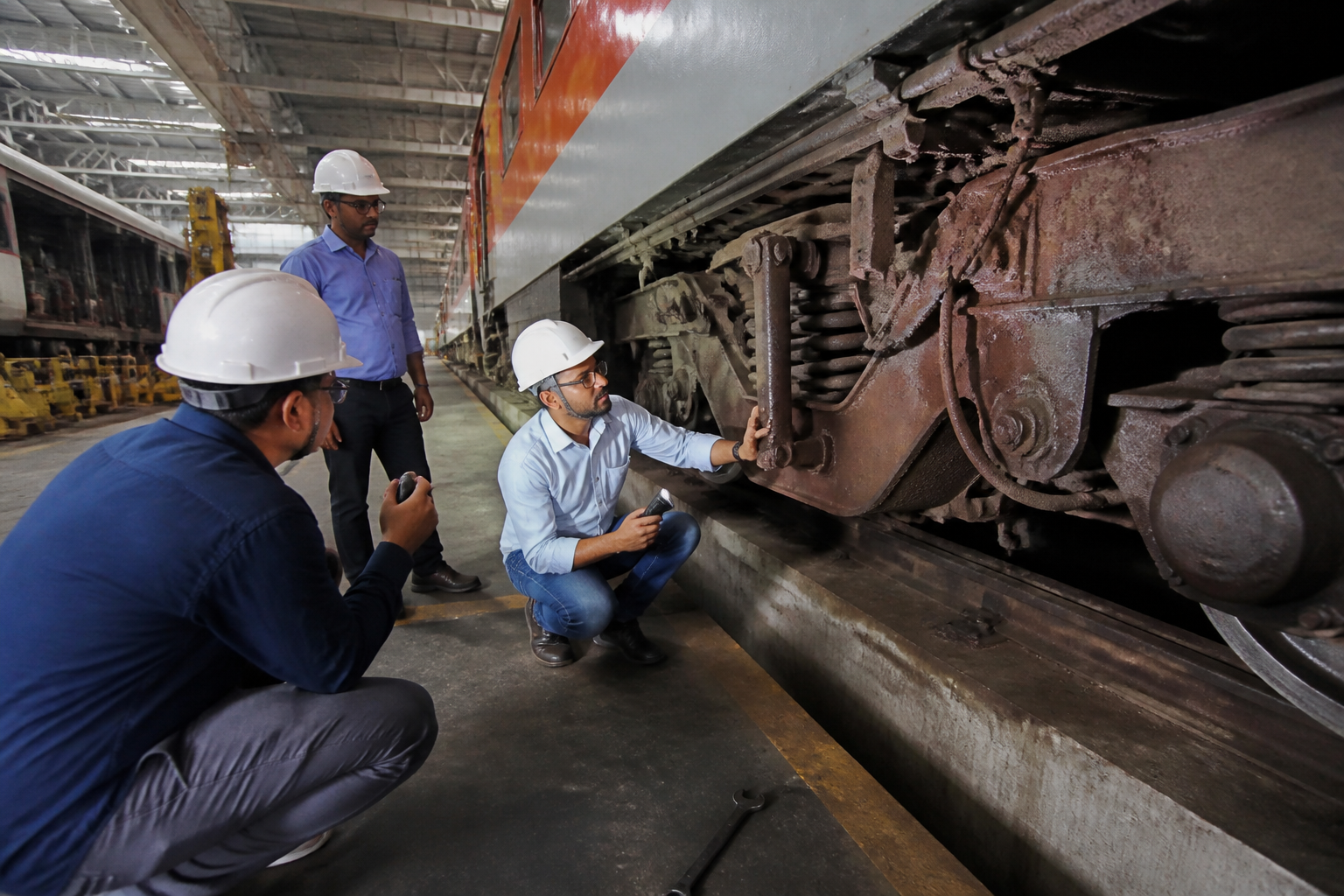
Indian Railways has ordered special safety checks across all zones after senior railway engineers raised concerns about heavy corrosion in the bogies of Linke Hofmann Busch (LHB) passenger coaches, identifying toilet leaks, cleaning practices and saline coastal air as contributing factors.
The concern was discussed at a recent conference of principal chief mechanical engineers, according to minutes prepared by the Railway Board and reported by PTI. The minutes described heavy corrosion in LHB bogies as a cause for worry and asked the three railway coach manufacturing units—Integral Coach Factory (ICF) in Chennai, Rail Coach Factory (RCF) in Kapurthala and Modern Coach Factory (MCF) in Rae Bareli—to examine the problem and identify suitable solutions.
The Railway Board has directed all railway zones to inspect critical safety areas and focus on components and sub-assemblies identified in a detailed assessment prepared by Eastern Railway in March. The report examined corrosion in air-conditioned and non-air-conditioned LHB coaches according to their age and the components affected.
LHB coaches were introduced in Indian Railways after the country began moving away from the older ICF design in 2003. The German-designed coaches were intended to improve speed, safety and service life, and India has since increasingly indigenised their manufacture. Indian Railways now manufactures LHB passenger coaches, apart from train sets, at its own production units.
The corrosion issue is concentrated in areas where structural components are located close to lavatories. According to the Eastern Railway report, water can seep through toilet flooring or escape from faulty pipe fittings before reaching the underframe. Leakage or overflow of effluent can expose the trough floor, sole bars and headstock to acidic, chloride-rich material, accelerating corrosion.
Officials and experts cited in the report also identified aggressive cleaning chemicals, untreated or high-salinity water, dents or damage to steel surfaces and poorly fitted vinyl advertising wrappers as possible contributors. Water can enter through tears, joints or unsealed edges in such wrappers and remain against the coach body.
Coaches operating in coastal regions face an additional risk from saline air. The experts said the high salt content acts as an electrolyte and speeds up the electrochemical process that causes corrosion. The issue therefore links coach design and construction with routine washing, drainage, route conditions and scheduled maintenance.
The recommended precautions include avoiding aggressive chemicals, thoroughly rinsing and drying coaches after washing, and keeping drain holes, slots and passages in underframe and bogie areas clear. These measures are intended to prevent water from collecting in stagnant pockets. Improvements to existing corrosion-protection systems have also been suggested.
The Railway Board’s direction places responsibility on railway zones and coach manufacturing units to inspect affected areas, identify the causes in individual coaches and implement the recommended precautions. The ordered checks will determine the extent of corrosion and the corrective measures required during scheduled maintenance.
