


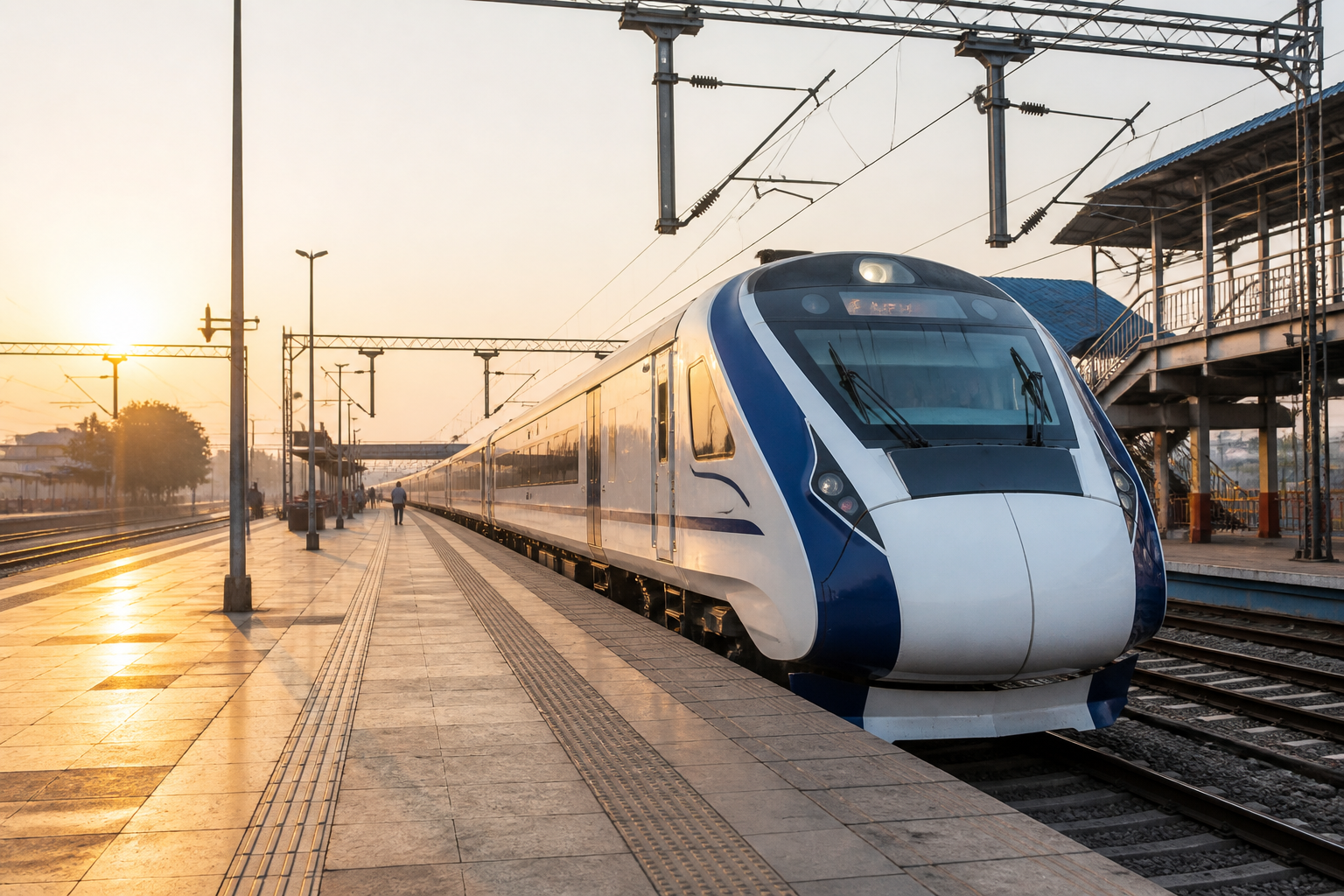
Vande Bharat Express is not merely a faster train. Its arrival marked a change in how Indian Railways designs, powers and experiences premium passenger services, moving the network from conventional locomotive-hauled coaches towards self-propelled train sets. The next step — an indigenous bullet train for the Mumbai-Ahmedabad high-speed rail corridor — will test whether that technological progression can extend from semi-high-speed operations to a genuinely new railway system.
The transformation is best understood through three generations of premium trains. Rajdhani Express, introduced in 1969, established faster long-distance inter-city travel between New Delhi and major cities. Shatabdi Express, launched in 1988, made daytime travel on shorter and medium-distance routes faster and more comfortable. Vande Bharat, introduced in 2019, added distributed propulsion, faster acceleration and braking, modern passenger systems and a train-set design to the equation.
Jagannarayan Padmanabhan, Senior Director and Global Head-Consulting at Crisil Intelligence, describes this progression as a movement from faster connectivity to a more integrated travel experience. Rajdhani represented a shift towards faster overnight travel, while Shatabdi focused on convenient daytime journeys. Vande Bharat, he said, represents a further evolution because it combines speed, acceleration, comfort, modern interiors, onboard services and a contemporary passenger experience.
That progression also reflects the changing engineering base of Indian Railways. The system moved from ICF-design coaches to Linke-Hofmann-Busch, or LHB, coaches and then to distributed-power train sets. Each transition addressed a different constraint: speed, safety, ride quality, operational efficiency and the ability to reduce journey times without relying only on higher maximum speeds.
Rajdhani broke the first speed ceiling
When the first Rajdhani ran between New Delhi and Howrah in 1969, it covered 1,445 kilometres in about 17 hours and 20 minutes, with three stoppages, at a speed of 120 kmph. Its introduction followed a series of technical studies by the Research Designs and Standards Organisation, or RDSO, which began examining ways to increase speeds in 1960.
At the time, the maximum operating speed on broad-gauge routes had been limited to 96 kmph for about a century. RDSO concluded that speeds on the Delhi-Howrah route could be increased without large-scale capital investment in tracks, bridges or signalling. Test and prototype rakes were run over the full route once a month for eight months, with trials reaching 136 kmph. The Railway Board accepted the recommendations in June 1968, paving the way for the first Rajdhani service.
Sudhanshu Mani, the retired general manager of the Integral Coach Factory and architect of the Vande Bharat trains, describes Rajdhani as a watershed moment. Track technology was improved to allow trains to run at 130 kmph, he said, and the routes on which they operated began to be known as Rajdhani-standard tracks.
The train also introduced a distinct service model. Rajdhani was designed as an overnight service in which passenger needs, including meals and linen, were addressed within the journey. Its importance was therefore not only its speed. It established a premium, branded approach to inter-city rail travel at a time when relatively few Asian countries, apart from Japan, had trains capable of similar speeds.
Shatabdi built on that model but changed the travel pattern. The first service, introduced in 1988, was fully air-conditioned and fully reserved, with speeds reaching 140 kmph. Its chair-car configuration and daytime schedule created a different proposition for travellers who needed faster medium-distance connections without spending a night on the train.
### The railway coach became part of the technology story
The history of premium trains is also a history of coach design. Indian Railways introduced LHB coaches using German technology in 2003, with the first set used for the Delhi-Mumbai Rajdhani. The shift was significant because coach design affects what happens during a crash as well as how a train performs during normal operations.
G Raghuram, Advisor at The Infravision Foundation, notes that ICF coaches were an improvement over earlier designs because they were non-telescopic. In a collision, this reduced the risk of coaches squashing into one another. LHB coaches added anti-climbing features intended to prevent coaches from rising over each other during a crash.
The transition did not stop with Rajdhani and Shatabdi. Sampark Kranti, Duronto, Tejas and Humsafar introduced different combinations of fewer stops, inter-state connectivity, premium amenities and revised service models. But the underlying change was institutional as much as technological: Indian Railways continued to use branded trains to test new operating concepts and passenger expectations.
Indian Railways eventually stopped producing ICF-design coaches and moved towards LHB coaches and train sets. This created the foundation for Vande Bharat, which treated the train not as a locomotive pulling a sequence of independent coaches, but as an integrated vehicle with propulsion, braking, doors, passenger information and onboard systems working across the set.
Vande Bharat changed the operating logic
Vande Bharat marked the next major milestone in 2019. Originally called Train 18 because the prototype was manufactured in 2018, the 16-coach, fully air-conditioned train was designed and rolled out in a reported 18 months. It placed India in the semi-high-speed self-propelled train-set category.
The most important change was distributed power. Unlike a conventional locomotive-hauled train, Vande Bharat does not depend on a separate locomotive to pull the entire rake. Its systems allow it to accelerate and decelerate more quickly, improving average speeds and reducing journey times by up to 45% on several corridors, according to the supplied report.
The engineering changes extend beyond speed. Vande Bharat includes automatic doors, wider sealed gangways, GPS-based passenger information systems, onboard infotainment, European-style seats and regenerative braking. The latter allows energy generated during braking to be recovered, making energy efficiency part of the train’s operating design.
Its mechanical systems also target ride quality. Semi-permanent jerk-free couplers and improved suspension are intended to make movement between coaches smoother. Raghuram says that locomotive-hauled trains can experience a transmission lag because power comes from one end of the train, producing a jerkier ride. Distributed power reduces that lag and enables quicker acceleration and deceleration across the train set.
Safety is another part of the transition. Vande Bharat includes provision for KAVACH, India’s indigenously developed Automatic Train Protection system, which is certified to Safety Integrity Level-4. The trains have also been upgraded over time. The report says Vande Bharat 3.0 can accelerate from zero to 100 kmph in about 52 seconds, while offering lower noise and vibration levels.
The manufacturing story is significant as well. Train sets and their systems are reported to have around 90% localisation. That places Vande Bharat within a broader effort to develop domestic railway engineering capability rather than treating premium trains solely as imported technology or assembled products.
The sleeper train expands the proposition
Vande Bharat initially addressed daytime travel. In 2026, its sleeper variant was launched, with two prototype rakes running between Howrah and Guwahati while additional sets are being tested or manufactured. The sleeper version is intended to apply train-set technology to overnight travel, the market historically associated with Rajdhani.
The report says the sleeper trains offer passenger amenities and safety features superior to Rajdhani Express trains. Around 260 Vande Bharat trains are expected to be rolled out in the coming years across high-density railway networks. Their operating speeds are expected to exceed 130 kmph and could reach 160 kmph as the network is upgraded.
The manufacturing programme is distributed across several institutions. BEML, in collaboration with ICF, is making the first 10 train sets. A further 120 are to be made by Kinet, an Indo-Russian joint venture, and 80 by a BHEL-Titagarh Wagons consortium. ICF has also been tasked with producing 50 sleeper train sets with more coaches and a full pantry for longer-distance journeys.
These numbers indicate that Vande Bharat is no longer only a flagship prototype. It is becoming a manufacturing and procurement programme involving public-sector factories, private companies and joint ventures. That scale will determine whether the technology remains a premium niche or becomes a more consequential part of the national rail network.
The bullet-train test is different
The proposed next step is an indigenous high-speed train set capable of 280 kmph. BEML is manufacturing the train, which is expected to be rolled out for trials in early 2027. It is intended for the Mumbai-Ahmedabad high-speed rail corridor, India’s first, part of which is scheduled to open in August 2027.
The contract, valued at Rs 866.87 crore, covers two prototype bullet trains. Unlike Vande Bharat, whose value lies partly in improving travel on existing railway corridors, the bullet train depends on a dedicated high-speed infrastructure system. Its success will therefore depend not only on the train set but also on corridor construction, testing, signalling, station systems and operational integration.
That distinction matters. Rajdhani increased speeds through targeted improvements on an existing route. Shatabdi refined the premium daytime service. Vande Bharat integrated propulsion, braking, safety and passenger systems into a self-propelled train. High-speed rail requires the train and the corridor to be designed as one system, with the infrastructure capable of supporting substantially higher speeds.
The progression from Rajdhani to Vande Bharat demonstrates that railway modernisation is cumulative. Faster trains require track improvements, better coaches, more sophisticated braking and safety systems, and operational practices capable of using those technologies. The railway’s passenger experience changes only when those components advance together.
The available evidence confirms a clear shift in Indian Railways from faster locomotive-hauled services towards domestically manufactured, integrated train sets. It also shows that Vande Bharat has become a platform for expanding both daytime and overnight premium travel. What remains to be established is how the proposed indigenous bullet train will perform in trials and how its dedicated corridor will be brought into operation. Those milestones will determine whether India’s next railway leap remains a manufacturing achievement or becomes a new, functioning layer of inter-city mobility.

