


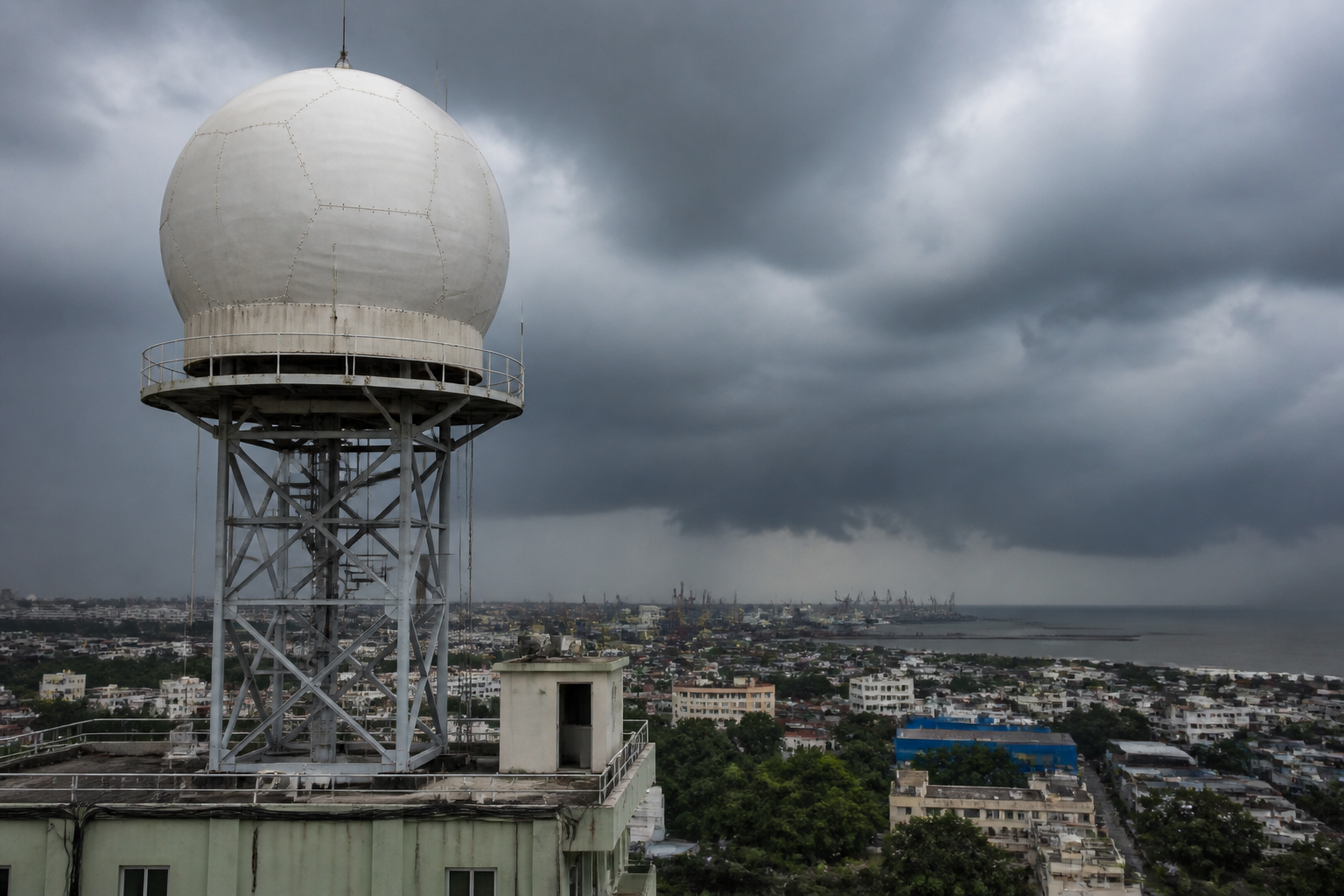
A reported technical problem at Chennai Port’s Doppler Weather Radar, combined with the pending installation of a new radar, has drawn attention to a critical but often invisible part of the city’s monsoon infrastructure. The issue comes as the northeast monsoon approaches and weather systems over the Bay of Bengal require continuous observation for short-term rainfall and cyclone monitoring.
According to a Thanthi TV report cited by DT Next, the Chennai Port radar is facing a technical issue. The report also said that work to install a new radar has not yet been completed. The supplied report does not establish the precise nature of the fault, how long the radar has been affected, or the expected completion date for the replacement installation. Those details matter because the usefulness of weather-monitoring infrastructure depends not only on whether equipment exists, but also on whether it is available, functioning and maintained when extreme weather develops.
Doppler weather radar occupies a specific place in the warning chain. It tracks rain-bearing systems, cyclonic formations and changes in rainfall intensity in near real time. Its most immediate operational value is nowcasting: providing short-term information about weather conditions over the next few hours. That is different from longer-range forecasting, which also draws on satellite observations and numerical weather models.
The distinction is important for a city such as Chennai, where rainfall intensity can vary sharply across locations and where urban impacts may develop faster than a general forecast can communicate. A district-wide warning may indicate that heavy rain is possible, but radar observations can help meteorologists follow the movement and strength of rain-bearing clouds as conditions evolve. In practical terms, that information supports the timing and refinement of warnings issued to residents and authorities.
The current concern therefore is not simply about one instrument at one site. It is about the resilience of an urban information system that combines radar, satellites, weather models and official communication. The India Meteorological Department continues to provide Chennai radar observations through its official platform, including rainfall intensity and other radar products, the report said. But the existence of alternative sources does not automatically make every part of the monitoring network interchangeable.
The report identifies other facilities that support weather analysis for Chennai, including the National Institute of Ocean Technology radar at Pallikaranai, as well as radars at Sriharikota and Karaikal. Satellite observations and weather models also contribute to the assessment, while the IMD’s Regional Meteorological Centre in Chennai issues district-wise warnings and nowcast information for Tamil Nadu and Puducherry.
This networked arrangement provides some redundancy. Chennai’s weather monitoring does not depend exclusively on the Chennai Port radar, and the presence of other radar facilities means that the reported fault does not amount to a complete loss of weather information. At the same time, redundancy has to be assessed by capability, coverage, data availability and operational coordination, not only by counting installations. The supplied material does not provide a technical comparison of the facilities or say whether the other radars can fully replicate the observations from Chennai Port.
That gap is central to understanding the city’s preparedness. A monitoring network can appear broad on paper while still having weak points if one facility covers a particularly important area, provides a specific type of observation or acts as a key source for rapid localised assessment. The report does not quantify the resulting change in coverage or warning capability, so the effect of the current glitch cannot be measured from the available information. What can be established is that the issue has emerged at a time when continuous monitoring is considered operationally important.
Chennai has encountered radar-related difficulties before. The Times of India reported in 2018 that the Doppler Weather Radar at the Chennai Port Trust building was not functioning at its optimal level and could measure only some parameters. The radar was later repaired and restored for round-the-clock operations in August 2022, according to an earlier DT Next report. The sequence points to a recurring maintenance challenge involving ageing or technically demanding weather infrastructure, although the supplied reports do not establish whether the current problem is connected to the earlier malfunction.
The history also shows why replacement and maintenance cannot be treated as separate questions. Restoring an ageing radar can return an important service, but it does not remove the need for a dependable long-term installation strategy. A replacement project that remains pending leaves the city reliant on existing assets for longer, while the operational consequences of a fault become more significant during periods of heightened rainfall activity.
The importance of uninterrupted radar operations was highlighted during the heavy rainfall episode of November 2021. The News Minute reported that the Chennai and Karaikal radars were under maintenance when the city subsequently recorded more than 20 centimetres of rain during an intense spell. The report also explained that Doppler radar is particularly useful for nowcasting, while satellites and numerical weather models support longer-range forecasting.
This earlier episode does not prove that radar maintenance caused any particular impact during the rainfall event. It does, however, demonstrate the practical problem created when maintenance overlaps with severe weather. The operational question is not merely whether a radar will eventually be repaired, but whether the monitoring system has enough planned resilience to remain useful when intense rainfall occurs during a period of reduced equipment availability.
For municipal agencies and residents, the distinction between forecasting and nowcasting has direct consequences. Forecasting can indicate the possibility of a weather system or rainfall event over a broader period. Nowcasting is more closely tied to immediate decisions, such as monitoring a rapidly intensifying rain band or communicating short-term conditions. The supplied material does not specify how warnings, drainage operations, traffic management or emergency response would be affected by the reported glitch. It does establish why the quality and continuity of radar observations matter to those wider urban functions.
Institutionally, the system involves more than the IMD alone. The IMD’s regional centre issues warnings and nowcasts, while radar facilities operated or associated with different institutions contribute observations. Chennai Port is the location of the affected radar, and NIOT operates the Pallikaranai facility identified in the report. The proposed new radar adds an implementation question: the city’s preparedness depends not only on technical design, but also on procurement, installation, commissioning, maintenance responsibility and coordination between agencies. The supplied report does not provide the project’s agency, budget, tender status or completion schedule, leaving those aspects unresolved.
The immediate policy signal is therefore straightforward but important. Weather-monitoring infrastructure must be treated as part of urban resilience, alongside drainage, flood-control assets, emergency communication and transport continuity. Its failure may not be as visible as a flooded road or a damaged bridge, but it can affect how quickly authorities understand changing conditions. Reliable observation is an enabling layer for decisions made across the city during heavy rain.
The pending replacement also raises the question of how cities plan for continuity while critical equipment is being repaired or replaced. Other radars, satellite data and models offer support, but the available evidence does not show whether a formal contingency arrangement is in place for Chennai or how responsibilities are divided during an outage. Without that information, the resilience of the system cannot be judged solely from the number of alternative data sources.
The evidence confirms three points. Chennai’s Port radar has been reported to face a technical issue; the proposed new radar installation remains pending; and the city continues to draw on other radars, satellites, models and IMD warnings. The evidence also records a history of earlier radar problems and a 2021 period when radar maintenance coincided with heavy rainfall. What remains unclear is the present fault’s technical severity, its effect on coverage, the replacement timeline and the specific continuity measures being used.
Those are the facts that deserve monitoring as the northeast monsoon advances. The next meaningful milestones would be confirmation of the radar’s operational status, clarification of the replacement project’s implementation schedule and information on how the wider monitoring network will support Chennai while the affected facility remains under repair or awaiting replacement.
