


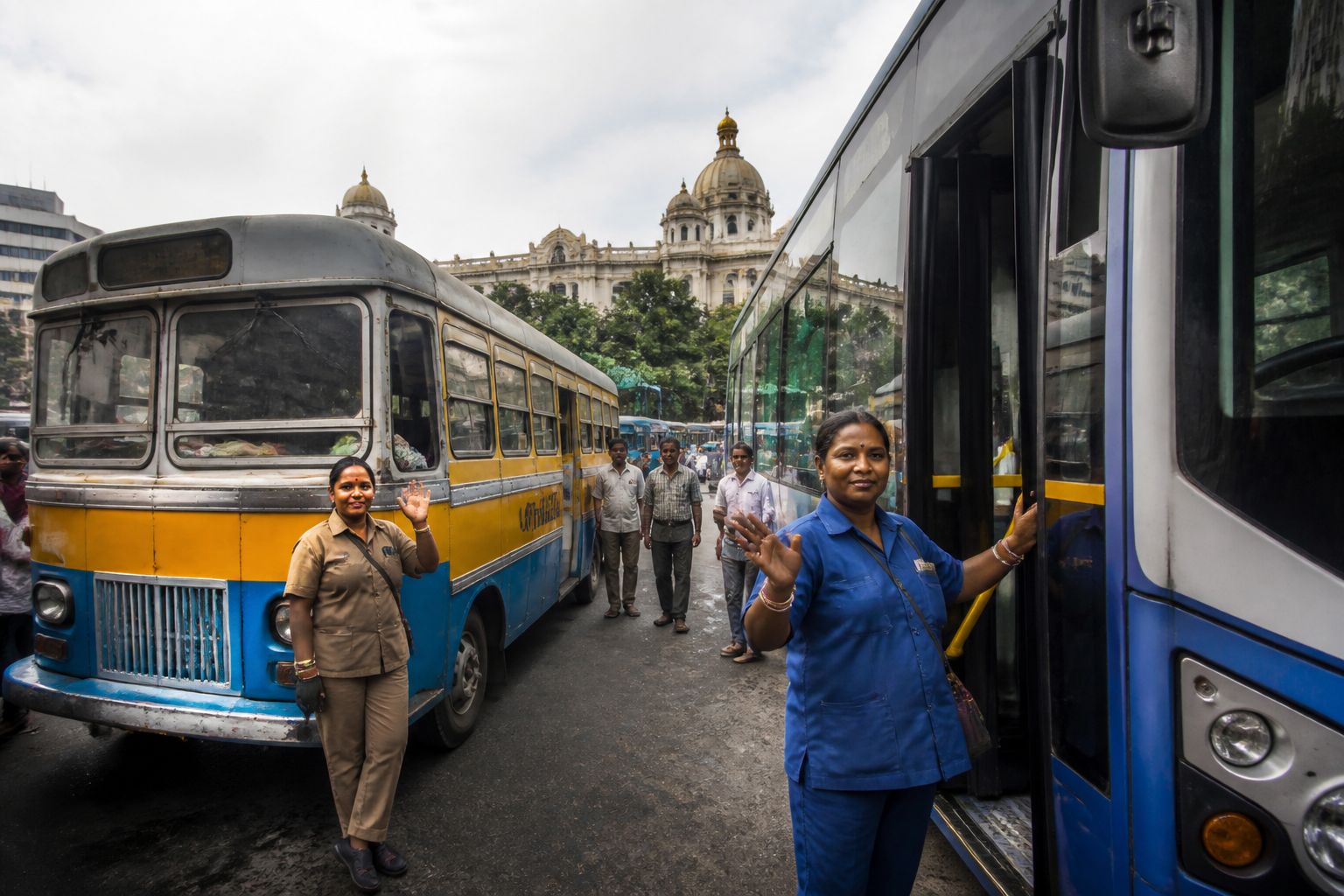
Kolkata Bus Jatra 4.0, scheduled for October 2, is being presented as a celebration of the city’s bus heritage. But the event also exposes a less commemorated part of public transport: the labour of women who operate, manage and sustain a system still widely associated with men.
Organised by the Kolkata Bus-o-Pedia Foundation, the fourth edition will feature at least five women bus conductors, alongside a selection of buses representing Bengal’s transport history and its gradual shift towards cleaner public mobility. The event will begin at 1.30pm from Howrah Maidan, with buses travelling to Rabindra Sadan and returning. The organisers have said that members of the public may board until the buses are full.
The event matters because buses remain more than heritage objects. They are working infrastructure, connecting residential areas, transport interchanges and employment centres through routes that often predate current discussions about integrated public transport. Bus Jatra’s focus on women behind the wheel and inside the vehicles places the workforce at the centre of that infrastructure story.
One of the participants, Dolly Rana, owns and works as the conductor on a bus operating on Route 57 between Kona and Esplanade. Rana told Telegraph India that she has owned the bus since 2017. After experiencing disputes with conductors she had employed, she decided during the 2020 lockdown to take on the conductor’s role herself, despite pressure to sell the vehicle. Her account provides a direct view of the financial and operational pressures involved in running a bus, particularly for an owner who must also manage fare collection and daily service.
Her experience also shows why representation in transport cannot be understood only through formal appointments. A woman may participate in the system as a conductor, driver, owner or operator, and each role carries different responsibilities. In Rana’s case, the decision to work on her own bus was linked to trust, revenue protection and the need to keep the vehicle running. The event gives visibility to that form of transport labour, which is usually experienced by passengers but rarely documented.
The organisers are also attempting to bring women bus drivers to the event. The source identifies women who have driven on routes including Diamond Harbour-Calcutta, the Nimta-Howrah minibus route and Route 34C between Noapara and Esplanade. Some of those drivers are no longer in service, while one driver working in Diamond Harbour had not confirmed her attendance when the report was published.
That detail points to an important distinction between visibility and continuity. A public event can recognise women who have entered transport work, but it cannot by itself establish whether their participation is becoming a durable feature of the sector. The information available for Bus Jatra 4.0 confirms the presence of women conductors and the organisers’ effort to include women drivers. It does not establish how many women are currently employed across Kolkata’s bus network, what proportion they represent, or whether their numbers are rising or falling.
Those gaps are significant because the city’s bus system includes different types of operators and routes. Bus Jatra will bring together a Route 57 bus, a Route 52 bus, a minibus operating on Route 29 between Tikiapara and Salt Lake, and the 103-year-old Ramrajatala-Esplanade route. A West Bengal Transport Corporation air-conditioned CNG bus will also join the rally. These vehicles represent different layers of the transport system rather than a single uniform fleet.
The participation of the Route 29 minibus for the first time is especially useful in understanding that diversity. Minibuses serve routes and passenger markets that may not resemble those of larger buses, while privately owned buses and state-supported services operate within different institutional arrangements. The source does not provide a comparative account of their finances, staffing or ridership, but the event’s vehicle mix makes clear that Kolkata’s bus culture has been built through multiple operating models.
The history behind the event is similarly layered. Bus-o-Pedia says the city’s transport history reaches back to a horse-drawn omnibus service introduced in 1830. The foundation began as a Facebook page in 2018 and is now registered as a trust. It has reported 4.92 lakh social media followers and a core group of around a dozen people with administrator rights. Since its first edition in 2023, Bus Jatra has attempted to connect historical memory with the continuing evolution of buses.
This is an unusual civic role for an enthusiast organisation. The foundation is not described as a transport authority, operator or labour organisation. Its influence comes from documenting and publicising buses, bringing together enthusiasts and creating a platform for people connected to the system. Its reported following suggests that bus heritage has an audience well beyond a small collector community. At the same time, the foundation’s own description of its structure shows that much of this work is being carried out by a small core group.
The arrangement raises a broader governance question: who records the history of everyday infrastructure? Official agencies may preserve details of routes, fleets and projects, while passengers remember reliability, conductors, drivers and the experience of travel. An enthusiast-led initiative can connect these dimensions, but it cannot replace systematic public records on the workforce, route performance or service conditions. Bus Jatra therefore functions both as a celebration and as an informal archive.
The event also carries a policy signal through the planned participation of a CNG bus from the West Bengal Transport Corporation. The organisers describe this as a way to highlight the state’s move towards cleaner fuels and greener public transport. The supplied material does not quantify the scale of the transition, compare emissions, or provide a timetable for fleet conversion. It does, however, show how environmental messaging is being incorporated into a public event otherwise centred on heritage.
That combination reflects the competing demands placed on city buses. They are expected to preserve continuity, provide affordable everyday mobility, support livelihoods and respond to environmental concerns. A heritage rally can make these different functions visible at the same time, but it does not resolve the operational questions behind them. The future of cleaner buses will depend on the wider transport system’s fleet decisions, financing and implementation, none of which are detailed in the source report.
For passengers, the significance of Bus Jatra lies in the way it changes the usual frame of public transport. Buses are commonly discussed through congestion, route changes, accidents, fares or fleet modernisation. Those concerns remain important, but the event shifts attention to the people who make service possible. A conductor’s work involves direct contact with passengers and fare collection; an owner-conductor such as Rana also carries responsibility for the viability of the vehicle. A driver manages the movement of the bus through crowded urban roads. These roles are part of the city’s mobility infrastructure even when they are absent from formal descriptions of networks and corridors.
The available evidence does not support a conclusion that Kolkata’s bus sector has achieved gender inclusion. It supports a narrower and more useful conclusion: women are participating in roles that have historically been male-dominated, and an annual public event is deliberately bringing their work into view. The fact that organisers are still trying to locate women drivers, including former drivers and one current driver whose attendance remained unconfirmed, also suggests that visibility is limited and participation may not be evenly distributed across routes or operating models.
Kolkata Bus Jatra 4.0 will therefore be worth watching not only for the buses that assemble at Howrah Maidan, but for the questions it leaves open. How many women currently work as drivers, conductors and owners? What enables them to remain in the sector? How do public agencies and private operators record their employment? And can the transition to cleaner buses preserve the livelihoods and route knowledge embedded in the existing system?
The confirmed event offers no answers to all of these questions. It does provide a public setting in which they can be asked. On October 2, the rally will bring together heritage vehicles, contemporary public transport and women whose work keeps buses operational. Its lasting value will depend on whether that recognition remains an annual tribute or becomes part of a more systematic understanding of the people and institutions behind Kolkata’s bus network.
