


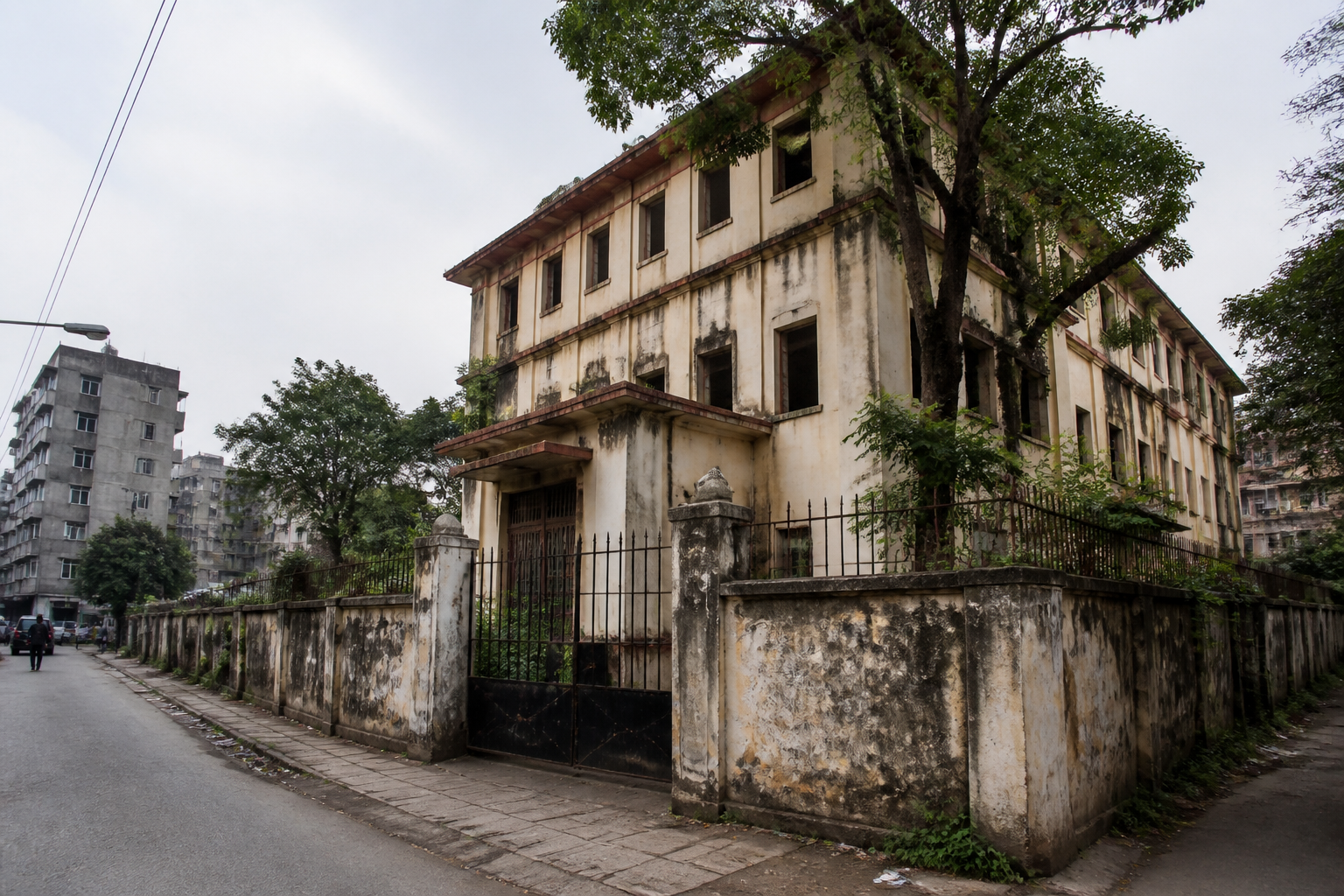
West Bengal’s decision to assess the future of 933 government-aided schools with no students is not only an education department exercise. It is also a test of how the state manages public land and buildings after the institutions created to serve communities stop attracting users.
School education minister Dipak Barman has said the assets of these schools will be handed over to the state government, which will decide how they can be used. The properties include buildings, land and other physical infrastructure that, according to the minister, has been lying unused for years. A committee has been formed to assess the condition and suitability of the assets.
The schools span the primary, upper-primary, secondary and higher-secondary levels. Barman said they had not attracted a single student for 20 years and had consequently been closed. The scale and duration of the vacancy distinguish this from a temporary fall in enrolment. These are institutions that have effectively lost their operating function, while their physical assets remain under public ownership.
That creates two separate administrative questions. The first is whether any of the schools can be revived. The second is what should happen when revival is no longer realistic. An order issued by school education secretary Binod Kumar directs each district to form a committee headed by the district magistrate to physically verify the schools, record the available infrastructure, assess the condition of land and buildings, and examine the availability of basic amenities.
The committees have also been asked to assess whether the premises are suitable for alternative public purposes, taking local requirements into account. Possible uses listed in the order include training centres, health centres, animal-resource development facilities such as veterinary units or livestock shelters, and community or other public-service facilities. For every school, the committees must state whether the institution can be revived or should be converted into an alternative facility.
This framework is significant because it places physical verification before reuse. A school listed on paper as an unused asset may have a functioning building, a deteriorated structure, valuable land, inadequate water or sanitation facilities, or access constraints that make a new use impractical. The district-level process is therefore expected to establish what exists, what condition it is in and what local purpose it could serve.
Barman has described the proposed handover as part of a possible inter-departmental exchange. He has also rejected speculation that the move is intended to transfer the properties to private businesses through the public-private partnership model. He said no school had joined the PPP model and that the government had not considered introducing it for these 933 properties.
That clarification matters because the reuse of publicly funded school land can quickly become a question of ownership, access and accountability. The minister’s statement establishes that the stated direction at present is government-led assessment and public or inter-departmental use, rather than a confirmed private transfer. The available information does not establish what final use will be selected for any individual school.
The urban dimension is especially visible in Kolkata and other urban areas. Sources in the education department told The Telegraph that many of the schools are in cities where parents prefer English-medium schools over Bengali-medium institutions. This points to a mismatch between the location and design of existing public education infrastructure and the choices being made by families. However, the material supplied does not provide a school-by-school breakdown, enrolment history, land area or building condition, so the extent of the urban concentration cannot yet be quantified.
The question is not simply whether a school has students today. A decision to close or repurpose a school changes the local geography of public services. It can affect how far children must travel, whether a neighbourhood retains a publicly accessible institution and whether an existing building can support another service without major expenditure. The district committees’ mandate to examine local requirements is therefore central to the process.
The government’s position also reflects a wider problem in publicly funded school administration: infrastructure and staffing can remain tied to institutions whose user base has declined or disappeared. In January 2025, former education minister Bratya Basu said several government and aided schools did not have enough students and that the government planned to merge some of them based on a pupil-teacher ratio study. That announcement triggered protests, with the Trinamool Congress government accused of weakening the public-funded school system.
The current exercise appears to move the issue from broad discussion of mergers to a more specific asset-level review. It covers schools that, according to Barman, have had no students for two decades. It also asks officials to distinguish between institutions that might be revived and those better suited for another public purpose. That distinction could prevent every low-enrolment school from being treated as an identical case, although the supplied information does not reveal the criteria that will determine revival potential.
The administrative structure is clear in outline. The school education department will transfer the assets to the state government; district magistrate-led committees will inspect and document them; and the committees will propose possible uses. The state will then decide how the properties are used. What remains unresolved is the next layer of governance: which department will control an asset after transfer, who will finance repairs or conversion, how local communities will be consulted, and how future use will be monitored.
Those questions are particularly important for buildings that have been unused for years. A vacant public property is not automatically a ready-made health centre, training facility or community space. Structural repairs, accessibility improvements, utilities, safety compliance and operating budgets may be required before a building can serve a new purpose. The committee order, as described in the supplied report, focuses on verification, condition assessment and suitability, but does not set out the funding model for conversion.
The available numbers show the scale of the immediate administrative task: 933 schools across four levels of schooling, with some reportedly located in urban areas and all described as having zero enrolment over the past 20 years. The report does not provide the total land area, the number of buildings in usable condition, the number located in Kolkata, or the cost of maintaining or repurposing them. Without those figures, the financial value of the asset pool and the potential savings or expenditure cannot be established.
The state is also dealing with a separate deadline concerning recruitment of teachers at the secondary and higher-secondary levels in government-aided schools. Barman said the government hoped to complete the recruitment by May next year, in keeping with a deadline set by the Supreme Court. The report links that process to a dispute over the proposed recasting of a merit panel based on 7 per cent OBC reservation for 66 classes, replacing an earlier decision to implement 17 per cent reservation for 140 classes. This recruitment issue is distinct from the zero-enrolment asset review, but both illustrate the administrative complexity surrounding government-aided schools.
For cities, the central issue is whether public infrastructure can be adapted without losing public accountability. If a school cannot be revived, an alternative public use could preserve community access to a centrally located building and reduce the need to create entirely new facilities. But that outcome depends on transparent inventories, defensible decisions and clear responsibility after the education department’s role ends.
The next stage will be the physical verification by district committees. Their findings should establish which of the 933 schools remain viable as educational institutions, which can support alternative public services, and what condition their land, buildings and basic amenities are in. Until those assessments and the state’s subsequent decisions are made, the future of the properties remains open.
